Red Lorry, Yellow Lorry
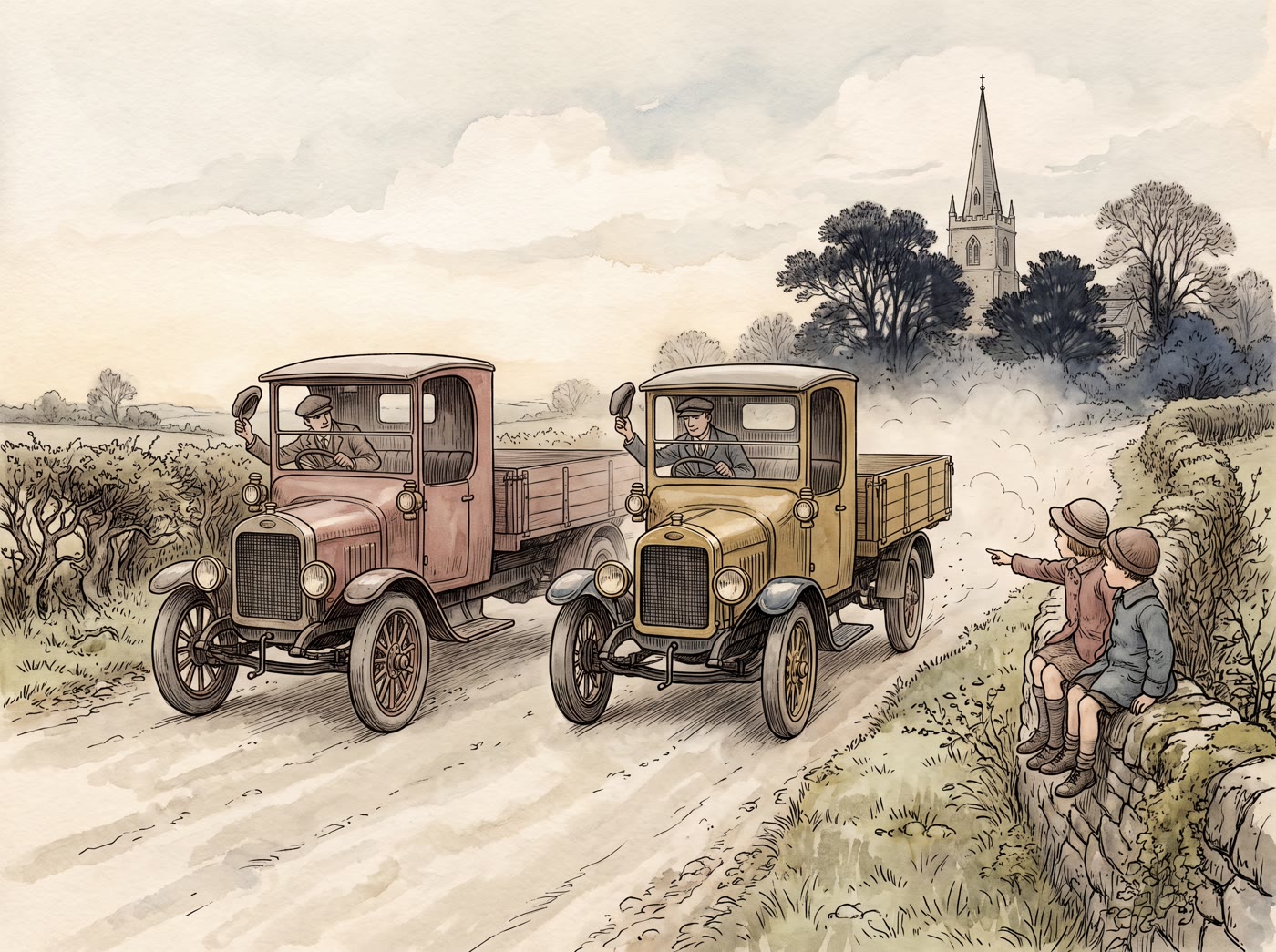
Red lorry, yellow lorry,
Red lorry, yellow lorry,
Red lorry, yellow lorry,
Red lorry…
This tongue twister is meant to be repeated at speed — as many times as you can manage before it collapses.
Where the rhyme comes from
Unlike Peter Piper, which can be traced to a dated book, Red Lorry, Yellow Lorry has no known author and no agreed first printing. It belongs squarely to the oral tradition: a playground and elocution phrase passed from mouth to mouth, which is exactly why it is so hard to pin down. Any date you see confidently attached to it should be treated with caution.
What we can date is the word at its heart. Lorry is the British term for a large goods vehicle — what American English calls a truck — and the Oxford English Dictionary records it from 1838, when it meant a long, low, flat wagon without sides, used on early railways and hauled by horses. Its own origin is uncertain; the leading suggestion is the old dialect verb lurry, “to pull or drag along”, which is supported by the fact that the earliest printings sometimes spell it lurry. Only in the early twentieth century, as motor vehicles arrived, did a lorry become the engined goods carrier we picture now.
That gives us a rough earliest window rather than a birthday: the twister cannot be older than the word, and the pairing of two coloured motor lorries suggests it settled into its familiar form some time in the twentieth century, once such vehicles were an ordinary roadside sight. It is frequently said to have been a standard warm-up for actors, elocution teachers and BBC announcers, and it certainly is used that way today — but that account circulates as received wisdom rather than documented history, so treat it as tradition rather than fact.
What does it mean?
Refreshingly little. There is no story, no hidden victim of the plague, no deposed monarch — just two lorries of different colours. Where Humpty Dumpty and its cousins attract elaborate historical theories, this one has escaped them, largely because there is nothing in it to hang a legend on. It is a pure articulation drill, and its meaning is its difficulty.
Why it is so hard. This is the genuinely interesting part, and here there is evidence. The phrase forces rapid alternation between two liquid consonants, /l/ and /r/, which are made in almost the same place in the mouth and differ mainly in what the tongue tip does — touching the ridge behind the teeth for l, curling back and away for r. Worse, both sounds appear inside the single word lorry, so the switch has to happen mid-word, twice per repetition. At speed the brain starts sending the plan for one sound while the tongue is still executing the other, and the result is the familiar mush of “yellow lolly” and “red rorry”.
A note for different accents. It is often claimed that the twister is harder for non-rhotic British speakers, whose r sits closer to l, than for American speakers with a more retroflex r. It is a plausible idea and a popular one, but it is offered as a theory rather than a settled finding. What is not in doubt is that speakers of languages which do not distinguish l and r find it formidable, which is why it turns up so often in English pronunciation classes.
Sharing it with children
Start slowly — absurdly slowly. Say red lorry, let the child echo it, then yellow lorry, then join the two. Only once the pair is clean should anyone try for pace. Children who race from the start simply learn to say it wrongly quickly.
Isolate the two sounds first. Have them hold llll with the tongue pressed firmly behind the top teeth, then rrrr with the tongue pulled back and touching nothing. Feeling the difference between the two positions is most of the battle. A useful drill is “lorry, yellow, lorry, yellow” said at a walking pace before attempting the full phrase.
Then make it a game. Count how many clean repetitions you manage before the first tangle — three is a respectable score, and five is genuinely good. Bring out a stopwatch and try to beat yesterday, remembering that three tidy runs beat one lucky sprint. Take turns around the table, each person adding one more repetition than the last. Whisper it, then boom it. Try it while marching, or while passing a toy lorry from hand to hand. Best of all, keep two toy lorries — one red, one yellow — and hold up whichever colour you want said next, in a random order. That is far harder than it sounds, and the wrong-colour mistakes are the funniest part. The tangles are the point, so laugh at every one.
Extra verses to sing
These verses aren’t traditional — they’re ours. Add them once the first one is easy.
Red lorry, yellow lorry,
Blue lorry, brown lorry,
Red lorry, yellow lorry,
Round the roundabout.
Yellow lorry, red lorry,
Lorry load of yellow rollers,
Yellow lorry, red lorry,
Really rarely early.