Oranges and Lemons
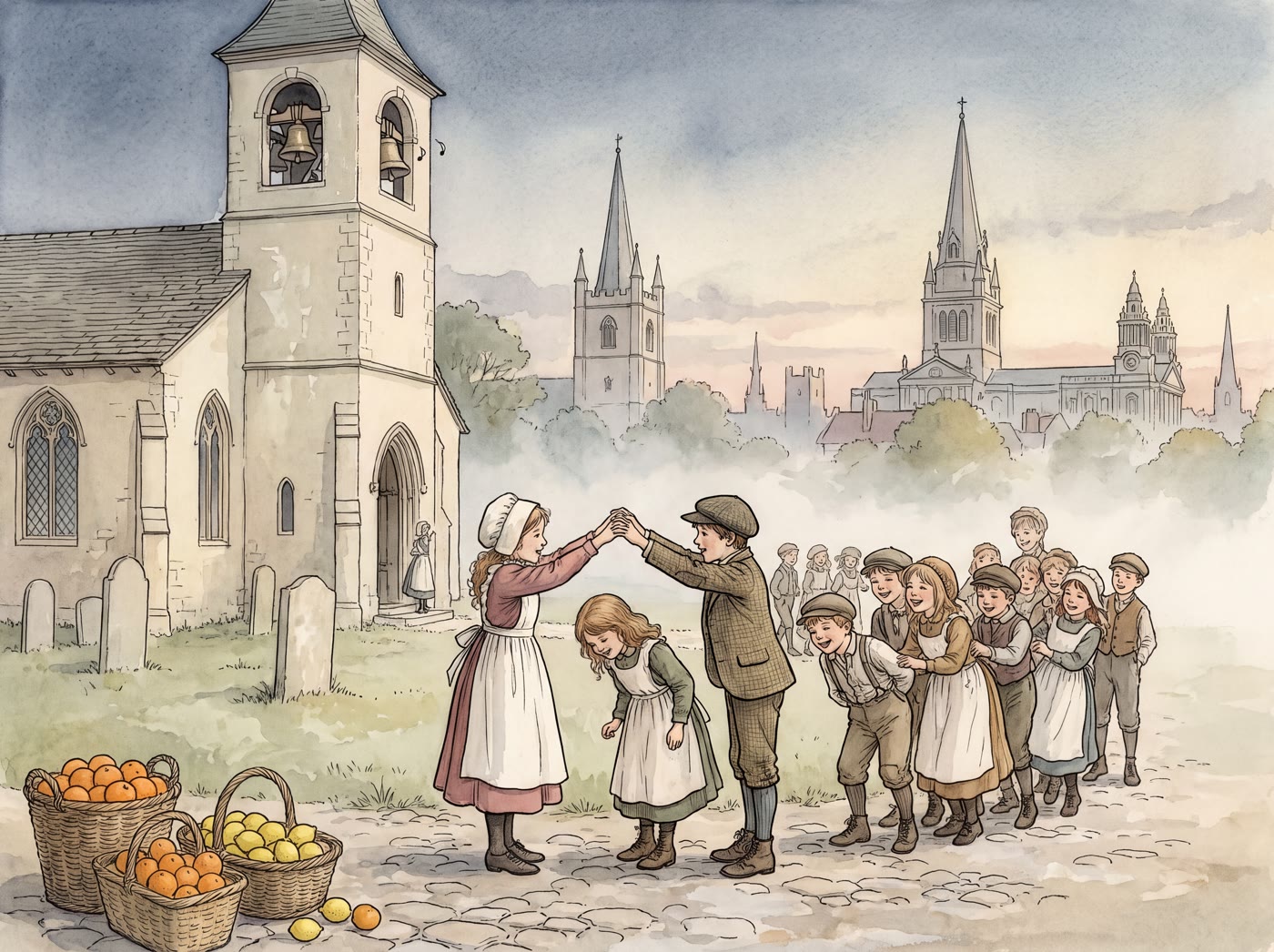
Oranges and lemons,
Say the bells of St. Clement’s.
You owe me five farthings,
Say the bells of St. Martin’s.
When will you pay me?
Say the bells at Old Bailey.
When I grow rich,
Say the bells at Shoreditch.
When will that be?
Say the bells of Stepney.
I do not know,
Says the great bell at Bow.
Here comes a candle to light you to bed,
And here comes a chopper to chop off your head!
Chip chop chip chop the last man is dead.
Where the rhyme comes from
The earliest printing is in Tommy Thumb’s Pretty Song Book, published in London in 1744 — the oldest surviving anthology of English nursery rhymes. It opens “Two Sticks and Apple, / Ring ye Bells at Whitechapple”, the oranges and lemons turn up midway rather than at the start, and it ends quietly: “When will that be, / Ring ye Bells at Stepney, / When I am Old, / Ring ye Bells at Pauls.” No candle, no chopper. The rhyme is number 13190 in the Roud Folk Song Index.
The grim ending arrives a century later. The candle-and-chopper lines were first collected by James Orchard Halliwell in the 1840s, and they belong to the singing game rather than to the eighteenth-century verse. Older than either is a country-dance tune called “Oranges and Lemons” in John Playford’s The Dancing Master, printed in 1665 — but it comes with dance directions and no words at all. Steve Roud notes that the earliest words come nearly a century later, and scholars do not treat the connection as established. A shared title is not a shared ancestry.
Which St Clement’s is meant has never been settled. St Clement Danes and St Clement Eastcheap both have a claim, and both stood near the wharves where ships landed citrus fruit. St Clement Danes has made the rhyme its own regardless: around 1919–1920 its vicar, the Reverend William Pennington-Bickford, had the restored bells set to ring out the tune and began an annual children’s service at which oranges and lemons were given out. The bells still play it four times a day.
The rhyme has a place in adult literature, too: George Orwell made remembering its words a recurring thread in Nineteen Eighty-Four (1949).
What does it mean?
Much is made of the rhyme’s “dark meaning”. The honest answer is that the dark part is the newest part.
The bells themselves. The secure meaning is the plain one. Each church “speaks” a phrase that rhymes with its name — Clement’s and lemons, Martin’s and farthings, Bailey and pay me — and together the phrases make a small comedy about a debt nobody can settle. It is a game about real London bells, and that is all the early texts support.
A condemned man’s last morning. A widely repeated story reads the churches as the bells heard on the way to execution, with the candle and chopper as the prisoner’s last night and his end. It is folklore rather than fact: the only violent lines are the nineteenth-century addition, absent from the 1744 text.
Henry VIII’s wives. Another theory hears the chopper as the axe that fell on Tudor queens. Same problem: no evidence in the early texts, and no chopper until the 1840s. A third, darker reading involving child sacrifice has even less behind it.
Sharing it with children
Two children face each other, join hands and raise them into an arch, secretly agreeing which of them is “oranges” and which is “lemons”. Everyone else files underneath in a line while the rhyme is sung. On the final “chop” the arms come down — gently, it is a catch rather than a chop — around whoever is passing through. The caught child whispers “oranges” or “lemons” and goes to stand behind that side’s arch-holder, and the singing starts again. When everyone has been caught, each team holds on round the waist and the game ends in a tug-of-war. With a big group, caught pairs can make new arches instead, so the tunnel grows and each pass becomes a faster dash.
For a bell chorus, give each small group one church. The leader sings the question lines and each group answers in its own bell voice — a bright tinkle for St Clement’s, a solemn boom for the great bell at Bow — with a “ding-dong” before every reply.
Older children can hunt the churches on a map of London as they sing. Mark both St Clement’s and let them decide which they believe in. The Opies note that similar church-bell rhymes turn up in other parts of England, so finish by finding the churches nearest your own home.
Extra verses to sing
These verses aren’t traditional — they’re ours. Swap in the bells and landmarks of your own town.
Pennies and pears,
Say the bells of St Clare’s.
Where shall we go?
Say the bells down below.
Over the hill,
Say the bells by the mill.
Home for our tea,
Says the old bell by me.
Kippers and toast,
Say the bells on the coast.
Who rang so loud?
Say the bells in the cloud.
Not I, not I,
Says the small bell nearby.
Here comes the moon to light you to bed,
And here comes a pillow to lay down your head.