Old King Cole
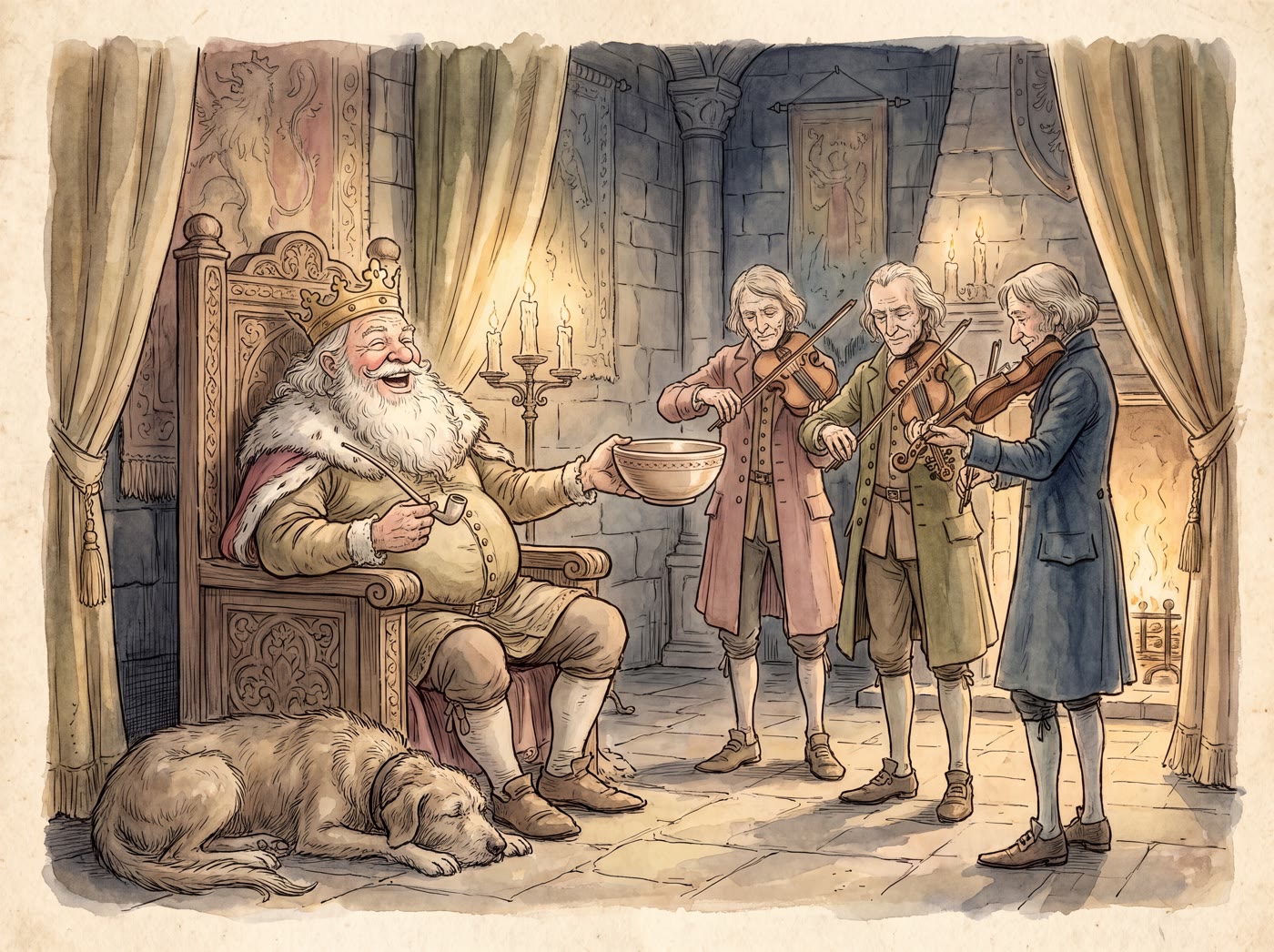
Old King Cole was a merry old soul,
And a merry old soul was he;
He called for his pipe, and he called for his bowl,
And he called for his fiddlers three.
Every fiddler he had a fiddle,
And a very fine fiddle had he;
Oh, there’s none so rare as can compare
With King Cole and his fiddlers three.
Where the rhyme comes from
“Old King Cole” first appears in print in William King’s Useful Transactions in Philosophy, published in London in 1708–09, where it is quoted as a verse the reader is plainly expected to know already. That tells us the rhyme was in circulation orally well before 1708, though how much earlier is anybody’s guess — there is no attested version before King’s. It carries the Roud Folk Song Index number 1164.
The words have wandered a little over three centuries. Some printings give the king “his glass” rather than “his bowl”, and Victorian collections cheerfully extended the rhyme with trumpeters, drummers and pipers so that children could add a new instrument with every round. The two-stanza version above is the one that settled into English nursery collections and is still the most widely sung.
What does it mean?
On the surface it means exactly what it says: a contented old king who wants nothing more than a smoke, a drink and some music. Attempts to pin him to a real person are all speculative, and folklorists generally treat them as folklore rather than history — centuries separate every candidate from the rhyme’s first appearance.
Coel Hen. The most repeated theory identifies Cole with Coel Hen — “Coel the Old” — a semi-legendary ruler of northern Britain around the time the Romans withdrew, sometimes also linked to Coel Godhebog, “the Magnificent”. The nickname is suggestive, but there is no documented line connecting these dimly recorded figures to an eighteenth-century nursery rhyme.
Colchester. A related tradition makes Cole the prince who built Colchester — a possibility William King himself mentioned in 1708. Colchester, however, was not in fact named after any King Coel, so this looks like folk etymology working backwards from the name.
Thomas Cole-brook. King’s other suggestion, later taken up by the music historian William Chappell, was “Old Cole”, alias Thomas Cole-brook, a twelfth-century Reading cloth merchant so wealthy and hospitable that his story was retold by Thomas Deloney in The Pleasant History of Thomas of Reading (c. 1598). A merchant king of good living fits the mood of the rhyme nicely — but again, it is a theory, not a record.
The likeliest reading is the simplest: Old King Cole is nobody in particular, an invented figure of jollity, and the rhyme is a small hymn to good company and a tune well played.
Sharing it with children
This is a marvellous lap rhyme because every line hands the child something to do. Bounce gently on the knee through “merry old soul”, then let them mime each call: a puff on an imaginary pipe, a big two-handed bowl lifted to the lips, and three fingers held up for the fiddlers. On the second stanza, saw an invisible bow across an invisible fiddle — toddlers will happily do this for far longer than you expect.
It also makes an easy first counting rhyme: three fiddlers, three fiddles, three bows. Older children love the Victorian trick of adding a verse for a new instrument each time round — trumpeters, drummers, pipers — and inventing the noise to go with it.
Extra verses to sing
These verses aren’t traditional — they’re ours. Sing them when three fiddlers simply aren’t enough.
Old King Cole was a merry old soul,
And a merry old soul was he;
He called for his drum, and he called for his chum,
And he called for his drummers three.
Every drummer he had a drum,
And a very fine drum had he;
So the castle shook till the candles took
To dancing with the fiddlers three.