Here We Go Round the Mulberry Bush
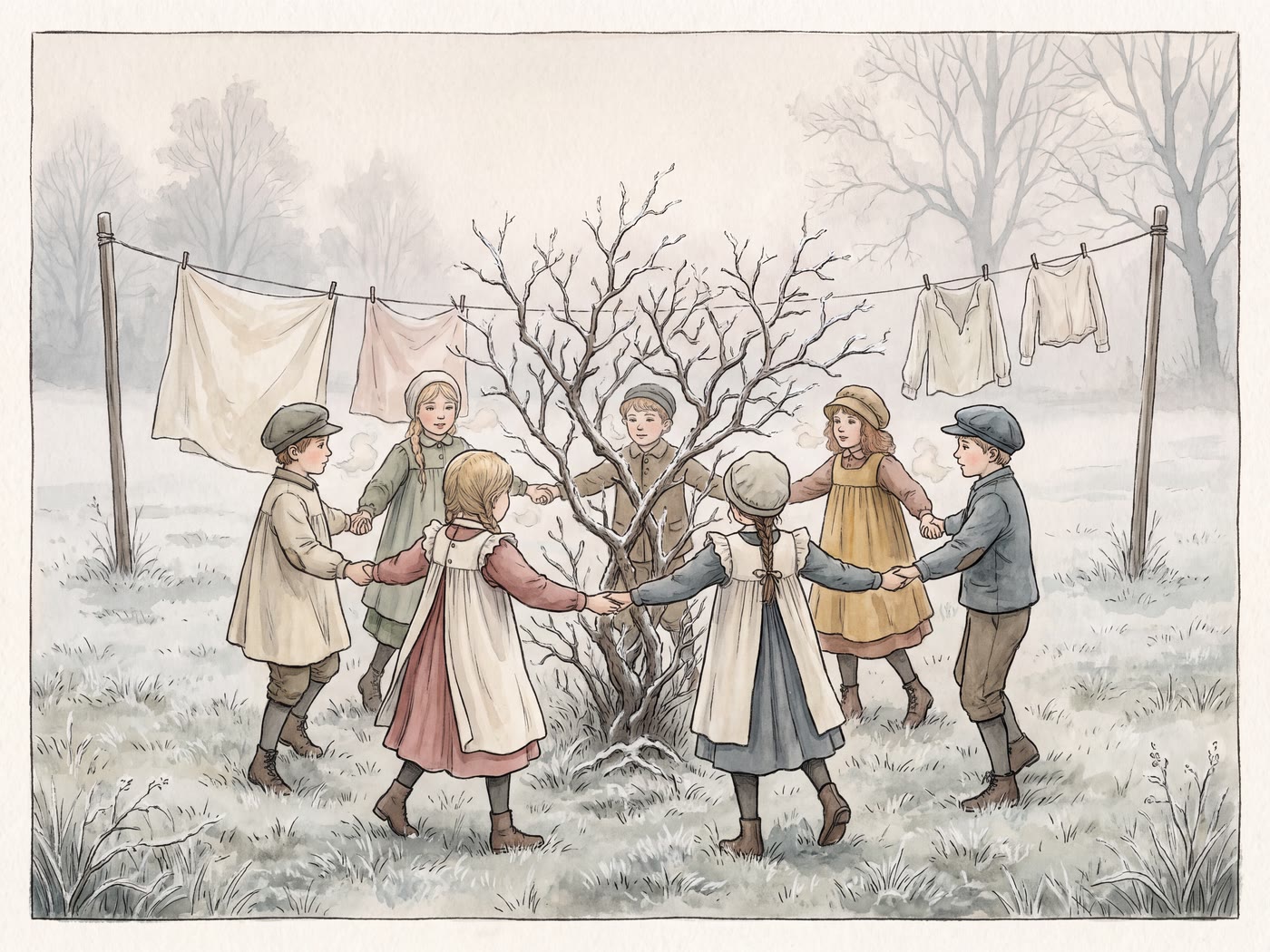
Here we go round the mulberry bush,
The mulberry bush, the mulberry bush,
Here we go round the mulberry bush
On a cold and frosty morning.
This is the way we wash our clothes,
Wash our clothes, wash our clothes,
This is the way we wash our clothes
So early Monday morning.
This is the way we iron our clothes,
Iron our clothes, iron our clothes,
This is the way we iron our clothes
So early Tuesday morning.
This is the way we mend our clothes,
Mend our clothes, mend our clothes,
This is the way we mend our clothes
So early Wednesday morning.
This is the way we sweep the floor,
Sweep the floor, sweep the floor,
This is the way we sweep the floor
So early Thursday morning.
This is the way we scrub the floor,
Scrub the floor, scrub the floor,
This is the way we scrub the floor
So early Friday morning.
This is the way we bake our bread,
Bake our bread, bake our bread,
This is the way we bake our bread
So early Saturday morning.
This is the way we go to church,
Go to church, go to church,
This is the way we go to church
So early Sunday morning.
Where the rhyme comes from
Here We Go Round the Mulberry Bush (Roud Folk Song Index number 7882) was first recorded in print in the 1840s. James Orchard Halliwell gives it as a ring game in Popular Rhymes and Nursery Tales (1849), and a very similar Scottish game-rhyme, “The Merry-Ma-Tanzie”, had been noted as early as 1842 by Robert Chambers in his Popular Rhymes, Fireside Stories, and Amusements of Scotland. The decade is secure; which came first depends on how close a cousin you accept.
Halliwell’s verses are shorter and plainer than the ones sung today. The dancers “wash our clothes”, “dry our clothes” and “mend our shoes”, and then “the gentlemen walk” and “the ladies walk”. There is no tidy march from Monday to Sunday. The seven-day round of washing, ironing, mending, sweeping, scrubbing, baking and church given above is the form most widely sung now — a later folk elaboration whose first printing has not been pinned down.
The tune is older than the words on paper. It is the one to which the dancer Nancy Dawson made her name in John Gay’s The Beggar’s Opera in mid-eighteenth-century London. It is shared with “Nuts in May” — which, as Alice Gomme recorded in The Traditional Games of England, Scotland and Ireland (1894), also ends “on a cold and frosty morning” — and with “Lazy Mary, Will You Get Up”; a variant of it carries “The Wheels on the Bus”. Ring games of the same shape are sung in Scandinavia and the Netherlands, where, in the Scandinavian versions, the children circle a juniper bush instead.
What does it mean?
The Wakefield prison story. The most repeated explanation says the song began with women prisoners at Wakefield, in Yorkshire, taking their exercise round a mulberry tree in the prison yard. It was put forward by R. S. Duncan, a former governor of HM Prison Wakefield, in a privately published book of 1994. The tree was real: it stood in the exercise yard, died in 2017 and was cut down in 2019, as the BBC reported at the time. But a real tree does not make a real origin. The story first appears in the 1990s, a century and a half after the song was already in print, and there is no historical evidence connecting the two.
The silk industry. Bill Bryson, in At Home (2011), suggests the rhyme may poke fun at Britain’s attempts to raise its own silk: mulberry leaves feed silkworms, the trees struggled in the British climate, and “a cold and frosty morning” would be the punchline. It is an elegant idea, but speculation.
A ring game about the week’s work. The likeliest answer is the least dramatic: a circle of children, a refrain to dance to, and verses that mime the chores they watched being done at home. The real puzzle is botanical. Mulberries grow on trees, not bushes, and Halliwell also gives the game going round a “bramble bush” — a bush that really is one. Later writers, among them E. Godfrey in Home Life Under the Stuarts (1903), have taken that as a hint that “bramble” may be the older wording.
Sharing it with children
This is a ring game before it is anything else. Hold hands in a circle — two people and a houseplant will do — and walk round on the refrain, shivering a little for the cold and frosty morning. On each verse, let go and stand still to mime the job: scrubbing at a washboard, pressing with a heavy iron, stitching, sweeping. Then join hands and circle again before the next day of the week.
Strictly it counts days rather than numbers, which is why it lives here beside Thirty Days Hath September. Hold up a finger for each day as it comes round, or ask “what comes after Wednesday?” before you sing the next verse. Once the pattern is familiar, hand the choosing over: each child invents a chore and everyone mimes it — brushing teeth, watering the garden, walking the dog.
Extra verses to sing
These verses aren’t traditional — they’re ours. Add them to the week, or make up your own.
This is the way we feed the cat,
Feed the cat, feed the cat,
This is the way we feed the cat
So early every morning.
This is the way we tidy toys,
Tidy toys, tidy toys,
This is the way we tidy toys
So late on Sunday evening.