The Twelve Days of Christmas
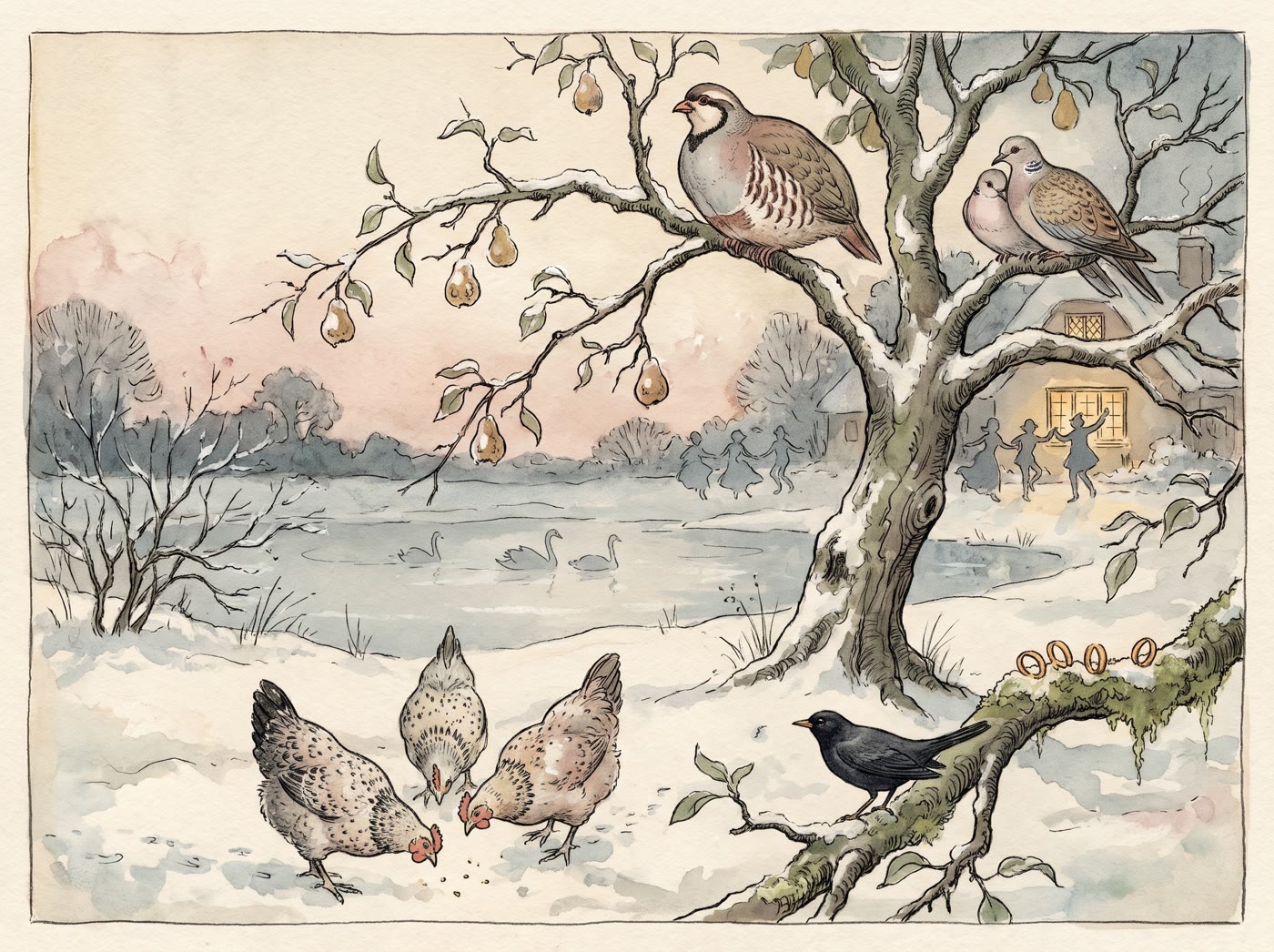
On the first day of Christmas
My true love sent to me
A partridge in a pear tree.
On the twelfth day of Christmas
My true love sent to me
Twelve drummers drumming,
Eleven pipers piping,
Ten lords a-leaping,
Nine ladies dancing,
Eight maids a-milking,
Seven swans a-swimming,
Six geese a-laying,
Five gold rings,
Four colly birds,
Three French hens,
Two turtle doves,
And a partridge in a pear tree.
Where the rhyme comes from
The earliest printed words appear in a children’s book, Mirth without Mischief, published in London around 1780 — though some catalogues date the surviving copy nearer 1800. A broadside printed at Newcastle carries the same gifts, and early versions have no music at all. In these texts the gifts include “colly birds”, and the last four are in a different order from the one most people sing now.
The exact origin is unknown, but it very probably began as a memory and forfeits game. Nineteenth-century collectors describe it that way. In 1842 James Orchard Halliwell noted that each child in turn repeated the gifts of the day and paid a forfeit for every mistake; Husk, writing in 1864, found it on Newcastle broadsides and described it as fitted for the game of forfeits, with the verses shared out between players; and Lady Gomme (1898) said it was played on the night of Twelfth Day, a slipped line costing the player a small possession that was later redeemed with a penalty. The twelve days run from Christmas Day to the day before Epiphany, 6 January, so the game belonged to the very end of the festivities.
The tune most people know comes from an arrangement by the English baritone and composer Frederic Austin, published in 1909; it was based on a traditional melody he remembered from his family. Earlier tunes were printed in 1846 and 1905 and differ from it. Later carol books credit Austin himself with the melody for “five gold rings”. His arrangement also settled the order of the last four days and popularised “calling birds”.
Days two to eleven follow the same pattern as the verses above: each day adds one new gift at the top and then counts back down to the partridge. Many singers say “calling birds” for the fourth gift and “gave” for “sent”; the words have always varied.
What does it mean?
The catechism code. A well-known story says the song was written to teach Catholic doctrine in secret when Catholicism was illegal in England, with each gift standing for an article of faith. It is widely repeated, but it first appears in print in the late twentieth century, and no document from the period it claims to describe mentions it. One of its earliest advocates, writing in 1994, described the reading as what the symbols had suggested to him, not a historical finding. Historians treat the code as modern folklore rather than fact. Long before it was proposed, the Opies, in The Oxford Dictionary of Nursery Rhymes (1951), thought it probable that whatever the chant’s ultimate origin, the lines that survive are “merely an irreligious travesty”.
Colly birds. “Colly” is a dialect word for “black”, so colly birds are blackbirds — the same root gives us “collie”. The word was puzzling even in the nineteenth century, and singers replaced it with “canary birds”, “coloured birds” and others; “calling birds” is the modern descendant.
The partridge and the pear tree. One suggestion is that “pear tree” echoes the French perdrix, partridge. It is only a suggestion. French songs with a similar cumulative shape, ending in turtle doves and a partridge, were collected in the nineteenth century.
The “five gold rings” have been read as ringed birds, but the illustration in Mirth without Mischief shows jewellery.
Sharing it with children
It is a counting song and a memory test in one. Count the gifts on your fingers as you sing, and notice how the numbers climb and fall again: the twelfth-day verse alone names 78 gifts.
For a group, play it the old way. Give each child one gift and have them stand on their line. For a forfeit when someone slips, keep it classroom-clean: sing the next line backwards, hop twice, or name a favourite winter animal. Older children can try the last verse in one breath, as nineteenth-century players did.
Extra verses to sing
These verses aren’t traditional — they’re ours. Use them as a wind-down when the counting is done.
On the thirteenth day of Christmas
My true love said to me,
“No more gifts to carry,
Come and sit by me,
And sing it through from the very start,
As slowly as can be.”