Christmas Is Coming
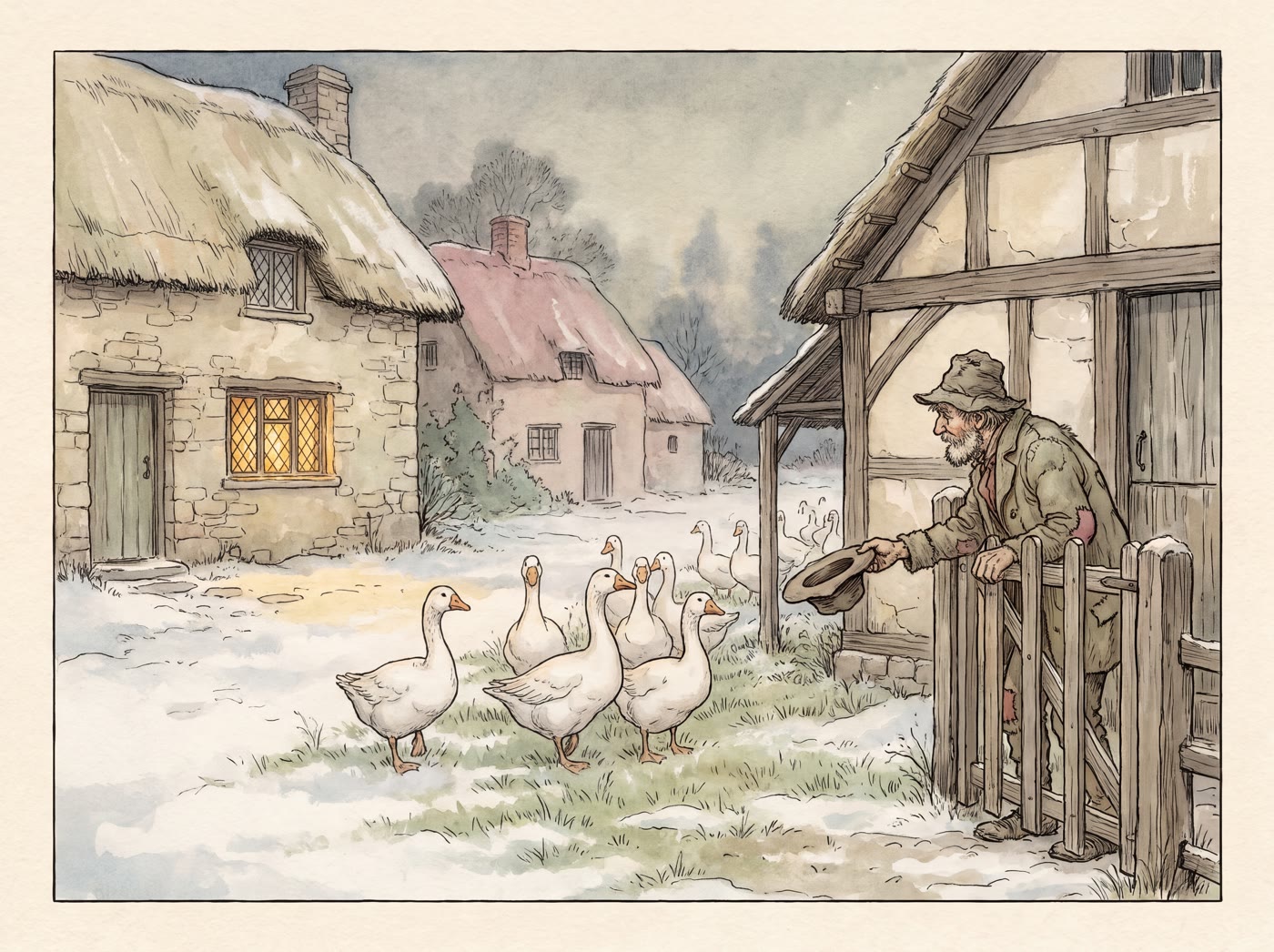
Christmas is coming, the geese are getting fat,
Please to put a penny in the old man’s hat,
If you haven’t got a penny, a halfpenny will do,
If you haven’t got a halfpenny — God bless you!
Where the rhyme comes from
The earliest printing we have read is in Shropshire Folk-Lore: A Sheaf of Gleanings, edited by Charlotte S. Burne from the collections of Georgina F. Jackson and published in 1886. It sits among the nursery rhymes and children’s jingles, labelled as coming from Ludlow, and the wording above is that one. The label tells us only where the collector heard it, not where the rhyme began.
Some sources give an earlier appearance, in the Oswestry antiquarian journal Bye-Gones in July 1885. We have not been able to read that page ourselves, so we pass it on as a reported date, not a confirmed one. Either way, the rhyme turns up in print in the mid-1880s, already circulating by word of mouth and credited to no author. How much older it is, nobody has established.
The words wander a little. Many people sing “the goose is getting fat” in the singular, “please put a penny” for “please to put”, “ha’penny” for “halfpenny”, and a closing “then God bless you”. Some versions add a farthing line before the blessing. The 1886 text has none of these, and none is more “correct” than another.
The tune is another open question. The rhyme is usually sung as a round, often to the folk melody Country Gardens, though other melodies exist. Who wrote the tune is unknown, and we have found nothing that says when the round arrangement began. A separate setting for four voices, an “old rhyme” arranged by Walford Davies, was published by Novello in 1914.
What does it mean?
The usual reading is simple enough: the geese are being fattened for the Christmas table, and a poor old man is asking passers-by for a few coppers to share in the season. That is interpretation, not documented intent — no source says what the rhyme’s makers had in mind — but the background fits.
The goose. Geese were fattened in autumn on harvest stubble, and those left over from Michaelmas, on 29 September, were kept on for Christmas. The extra feed had to be paid for, so a Christmas goose was expensive. Turkey reached England in the sixteenth century but stayed a costly luxury until the nineteenth. Goose clubs were set up to help poorer families, who put away a few pence each week so as to afford a bird on the day.
The begging. The same 1886 book prints door-to-door Christmas songs from Shropshire, among them a wassail hymn that insists “we are not daily beggars” and a souling rhyme sung for gifts. Asking at the door at Christmas was an established custom there, which is why the old man and his hat read as natural. Who the “old man” is, if he is anyone in particular, is unknown.
The money. A halfpenny was half a penny and a farthing a quarter of one. Before decimalisation in 1971 there were 240 pence in the pound. Farthings stopped being legal tender at the end of 1960 and the halfpenny on 31 July 1969, so a child today may never have held either.
Sharing it with children
Start with the round. Divide into two or three groups, and have each group begin the first line once the group before it has finished it. The four lines are short enough that even small children can hold their own part, and “God bless you”, sung a little louder, makes a good last line to land on.
Then play shop with the old money. Give each child toy coins, and let them “pay” the hat: one penny, or two halfpennies, which make a penny, or four farthings if you have them. Children without the right coin sing the last line. It is a gentle way into counting, halves and quarters, and into asking why the rhyme says what it says.
A hat on the floor and a handful of buttons will do if there are no toy coins. For a quieter version, say the words in a steady rhythm and clap on each “penny”.
Extra verses to sing
These verses aren’t traditional — they’re ours. Sing them after the old words if the geese deserve a second chance.
Christmas is coming, the geese are all right,
They’re waddling home by the lantern light,
If you haven’t got a crust, a crumb will do,
If you haven’t got a crumb, here’s a song for you.
Christmas is coming, the old man smiles,
His hat is full for the cold, long miles,
If you haven’t got a penny, a kind word will do,
And a merry Christmas to you.