Hark, Hark, the Dogs Do Bark
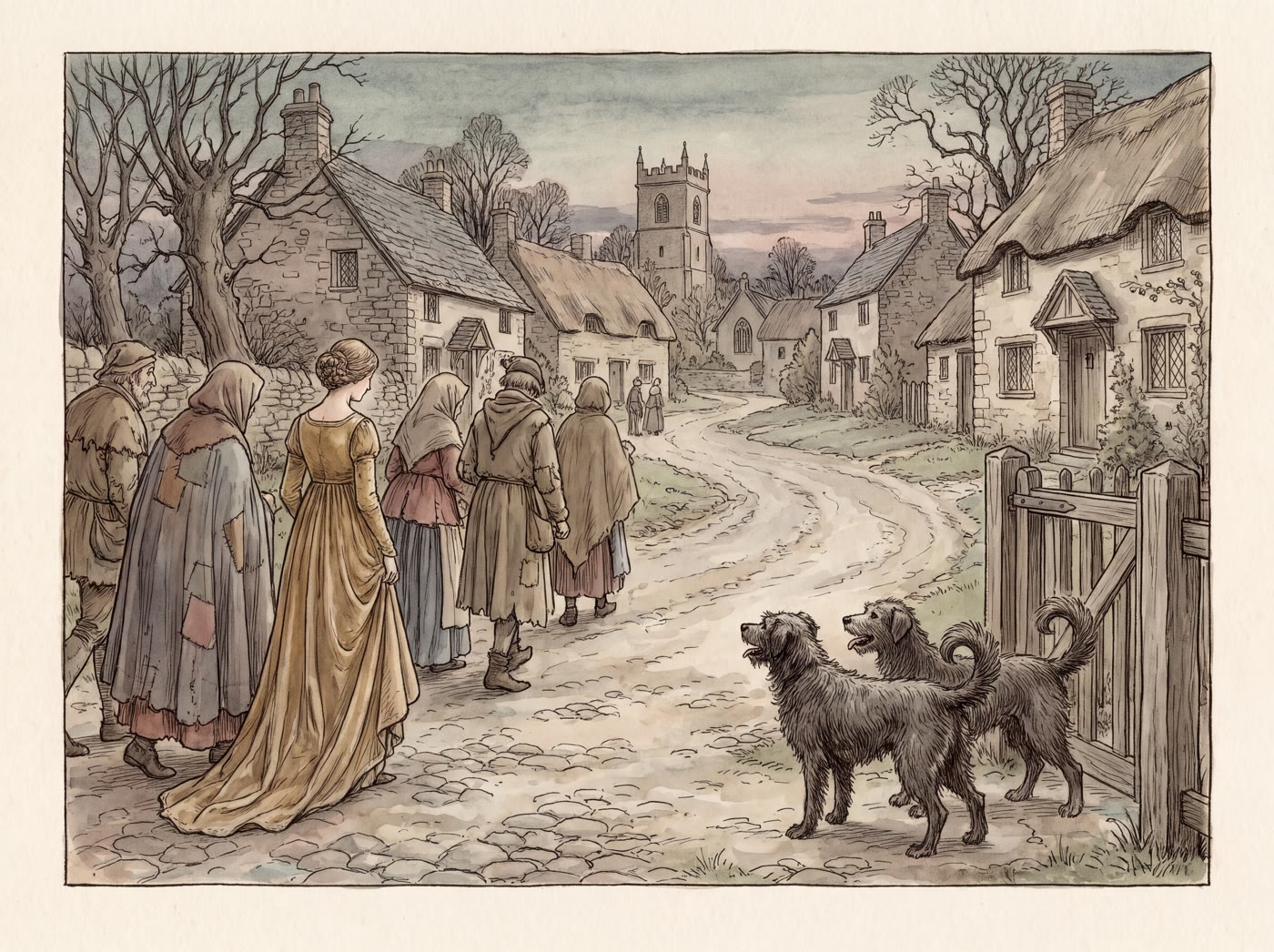
Hark, hark, the dogs do bark,
The beggars are coming to town;
Some in rags, some in jags,
And some in velvet gowns.
Where the rhyme comes from
The earliest printing of the beggar rhyme that we can point to is in the 1788 edition of Tommy Thumb’s Song Book, under the title “Hark Hark”. That is the earliest known, not necessarily the first: it is not known whether earlier editions of the book carried it. The verse also turns up in Gammer Gurton’s Garland, though the date of that printing is reported inconsistently, so we leave it aside. In 1853 James Orchard Halliwell filed it among the “relics” in his collection rather than the historical rhymes, and offered no theory about what event, if any, lay behind it.
The opening is older than the beggars. A lyric written down in 1672 begins “Hark, hark! the dogs do bark”, but goes on to a wife coming in with “rogues and jades and roaring blades” making a devilish din — a rowdy song, not a nursery rhyme, and not about beggars. A similar cry appears in Ariel’s song in Shakespeare’s The Tempest, written around 1610. Calling out and barking dogs seem to have been a stock way to start a song; the beggar version, as far as the evidence goes, appears only in the 1780s.
The wording varies. Many versions swap the order to “some in jags, some in rags”; some say “tags” instead of “jags”; and some give just one person the finery — “and one in a velvet gown”. Each is a legitimate variant, and the one above is close to the form found in books of the early nineteenth century.
What does it mean?
What are “jags”? There are two possibilities. In the phrase “rags and jags”, jags simply means torn shreds of cloth, and nineteenth-century dialect dictionaries knew it that way. But in Tudor times a “jag” was also a cut or slash made deliberately in a garment to show the lining beneath; the chronicler William Harrison, writing in 1577, complains of doublets “full of jags and cuts”. Which one the rhyme intends is not established. Torn cloth is the likelier reading, but a line that runs from rags to slashed finery to velvet is a nice thought.
Wandering beggars after the Dissolution of the Monasteries. A popular explanation links the rhyme to the 1530s, when displaced monks and their dependants are said to have taken to the roads. It is widely repeated, and writers such as Albert Jack have put it forward, but no early text of the rhyme supports it — the earliest beggar version is some 250 years later.
William of Orange and the Dutch. Another reading ties the rhyme to the 1688 Glorious Revolution, on the strength of the word “beggar”, which has been connected to the Beghards, a Dutch mendicant order. Even the writers who mention it tie it only to that one word, and the origin of “beggar” is itself disputed. We regard it as weak and unevidenced.
A Jacobite jingle. The Victorian antiquary Sabine Baring-Gould, in English Minstrelsie (1895), thought the beggar verse the later of the two songs and a jingle dating from after 1714. That is one scholar’s opinion, offered without proof.
The safest conclusion is the modest one. As the writer Chris Roberts observes in Heavy Words Lightly Thrown, the theme of ragged newcomers arriving in a town could describe almost any time from the Middle Ages onwards, which is probably why so many have claimed the rhyme for their own. Who first made it, and what they meant, is unknown.
Sharing it with children
Begin with the dogs. Ask what a dog says and let everyone have a go — woof, ruff, yap, arf — then bark together on the first “hark”. Cupping a hand to the ear for “hark” makes a good listening gesture, and a quiet-to-loud barking game is a useful way to practise volume.
Dressing up suits the second half. Gather a pile of scraps, scarves and old cloth, and one soft “velvet” scarf or cushion cover; children choose to be in rags, in jags (snip a few fringes along a strip of fabric) or in the velvet gown. The beggars in the rhyme are simply travellers arriving, so there is no need to mock them — a little explanation that people once travelled the roads in hard times is enough.
Finally, march: stamp for the first line, tiptoe for the second, and parade around the room “into town” on the last two, counting off who is wearing rags, who jags, and who velvet.
Extra verses to sing
These verses aren’t traditional — they’re ours. Sing them if you would like the visitors to be welcomed.
Hark, hark, the dogs do bark,
The travellers are coming to town;
Some with a song, some with a gong,
And some with a silver crown.
Hush, hush, the dogs are still,
The travellers sit down;
Some have bread, some have a bed,
And all are welcome in town.