Cobbler, Cobbler, Mend My Shoe
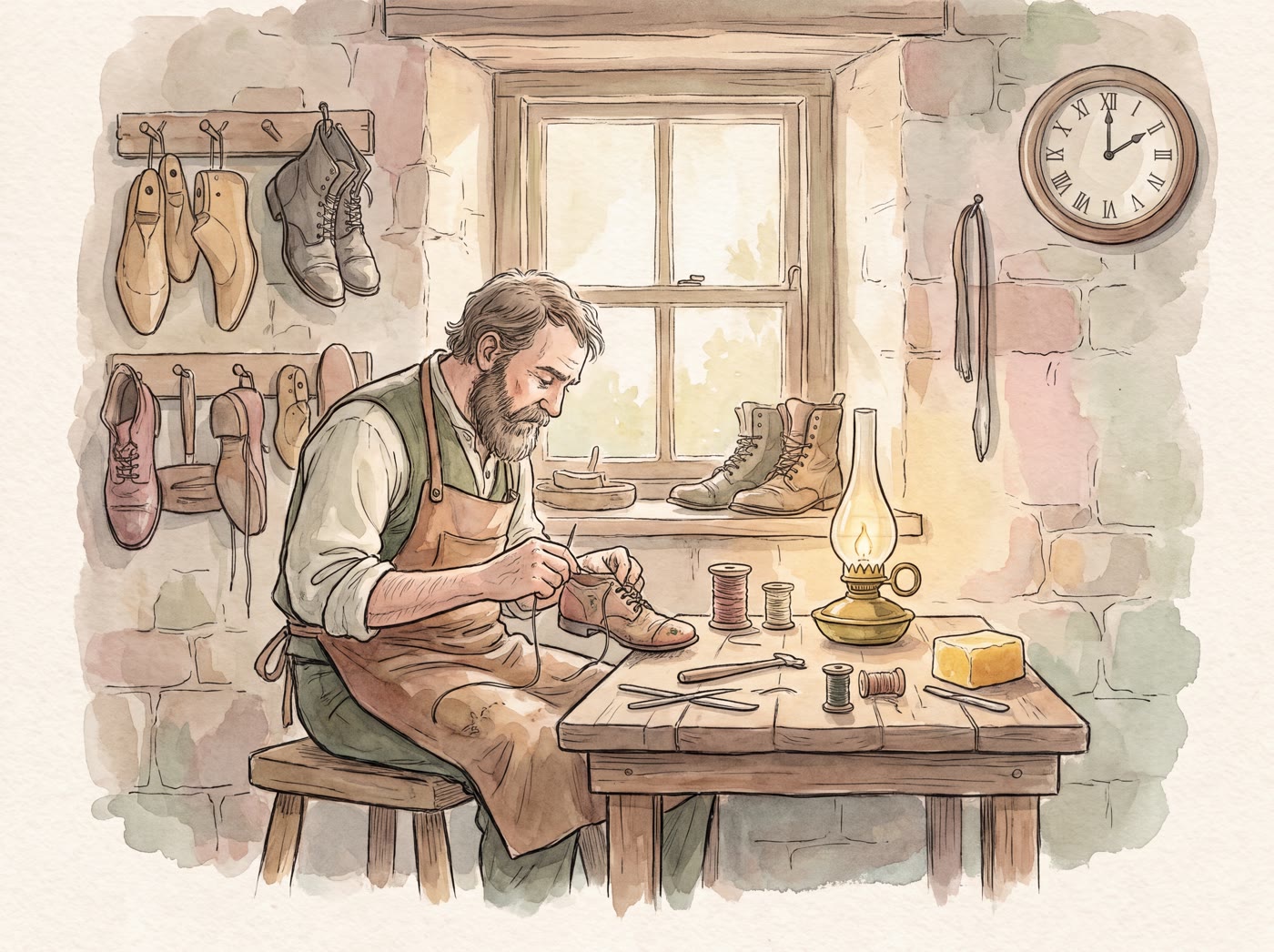
Cobbler, cobbler, mend my shoe,
Get it done by half past two.
Half past two is much too late,
Get it done by half past eight.
Stitch it up and stitch it down,
And I’ll give you half a crown.
Where the rhyme comes from
The rhyme is old, anonymous and well established in the standard collections, but its history is less tidy than the lines suggest. The earliest date with a scholarly source behind it is 1807, for a book called Original Ditties for the Nursery. That date comes from Iona and Peter Opie’s Oxford Dictionary of Nursery Rhymes, as reported by the Ballad Index, which is the source we have to rely on here rather than the Opies’ own text.
The Ballad Index prints two texts under its entry and does not say which of them the 1807 date belongs to. In one, the cobbler answers back: “Yes, good master, that I’ll do; / Here’s my awl and wax and thread, / And now your shoe is quite mended.” The other is close to the lines at the top of this page. A different continuation again was current in 1895, when Sabine Baring-Gould printed it in A Book of Nursery Songs and Rhymes: “Give it a stitch, and that will do. / Here’s a nail, and there’s a prod, / And now my little maid’s well shod.”
As for the “half past two” and “half a crown” wording printed above, the date is not known. The Ballad Index records the half-past-two lines without dating them, and websites that give the rhyme a confident year do not say where they found it. It is the form most often sung and reproduced today, which is why it stands at the top of the page, but nobody should tell you how old it is without showing their evidence.
The coin, at least, is easy to place. A half crown was worth two shillings and sixpence, an eighth of a pound. Britain issued its first gold half crown in 1526 and its first silver one in 1551, and the coin was withdrawn on 1 January 1970, just before decimalisation. It was a familiar coin for centuries, which suits a customer bargaining over a mended shoe.
What does it mean?
There is no recorded hidden meaning, and we would rather say so than invent one. Read plainly, it is a small scene: an impatient customer wants a shoe back by half past two, then thinks again and allows until half past eight, and sweetens the bargain with half a crown for neat stitching.
A song for putting shoes on. The Ballad Index’s editor, working from James Orchard Halliwell, says the rhyme appears to have been used to coax children into their shoes. That is a reasonable reading of the first line, but it is one reader’s inference from a secondary source, not something we can confirm.
Hunt the Slipper. The Opies are reported to suggest a connection with the game of Hunt the Slipper. The Ballad Index adds that Martha Warren Beckwith and Helen Roberts’s Folk-Games of Jamaica (1922) files a version of the rhyme under that very title, which points the same way. It is a suggestion with one supporting hint, not a settled history.
Sharing it with children
Hammer the beat. The rhythm falls naturally into steady taps. Sit with a child and tap a spoon or a fist on the table on each stressed word, then let them take over the hammering while you say the words. Lift your hand on “stitch it up” and bring it down on “stitch it down”, drawing an imaginary needle through the air.
Tell the time. The rhyme names two times, which makes it a gentle way into reading a clock. Set a toy clock to half past two, then half past eight, and ask which is the later of the two. Ask what you would be doing at each of those times, and see whether the child can move the hands to match.
Hide the shoe. This is a play idea of ours, not a documented traditional game. Sit the children in a circle with one shoe hidden behind a child’s back and pass it around quietly while you recite the rhyme. When the rhyme ends, the child in the middle (the “customer”) guesses who holds it. If you like, mention that the Opies saw a possible link with Hunt the Slipper.
Extra verses to sing
These verses aren’t traditional — they’re ours. Sing them to the same tune after the old words, and change the shoe to suit whoever is listening.
Cobbler, cobbler, here I stand,
Little shoe held in my hand.
Tap it, tap it, make it new,
Mend the hole the rain came through.
Cobbler, cobbler, thank you, friend,
Not a hole is left to mend.
Now I’ll skip along the street,
Tap, tap, tap with happy feet.