Old MacDonald Had a Farm
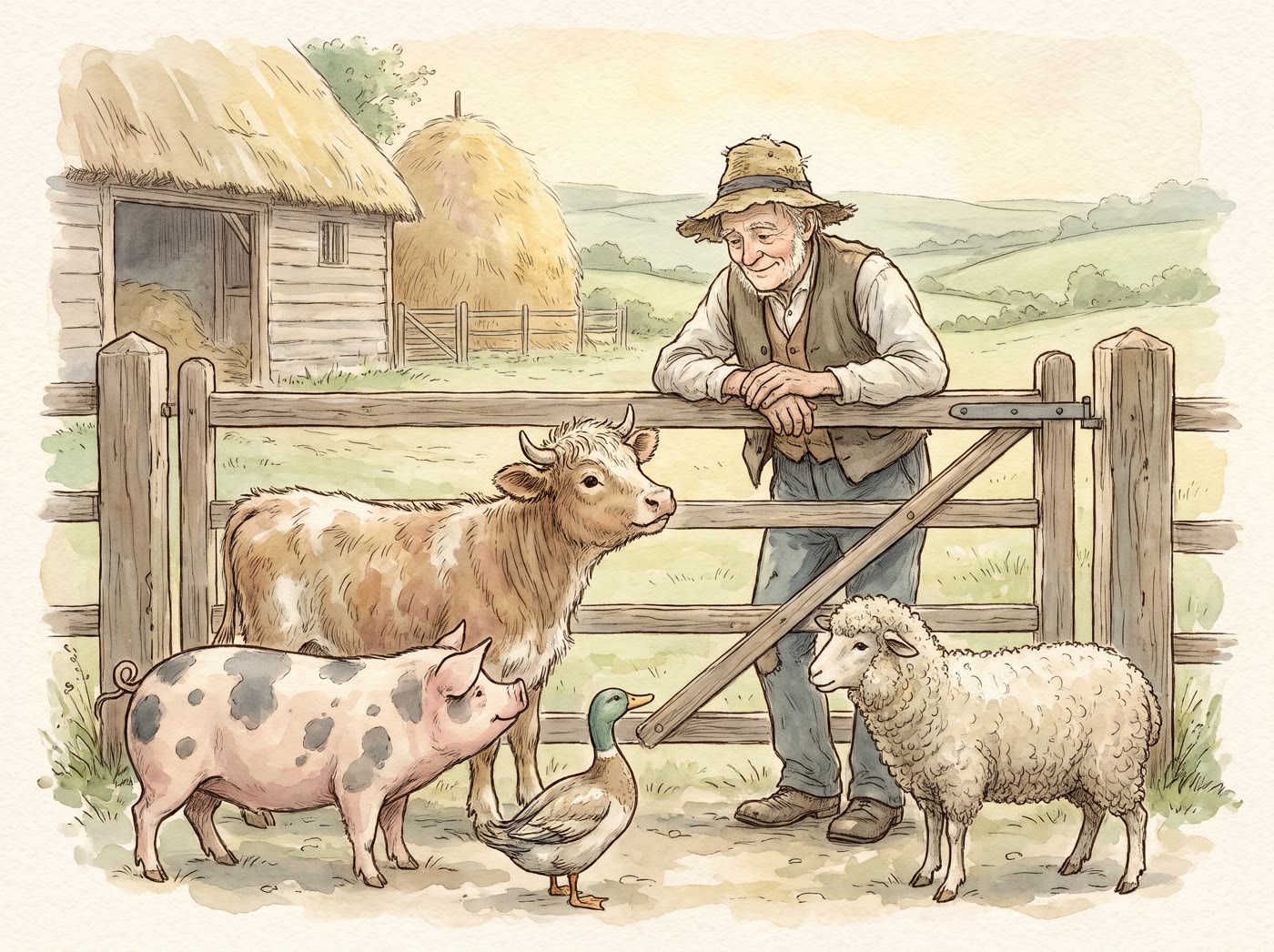
Old MacDonald had a farm, E-I-E-I-O!
And on his farm he had a cow, E-I-E-I-O!
With a moo-moo here and a moo-moo there,
Here a moo, there a moo,
Everywhere a moo-moo,
Old MacDonald had a farm, E-I-E-I-O!
Old MacDonald had a farm, E-I-E-I-O!
And on his farm he had a pig, E-I-E-I-O!
With an oink-oink here and an oink-oink there,
Here an oink, there an oink,
Everywhere an oink-oink,
Old MacDonald had a farm, E-I-E-I-O!
Old MacDonald had a farm, E-I-E-I-O!
And on his farm he had a duck, E-I-E-I-O!
With a quack-quack here and a quack-quack there,
Here a quack, there a quack,
Everywhere a quack-quack,
Old MacDonald had a farm, E-I-E-I-O!
Old MacDonald had a farm, E-I-E-I-O!
And on his farm he had a sheep, E-I-E-I-O!
With a baa-baa here and a baa-baa there,
Here a baa, there a baa,
Everywhere a baa-baa,
Old MacDonald had a farm, E-I-E-I-O!
Where the rhyme comes from
Many websites state flatly that Thomas D’Urfey wrote this song for a stage piece in 1706. The evidence does not go that far. What can be shown is that D’Urfey’s song “In the Fields in Frost and Snow”, from a 1706 stage piece (given as Wonders of the Sun or The Kingdom of the Birds) and later reprinted in his Pills to Purge Melancholy, has the same farmyard-noise pattern: “Booing here, Booing there, / Here a Boo, there a Boo, every where a Boo”. The words and the tune are otherwise quite different. It is the earliest known song with this pattern, so a possible ancestor — but it is not known whether it began the tradition, or borrowed from a song already being sung. The author of the modern song is unknown.
Folk-song collectors found farmyard songs of this family in the decades around 1900. “The Farmyard Song” was taken down from John Lloyd of Manchester in the 1880s, Percy Grainger collected “Father’s Wood I O” in Lincolnshire in 1906, and in 1908 Cecil Sharp noted “The Farmyard” from a 74-year-old woman in a London workhouse, with its “moo moo here and a moo moo there”. These were collected, not published, but they show how widely the song had spread, and how freely it changed.
The song in something like its present form appears in print in 1917, in Tommy’s Tunes, F. T. Nettleingham’s collection of soldiers’ songs from the First World War, under the title “Ohio” and with a farmer called Old Macdougal. Accounts of its refrain differ, so we do not quote it here; some writers suggest the refrain may have been a play on the place name. Across the Atlantic, the Ozark collector Vance Randolph printed an “Old Missouri” version, sung in 1922, in which the farmer owns a mule and the verses name its parts rather than a yard full of animals.
The name “Old MacDonald” turns up on record in 1925, when the Sam Patterson Trio recorded “Old MacDonald Had a Farm”, and again in 1927 with Gid Tanner and his Skillet Lickers, who spelled it “McDonald”. Spellings still vary today.
What does it mean?
E-I-E-I-O. No one knows what it means. The most likely answer is that it is a stock nonsense refrain, of the kind found in many folk songs, there to be sung rather than understood.
A hidden or darker meaning. Searches turn up suggestions that the song is about slavery, or hides some other dark message. We found no evidence for any of them. Some nineteenth-century farmyard songs were performed in blackface minstrelsy, according to the folk-music scholar Vic Gammon, but that tells us who sang them, not that the song was ever a coded text. It is a song about a farmer and his animals, and the evidence supports nothing more.
Sharing it with children
The order of the animals varies from singer to singer, and the song goes on for as long as the singers can think of animals. Only the formula stays fixed.
This is a song for taking turns. Sing the refrain together, then pause before the sound and let the child supply it — a moo, an oink, a squeak that the song never intended. Once they know the pattern, hand over the choice: “And on his farm he had a…?” and let them name the next animal.
For older children it makes a memory game. Keep every animal in the order they arrive, and at each new verse sing the sounds back from the first to the last, with the newest animal in the final place. See how long the farm can grow before someone loses the thread. The setting is easy to swap, too: the farm can become a zoo, a jungle or a pet shop, with a new set of noises to invent.
Extra verses to sing
These verses aren’t traditional — they’re ours. Add them to the end of your farm, or invent your own.
Old MacDonald had a farm, E-I-E-I-O!
And on his farm he had a hen, E-I-E-I-O!
With a cluck-cluck here and a cluck-cluck there,
Here a cluck, there a cluck,
Everywhere a cluck-cluck,
Old MacDonald had a farm, E-I-E-I-O!
Old MacDonald had a farm, E-I-E-I-O!
And on his farm he had a goat, E-I-E-I-O!
With a meh-meh here and a meh-meh there,
Here a meh, there a meh,
Everywhere a meh-meh,
Old MacDonald had a farm, E-I-E-I-O!