Baa Baa Black Sheep
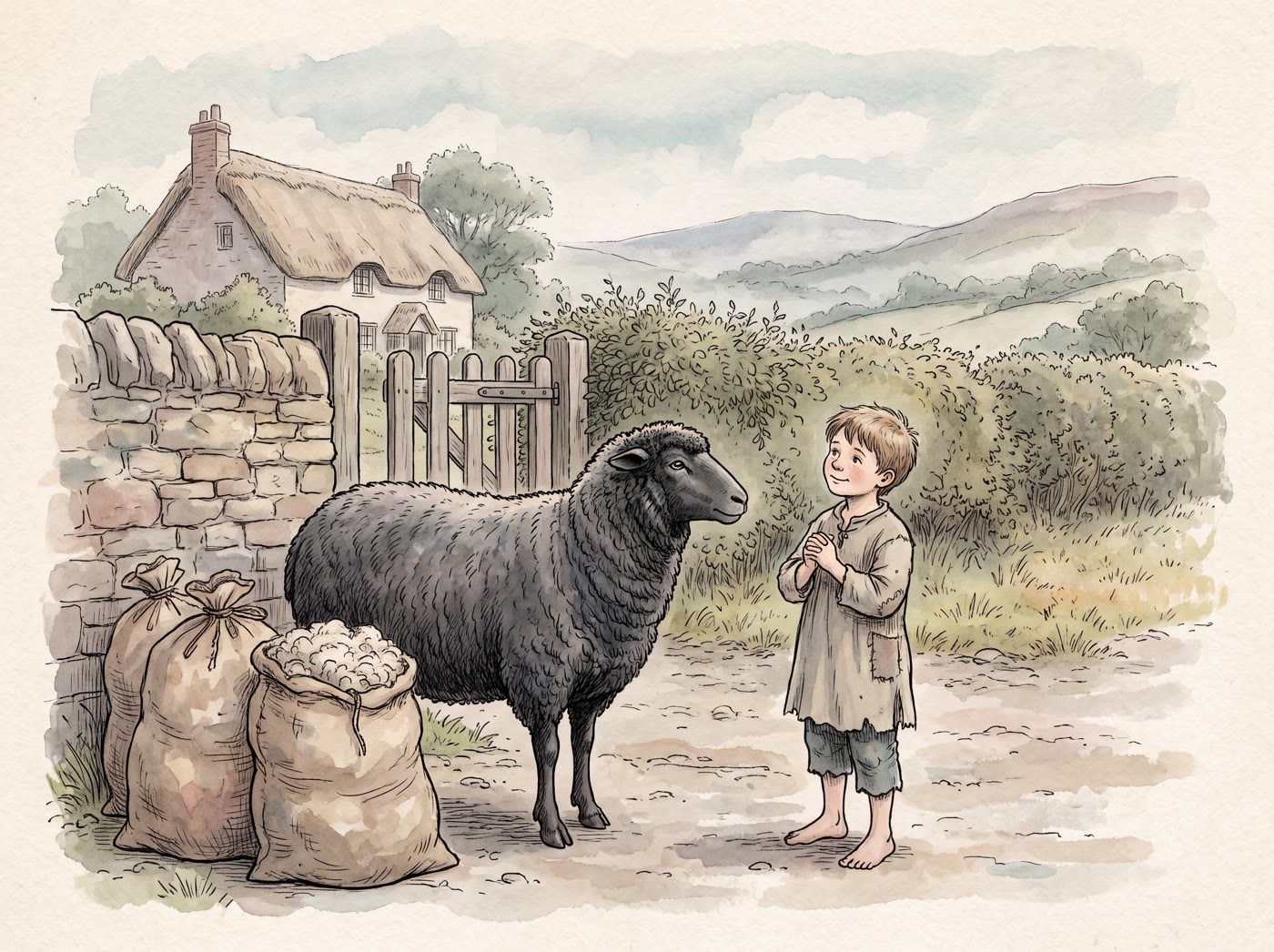
Baa baa black sheep, have you any wool?
Yes sir, yes sir, three bags full.
One for the master, one for the dame,
And one for the little boy who lives down the lane.
Where the rhyme comes from
Baa Baa Black Sheep is one of the oldest English nursery rhymes still in everyday use. Its earliest known printing is in Tommy Thumb’s Pretty Song Book, published in London around 1744 — the oldest surviving collection of English nursery rhymes. There it appears as “Bah, Bah, a black Sheep”, and the words are startlingly close to the ones children sing today: “Have you any Wool? Yes merry have I, Three Bags full, One for my Master, One for my Dame, One for my Little Boy That lives in the lane.”
In two and a half centuries the verse has barely shifted — “yes merry have I” softened into “yes sir, yes sir”, and the boy moved from “in the lane” to “down the lane”. The familiar tune is not original to the rhyme at all: it is a variant of the 18th-century French melody Ah! vous dirai-je, maman, the same air that carries Twinkle Twinkle Little Star and the Alphabet Song.
What does it mean?
On its face the rhyme is a simple, cheerful transaction: a question, an answer, and a fleece shared three ways. As with most nursery rhymes, though, grander explanations have grown up around it — and the evidence for them is thin.
The wool tax. Katherine Elwes Thomas suggested in The Real Personages of Mother Goose (1930) that the rhyme voiced resentment at heavy taxation on wool. This is usually tied to the “Great” or “Old” Custom, an export duty on wool introduced by Edward I in 1275 that survived into the 15th century, with the three bags read as the king’s share, the church’s share and the farmer’s. It is a tidy story, but a theory rather than a finding: the 1275 duty was a flat charge per sack, not a division of the fleece into thirds, and no source connects it to the rhyme before the 20th century.
The slave trade. A more recent claim, aired during debates about nursery rhymes in the 1980s, is that the rhyme refers to the slave trade. Historians have found no supporting evidence for this, and it appears to be a modern reading rather than an origin. It is worth adding that black wool was not necessarily a poor relation — it could be woven into dark cloth without dyeing, which sometimes made it the more valuable fleece.
The likeliest explanation remains the plainest one: a rhyme about sheep, sung in a country where wool was for centuries the great national commodity, kept alive because it is short, tuneful and easy for a small child to answer back to.
Sharing it with children
This is a lovely first call-and-response rhyme. Ask the question yourself — “Baa baa black sheep, have you any wool?” — and let the child be the sheep and answer. Hold up three fingers on “three bags full”, then fold one down for the master, one for the dame and one for the little boy, which turns the verse into gentle counting practice without anyone noticing.
On a lap, bounce lightly through the first two lines and give three soft pats for the three bags. Older children enjoy naming who gets each bag — a grown-up, a grandparent, themselves — and a handful of raw fleece or cotton wool to squeeze while they sing makes the whole thing wonderfully real.
Extra verses to sing
These verses aren’t traditional — they’re ours. Sing them on to the same tune when one verse isn’t enough.
Baa baa black sheep, where does your wool go?
Into a basket, spun soft as snow.
One for a blanket, one for a shawl,
And one for a stocking to hang in the hall.
Baa baa black sheep, sleepy in the lane,
Your coat will grow woolly and warm again.
One for the springtime, one for the frost,
And one for the lamb who has wandered and got lost.