Mary Had a Little Lamb
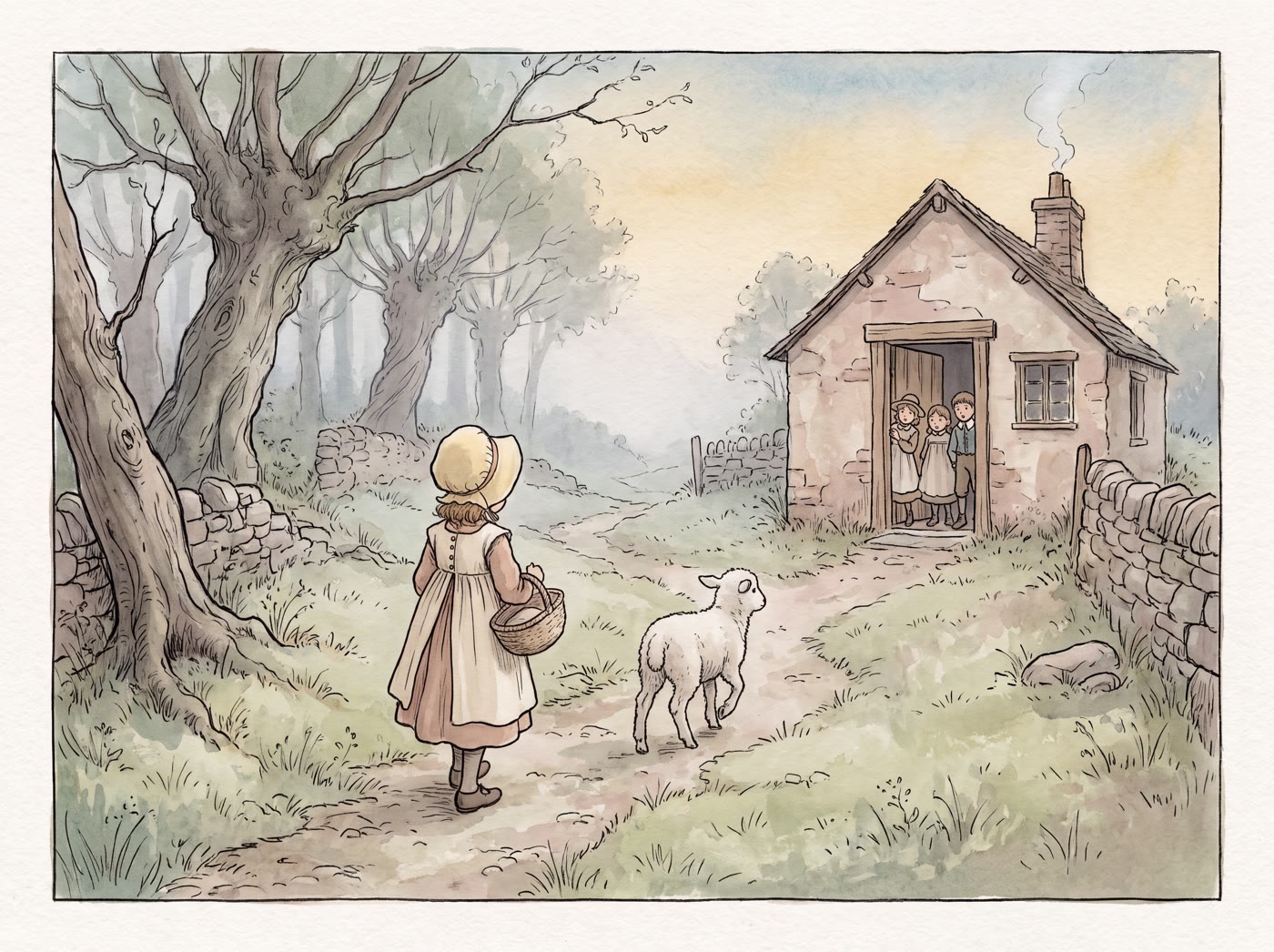
Mary had a little lamb,
His fleece was white as snow,
And everywhere that Mary went,
The lamb was sure to go.
He followed her to school one day,
Which was against the rule,
It made the children laugh and play
To see a lamb at school.
And so the teacher turned it out,
But still it lingered near,
And waited patiently about,
Till Mary did appear.
“Why does the lamb love Mary so?”
The eager children cry.
“Why, Mary loves the lamb, you know,”
The teacher did reply.
Where the rhyme comes from
Unusually for a nursery rhyme, this one has a firm date and a named author. It was published as “Mary’s Lamb” by the American writer and editor Sarah Josepha Hale, in her little book Poems for Our Children, issued by the Boston firm Marsh, Capen & Lyon on 24 May 1830. The same year it appeared in the children’s magazine the Juvenile Miscellany. Hale is also remembered as the campaigner who persuaded Abraham Lincoln to make Thanksgiving a national holiday.
The tune most children sing came slightly later: the composer Lowell Mason set the words to music in his Juvenile Lyre in the 1830s, adding the familiar repetition — “little lamb, little lamb” — that turned a printed poem into a singing game. The verse then earned a curious footnote in technology: in 1877 Thomas Edison is said to have recited “Mary had a little lamb” into his new phonograph, making it one of the first pieces of recorded speech.
What does it mean?
There is no hidden politics here, no plague or king in disguise. On its face the poem is a small moral tale for infant schools: the lamb follows Mary because Mary is kind to it, and the teacher says so plainly in the last verse. Hale wrote her poems, in her own subtitle, “to inculcate moral truths and virtuous sentiments”, and gentle affection repaid is exactly the lesson.
The Mary Sawyer story. A much-repeated tradition holds that the poem describes a real girl, Mary Sawyer of Sterling, Massachusetts, who reared an orphan lamb and took it to the Redstone School, and that a visiting young man named John Roulstone was so charmed that he rode over the next day with the first twelve lines written on a slip of paper. Mary Sawyer — by then Mrs Tyler — told the story in later life, and in the 1920s Henry Ford took it up with enthusiasm, buying the schoolhouse and publishing a book about it. It should be treated as folklore rather than established fact: the slip of paper was never produced, no pre-1830 printing of any lamb poem has ever been found, and Roulstone died in 1822.
Hale as sole author. The documentary evidence points the other way. Hale claimed the poem, published it under her own name, and said it was her own invention rather than a report of a real incident. A common compromise theory — that she heard of a real lamb and built her verses on it — is plausible but, again, unproven. Historians generally credit Hale with the whole poem.
Sharing it with children
This is a lovely lap rhyme for a slow, rocking beat. Sit a child on your knees and sway steadily through each verse, then let the last line settle softly. Little hands enjoy a simple set of actions: two fingers “walking” up the arm for Mary, a woolly stroking motion on “fleece was white as snow”, a shooing wave for the teacher turning the lamb out, and a big hug on “Mary loves the lamb”.
Because the story runs in order — walking, school, turned out, waiting, explained — it is an excellent first rhyme for talking about what happens next. Ask a child to guess before each verse. A cotton-wool lamb glued to card makes a good rainy-afternoon partner for singing it, and the closing question and answer works beautifully as a two-voice game with an older sibling.
Extra verses to sing
These verses aren’t traditional — they’re ours. Sing them if the lamb deserves a longer day.
The lamb went home with Mary then,
Along the winding lane,
And every step he skipped for joy
To be with her again.
And when the winter snow came down
And hid the fields from view,
You could not tell the lamb from snow —
But Mary always knew.