Old Mother Goose
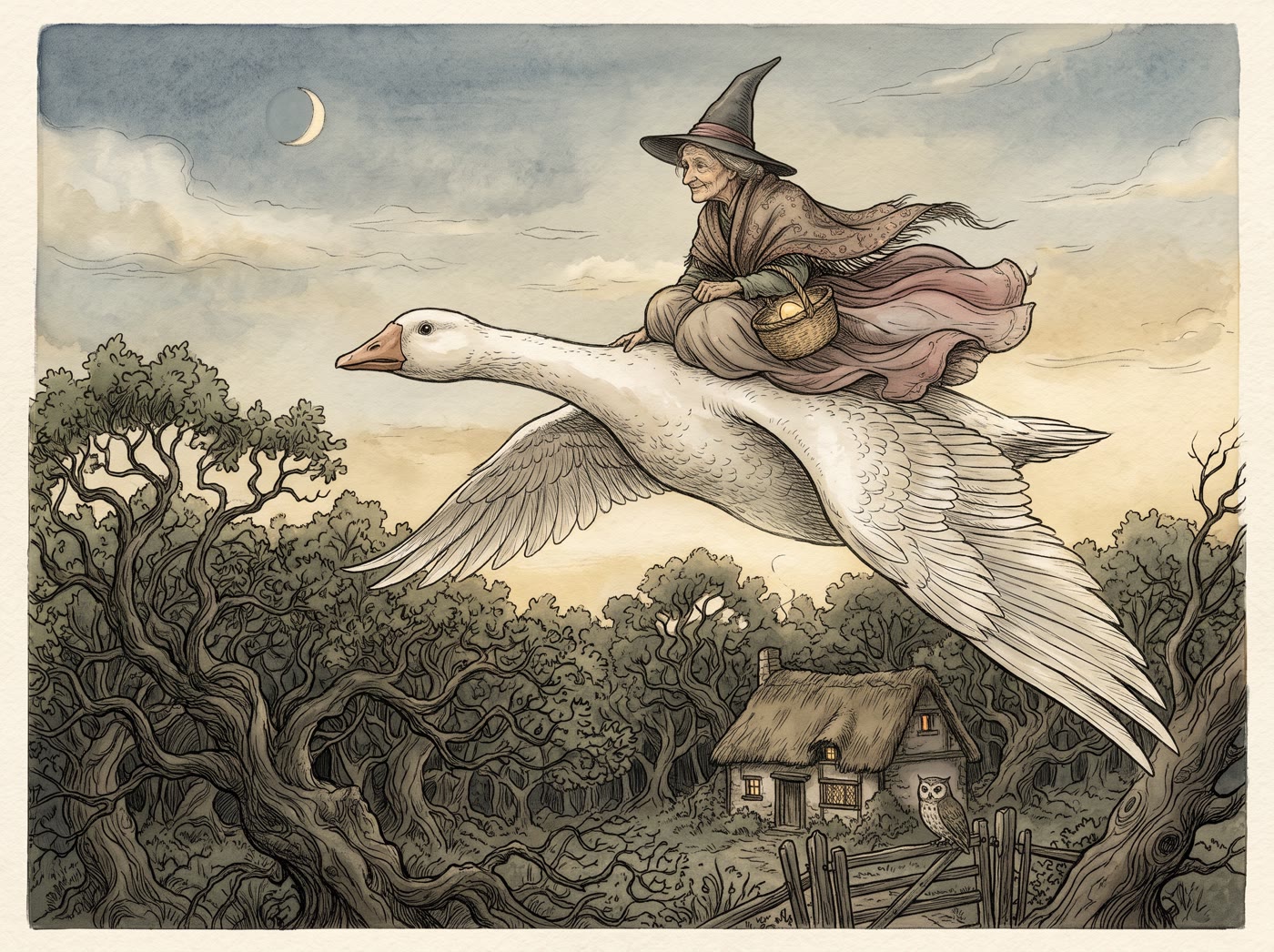
Old Mother Goose, when
She wanted to wander,
Would ride through the air
On a very fine gander.
Mother Goose had a house,
’Twas built in a wood,
Where an owl at the door
For sentinel stood.
This is her son Jack,
A plain-looking lad,
He is not very good,
Nor yet very bad.
She sent him to market,
A live goose he bought,
Here, mother, says he,
It will not go for nought.
Jack’s goose and her gander
Grew very fond;
They’d both eat together,
Or swim in one pond.
Jack found one morning,
As I have been told,
His goose had laid him
An egg of pure gold.
Jack rode to his mother,
The news for to tell,
She call’d him a good boy,
And said it was well.
Where the rhyme comes from
Three different stories get tangled together under this title, and it helps to pull them apart. The first is the rhyme itself. In the nineteenth century it was a long story-poem of fifteen stanzas, printed in cheap illustrated chapbooks with titles such as Old Mother Goose and the Golden Egg — one is dated to the 1820s — and recorded by James Orchard Halliwell in The Nursery Rhymes of England in the 1840s. The words above follow Halliwell. Most modern books keep only the first stanza, which is why the rhyme most people know is just four lines long.
The story-poem is a retelling. All the printed versions depend on a pantomime staged in London in 1806, Harlequin and Mother Goose, or The Golden Egg, by Thomas John Dibdin. It mixed the fable of the goose that laid golden eggs with Harlequin and Columbine, and the stage directions had Mother Goose flying a gander on stage. That explains the gaps in the rhyme: it hurries through the plot, and only the pantomime fills in what the verses skip. After the pantomime, illustrators began to draw Mother Goose as an old woman in a tall pointed hat, on a goose.
A note on what is missing here. The older printings carry the story on for several more stanzas, and some of them are built on an antisemitic stereotype. We have left those out, and we end the printed story at the point where Jack takes the golden egg home to his mother.
The second thing is the name. “Mother Goose” is older than this rhyme. French writers were using la Mère Oye for a teller of tales in the seventeenth century, and Charles Perrault’s fairy tales, published in France in the 1690s, carried the subtitle Contes de ma mère l’Oye. Robert Samber’s English translation followed in 1729. The nursery collection Mother Goose’s Melody was probably first published around 1780–81 by Thomas Carnan, though the earliest copy that survives is dated 1784. We have found no evidence that this rhyme was in it.
The third is the story of a real Mother Goose in Boston. It says she was Elizabeth Goose, who sang rhymes to her grandchildren while her son-in-law, the printer Thomas Fleet, wrote them down and published them. It is widely repeated in America, but no such printing has ever been found, and historians believe it was concocted in 1860 by Fleet’s great-grandson, John Fleet Eliot. The Opies, the leading scholars of nursery rhymes, give it no credence, and the generally accepted view is that the name never referred to any one person.
What does it mean?
Nothing hidden: it is a short fairy tale in rhyme. The golden egg is the old fable of the goose that laid golden eggs, and the flying gander comes from the pantomime. Other people have tried to identify Mother Goose with a historical queen, such as the French “goose-foot” queens Bertha or Bertrada. This is speculation, with nothing behind it that would tie it to the rhyme.
Sharing it with children
Make wings of your arms and swoop through the first stanza, swaying on “ride through the air”. A cushion makes a fine gander for a child to ride across the floor. The rest of the rhyme is a ready-made play: an owl with wide eyes at the door, Jack setting off to market, a goose and a gander paddling in one pond, and the golden egg itself, which can be a yellow ball or a scrunched-up piece of foil. Let the child be Jack and find it in the morning. Four strong beats to every pair of lines means it also clips along nicely to clapping.
Extra verses to sing
These verses aren’t traditional — they’re ours. Sing them to carry the story on a little way after Jack gets home.
Old Mother Goose
Put the egg on a shelf,
And Jack said, “Mother,
Let’s keep it ourselves.”
So they sat by the fire
While the owl hooted twice,
And the gander and goose
Slept as snug as two mice.