Gaffer Gilpin Got a Goose and Gander
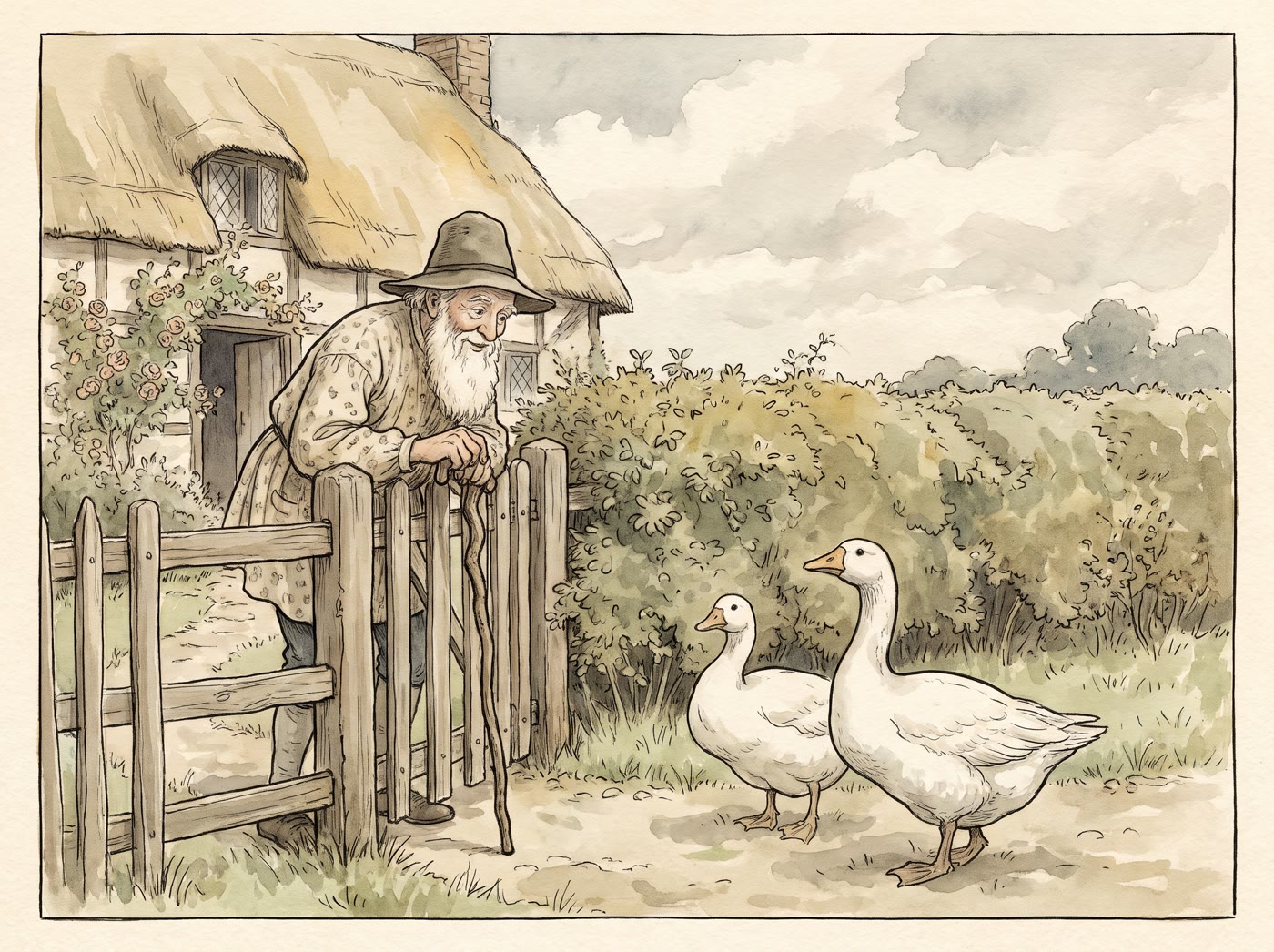
Gaffer Gilpin got a Goose and Gander:
Did Gaffer Gilpin get a Goose and Gander?
If Gaffer Gilpin got a Goose and Gander,
Where’s the Goose and Gander Gaffer Gilpin got?
Where the rhyme comes from
Gaffer Gilpin is the “G” entry in Peter Piper’s Practical Principles of Plain and Perfect Pronunciation, a book of alphabet tongue twisters published by John Harris in London and usually dated 1813. It is the same little book that gave us Peter Piper. Each letter of the alphabet gets its own alliterating character, and Gaffer Gilpin, as G, is seventh in the sequence, following Francis Fribble. Project Gutenberg lists the book as anonymous, and the book itself puts “Peter Piper” forward as its teacher, so we name the publisher rather than an author.
The words above are quoted from the 1836 Philadelphia edition, printed by Willard Johnson, which is the text we have been able to read in full as a Project Gutenberg text. Capitals and punctuation follow that printing. Other editions may differ in small details.
Like every entry in the book, it follows one four-line pattern. The first line states something; the second turns the same words into a question; the third begins “If” and says the statement all over again; and the fourth, beginning “Where”, asks after the object of the sentence. You can see the same shape in Andrew Airpump and Neddy Noodle. As far as we can tell, this is a verse composed for a children’s book rather than a rhyme collected from oral tradition, and we know of no record of who the real Gaffer Gilpin might have been, or whether there was one.
What does it mean?
The word “gaffer”. In the sixteenth century a gaffer was a title of respect for an older man, and the word later came to mean simply an old man, particularly an elderly countryman. Dictionaries give its origin as probably a contraction of “godfather”, with “grandfather” an influence on the sound. Its female counterpart was “gammer”. The modern British sense of a boss or foreman came later, as did the film-set gaffer who looks after the lighting. In this verse, we take it to mean the older sense: Mr Gilpin is an old countryman. (That is our inference from the date, not something the book says.)
The goose and the gander. A gander is a male goose, a word that goes back to Old English. The verse never says how many birds Gaffer Gilpin got — a goose and a gander read naturally as a pair, but that is our reading — and it never says what became of them.
The point of the verse. Nothing is recorded about what it means, and the questions are never answered: where the goose and gander have got to stays a mystery, and the words exist to be said rather than understood. As far as we know, the meaning of the rhyme is simply that there is none beyond the sound.
Our reading, and only ours. William Cowper’s comic ballad John Gilpin, about a draper who rides a runaway horse, dates from 1782 and was hugely popular, so the surname Gilpin may have been a familiar one when this book appeared. It is tempting to think the name is a nod to Cowper. No source we have found says so, and the two characters have little in common. The name works perfectly well as pure alliteration.
Sharing it with children
This one drills the hard G, the sound at the start of Gaffer, Gilpin, got, Goose, Gander and get. Five words in every line begin with it, and, in our own experience of saying it, the trouble comes when the tongue has to keep returning to the back of the mouth for the same sound again and again. That is an observation, not a sourced claim.
Ask and answer. The verse is built as a conversation. One person says lines one and three, the other says lines two and four. Swap parts and go again, a little faster each time.
Slow, then quick. Say the first line three times slowly, with a firm, clear G each time, and then three times at ordinary speed. Children who can manage that can try the whole verse in a single breath.
Goose and gander. Hide two soft toys, one for the goose and one for the gander, and let the children hunt for them while the grown-up chants the last line, “Where’s the Goose and Gander Gaffer Gilpin got?”. For smaller children, flap elbows for the goose and waddle for the gander on every capital-G word.
Extra verses to sing
These verses aren’t traditional — they’re ours. They follow the same four-line pattern, so you can swap them in for a second round.
Grandma Green grew a Garden of Grapes;
Did Grandma Green grow a Garden of Grapes?
If Grandma Green grew a Garden of Grapes,
Where’s the Garden of Grapes Grandma Green grew?
Gertie Goat gobbled a Gooseberry Gate;
Did Gertie Goat gobble a Gooseberry Gate?
If Gertie Goat gobbled a Gooseberry Gate,
Where’s the Gooseberry Gate Gertie Goat gobbled?