Neddy Noodle Nipped His Neighbour’s Nutmegs
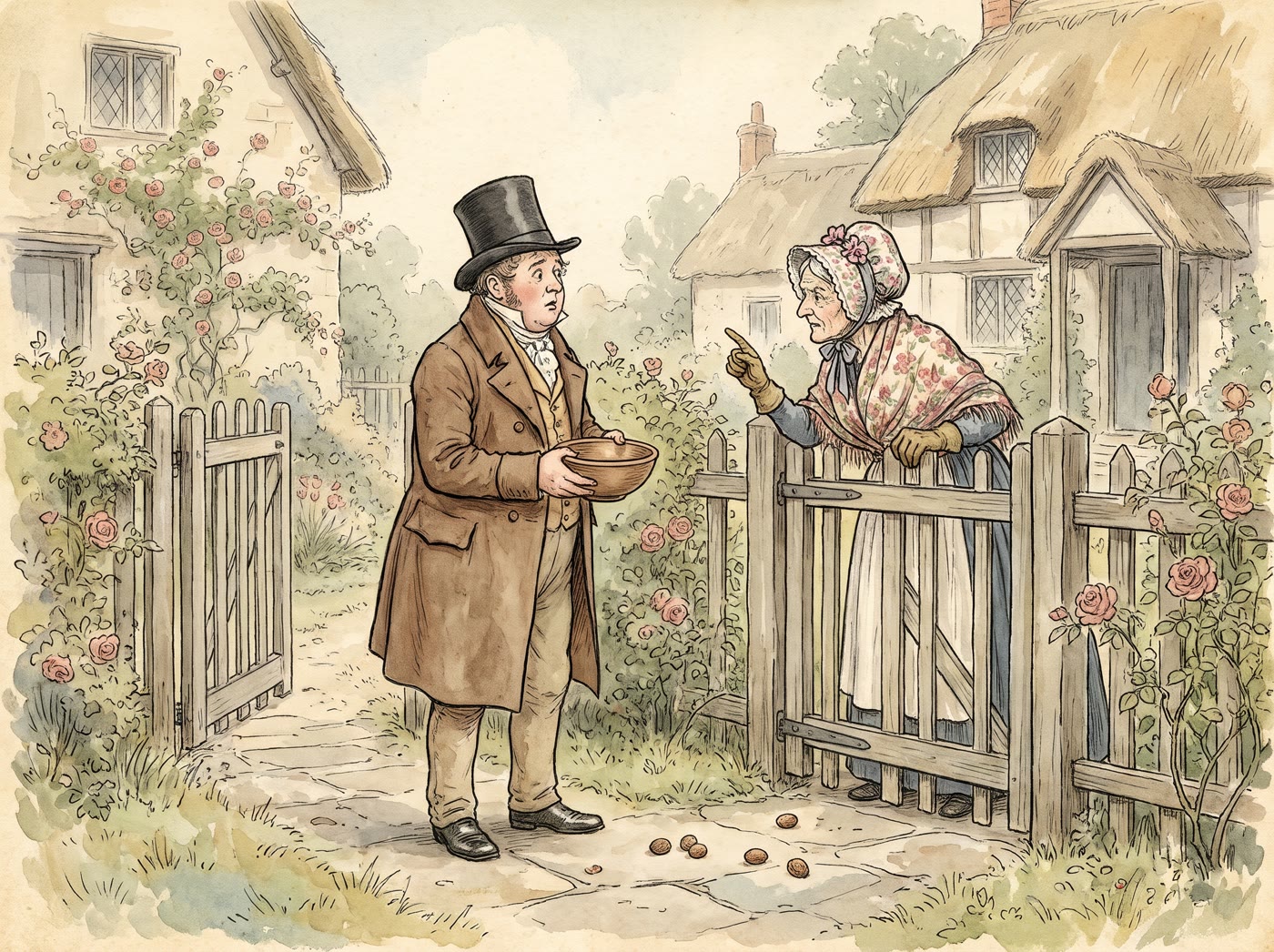
Neddy Noodle nipp’d his neighbour’s Nutmegs;
Did Neddy Noodle nip his neighbour’s Nutmegs?
If Neddy Noodle nipp’d his neighbour’s Nutmegs,
Where are the neighbour’s Nutmegs Neddy Noodle nipp’d?
Where the rhyme comes from
Neddy Noodle is the “N” entry in Peter Piper’s Practical Principles of Plain and Perfect Pronunciation, the alphabet of tongue twisters that also gave us Peter Piper. The book is usually dated to 1813, when it is said to have been published in London by John Harris; we have not seen that first edition ourselves, so treat the date as the one commonly given rather than one we have checked. Each letter gets its own alliterating name, and Neddy comes between Matthew Mendlegs and Oliver Oglethorpe.
The words above are quoted from the edition printed in Philadelphia by Willard Johnson in 1836, which is the text we have been able to read in full; it is freely available from Project Gutenberg, which lists it as anonymous. Spelling and capitals are as printed there, including the old “nipp’d”. A modern version we found online prints “nipped” and “nutmegs” in lower case, and other editions may differ in small details. We name no author: the book puts “Peter Piper” forward as its teacher and does not say who wrote it.
Every entry follows one four-line pattern. The first line states something; the second turns it into a question; the third begins “If” and repeats the statement; and the fourth, beginning “Where”, asks after the object. Because the nutmegs are plural, Neddy’s closer says “Where are” rather than “Where is”. The same shape runs through Andrew Airpump, Billy Button and Davy Dolldrum.
What does it mean?
Taken at face value, it is a small domestic mystery that is never solved. Somebody’s nutmegs have gone missing; Neddy is accused, the accusation is turned into a question, and then into a riddle about where the nutmegs have got to. The verse never answers it. As far as we know, the point is the sound rather than the story.
“Noodle”. Here the word has nothing to do with pasta. A “noodle” was an old word for a fool, and dictionaries record it in print in the eighteenth century, well before the book. Its own origin is uncertain; it may be a variant of “noddle”, meaning the head. That the surname was meant as a joke on a silly person is our reading, not something any source says.
“Nipped”. To nip is to pinch sharply, and from the context we read “nipp’d his neighbour’s Nutmegs” as “pinched them”, in the sense of helping himself to them. That is our reading of the sentence, not a sourced dictionary gloss for 1813. Nutmeg itself is a spice made from the seed of a tropical tree, and the verse needs nothing more about it than its sound.
Sharing it with children
This one drills the N sound, and it is made harder by the way the Ns pile up at the joint “neighbour’s Nutmegs”. Several words in a row begin with N, and it is easy to slip into a different sound halfway through. That is our own observation from saying it aloud, not a sourced claim, but it is easy to check.
Slow, then quick. Say line one three times slowly, pressing the tongue firmly behind the top teeth for every N, then three times at ordinary speed. Stress the first beat of “NUT-megs” and the line tends to fall into place.
Ask and answer. The verse is built as a conversation. One person says lines one and three, the other says lines two and four. Swap parts and go again, a little faster each time.
Hum the N. Ask a child to say “nine” with their nose very gently pinched, and then with it free, and to say what they notice. Most people can feel the sound change, and it makes a good first step before the full twister.
Smell the nutmeg. With an adult in charge, let a child smell a whole nutmeg, or a pinch in a closed jar, and describe what they notice before saying the verse. Smelling only, never tasting, and check for allergies first. For a gentler game of hide and find, put a whole nutmeg under one of three cups, shuffle them, and ask “Where are the nutmegs?” in the voice of line four.
Write your own letter. Take a child’s name and build a four-line verse in the same pattern: a statement, the question, the “If” repeat, and a “Where” closer. Keep it light: the fun is in the sound.
Extra verses to sing
These verses aren’t traditional — they’re ours. They follow the same four-line pattern, so you can swap them in for a second round.
Nancy Nettle noticed nine new neckties;
Did Nancy Nettle notice nine new neckties?
If Nancy Nettle noticed nine new neckties,
Where are the Neckties Nancy Nettle noticed?
Nicky Newt needed nine nightcaps;
Did Nicky Newt need nine nightcaps?
If Nicky Newt needed nine nightcaps,
Where are the Nightcaps Nicky Newt needed?