Davy Dolldrum Dreamed He Drove a Dragon
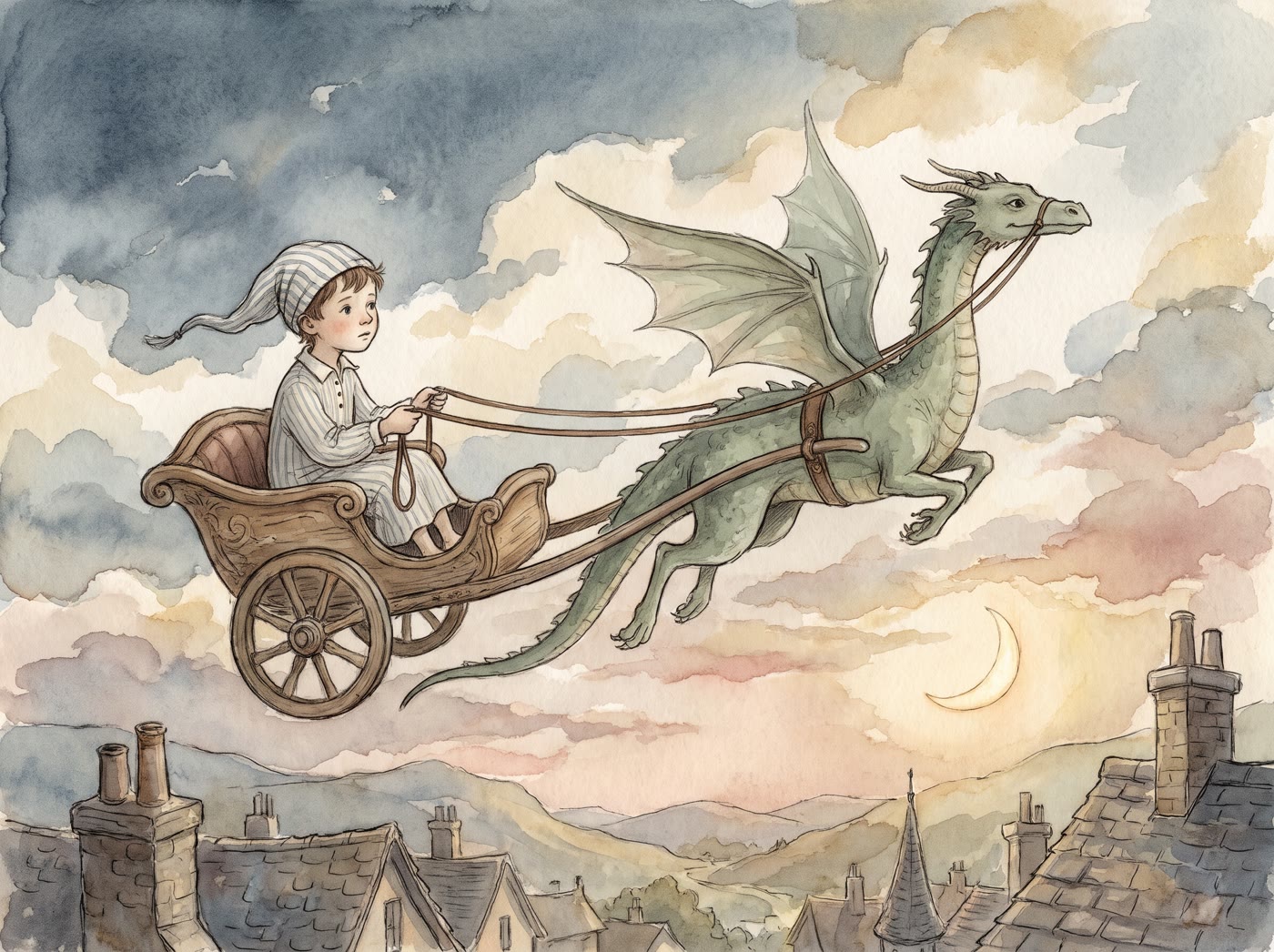
Davy Dolldrum dream’d he drove a Dragon:
Did Davy Dolldrum dream he drove a dragon?
If Davy Dolldrum dream’d he drove a dragon
Where’s the dragon Davy Dolldrum dream’d he drove?
Where the rhyme comes from
The words above are as printed in an 1836 Philadelphia edition of Peter Piper’s Practical Principles of Plain and Perfect Pronunciation, where Davy has the letter D. We give that edition’s wording and spelling, old-fashioned “dream’d” and all; we have not seen the first edition, so we cannot say the 1813 text matches it line for line.
The book was first published in London by John Harris in 1813, according to The Oxford Companion to Children’s Literature. It is an alphabet of tongue twisters, one for each letter, and it is the book in which Peter Piper and his peck of pickled peppers first appeared in print. No author is named in the 1836 printing, whose preface speaks in the voice of “Peter Piper” himself and announces its aim as “to Prevent the Pernicious Prevalence of Perverse Pronunciation”. In that printing Davy is the fourth entry, after Andrew Airpump, Billy Button and Captain Crackskull.
Every entry in the 1836 edition follows the same four-line pattern, and Davy shows it neatly. First a statement: Davy Dolldrum dreamed he drove a dragon. Then a question that repeats it: did he? Then an “if” that sets the statement up once more. Finally a “where’s”, which turns it into a small riddle: where is the dragon he dreamed he drove? Billy Button’s buttered biscuit and Peter Piper’s peppers are handled in just the same way. Modern sites and picture libraries often spell the name “Doldrum”, like the ordinary word; the 1836 edition has two l’s.
What does it mean?
Nothing, by design: it is nonsense built to be hard to say, and we have found no evidence that Davy was a real person or a satire on one. The “where’s the dragon?” closing line is the joke of the pattern — a dream cannot be produced as evidence.
The name. In the early nineteenth century a “doldrum” was a dull, sluggish person, and the plural “doldrums” meant a spell of low spirits; the word is thought to be related to the Old English dol, foolish. The earliest printed use that dictionaries record for the “low spirits” sense is from 1811, two years before the book. The ocean “doldrums” of the sailors’ calms came later, so they have nothing to do with Davy. It is tempting to hear a drowsy dreamer in the name, and that is our reading only: nothing we have found says the author chose it as a pun.
Sharing it with children
The difficulty is the run of d and dr sounds. The tongue wants to say “Drolldum” instead of Dolldrum, and a good deal of the fun is in catching that slip. Say it slowly together first, one line at a time, with a clear d at the front of each word. Then speed up, and see who can get through all four lines without a stumble.
For a quieter game, ask children to draw the dream: Davy, the dragon and whatever he is driving it with. Then ask the book’s own question, “where’s the dragon?”, and let them decide where it went when Davy woke. It works well as a bedtime twister, since the subject is a dream.
Extra verses to sing
These verses aren’t traditional — they’re ours. They borrow the book’s statement-question-if-where pattern: one for a new dreamer, one for Davy once he wakes.
Dilly Dalrymple dreamed she danced with a dolphin:
Did Dilly Dalrymple dream she danced with a dolphin?
If Dilly Dalrymple dreamed she danced with a dolphin,
Where’s the dolphin Dilly Dalrymple dreamed she danced with?
Davy Dolldrum drew the dragon at daybreak:
Did Davy Dolldrum draw the dragon at daybreak?
If Davy Dolldrum drew the dragon at daybreak,
Where’s the dragon Davy Dolldrum drew at daybreak?