Billy Button Bought a Buttered Biscuit
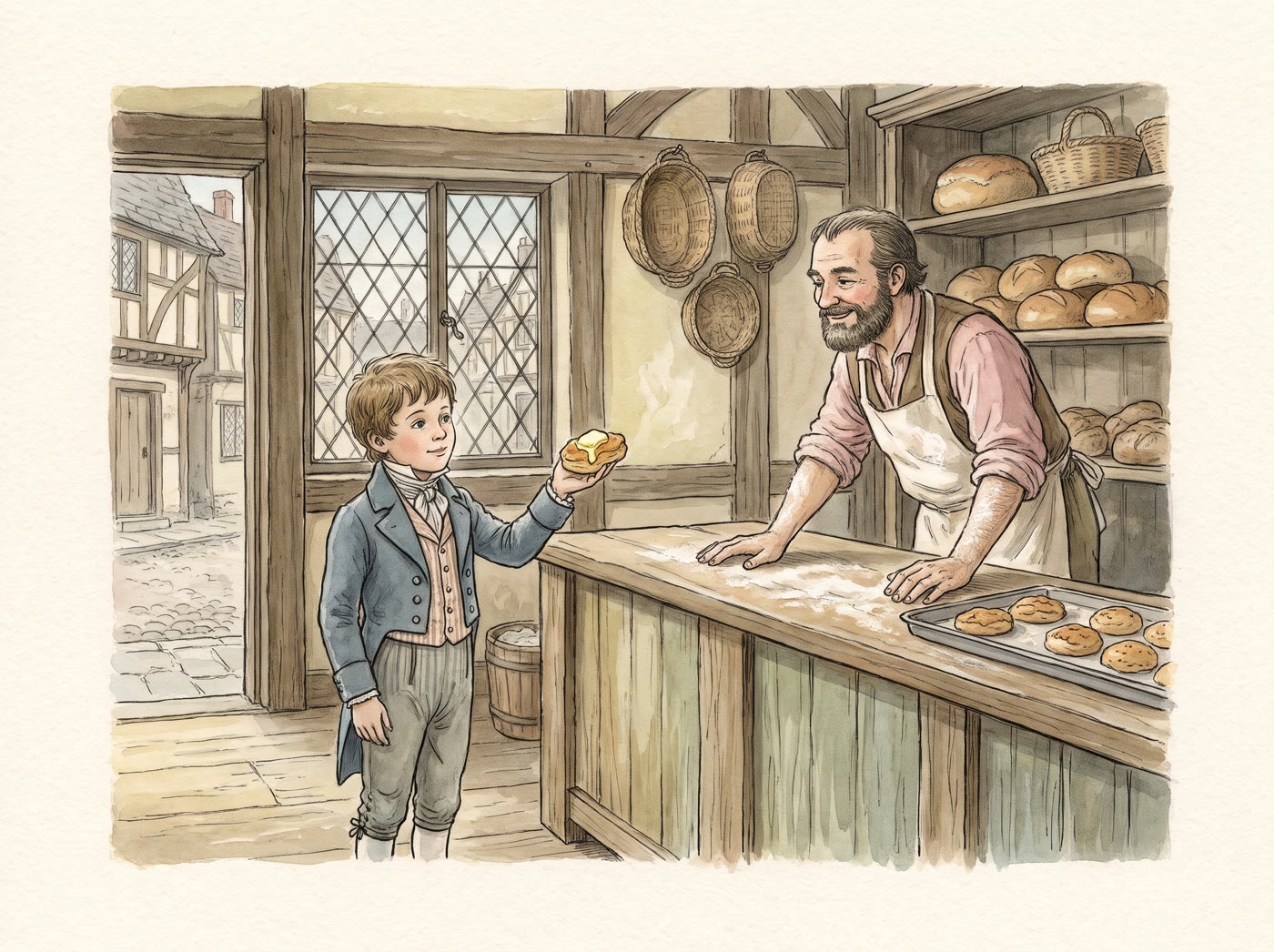
Billy Button bought a buttered biscuit.
Did Billy Button buy a buttered biscuit?
If Billy Button bought a buttered biscuit,
Where’s the buttered biscuit Billy Button bought?
Where the rhyme comes from
This is not the twister about Betty and her bit of butter — that one is Betty Botter. Billy Button is a separate verse, four lines long, built as a statement, a question, a condition and a demand.
Billy Button belongs to Peter Piper’s Practical Principles of Plain and Perfect Pronunciation, an illustrated book of tongue twisters published by John Harris in London in 1813. It gave one twister to nearly every letter of the alphabet, and Billy Button is the verse for B. Nearly all of them follow the same pattern: “If so-and-so did such-and-such, where’s the such-and-such that so-and-so did?” The best known of the set is Peter Piper, which gave the book its name.
The wording above is modernised. The text we have been able to check is the 1836 Philadelphia printing by Willard Johnson, which gives the first line as “Billy Button bought a butter’d Biscuit:” — the apostrophe simply marks the past participle, as in the same book’s “ask’d” and “crack’d”. We have not seen a copy of the 1813 edition, so we do not claim that wording is exactly what Harris printed; editions of the book are known to differ in small details.
The neighbours in the book are a lively crew. In the 1836 printing, Andrew Airpump asks his aunt her ailment, and Captain Crackskull cracks a catchpoll’s cockscomb. The book’s preface is itself a single tongue twister on the letter P, and it presents the whole collection as an aid to “Proper, Plain and Precise Pronunciation”. The 1836 text is credited to no author, and we know of no one who can be named as the writer of the Billy Button verse.
What does it mean?
Nothing that we know of. There is no evidence of a real Billy Button, no hidden story and no folklore to weigh up: the name seems to have been chosen because it begins with the right letter. The book’s own stated purpose is pronunciation practice, and the verse does that job well. We would rather say that the meaning is unknown, beyond the sound-play, than invent one.
Why it trips the tongue. Almost every stressed word starts with the same lip-popping b, and the vowel that follows keeps changing — bought, buy, button, buttered, biscuit. Button and buttered open with the same syllable and then part company, and in quick speech the middle t tends to blur. The second line adds buy among all the boughts, and that switch is an easy one to fumble.
Sharing it with children
Learn it as four separate jobs: say the first line alone until it is comfortable, then add the question, then the “if” line, then the final demand. The child echoes each line back before the next one is added.
Try these games:
Feel the b. Hold a hand in front of your mouth and feel the soft puff of air on each b.
Whisper to shout. Say the verse in a whisper, then at an ordinary volume, then in a great theatrical bellow, keeping every word clear.
Clap on every B. Clap each time a word begins with b and count the claps together at the end.
Make your own. Borrow the book’s pattern for a different letter: a name, an alliterative action, an object. “Katie Kettle kept a kind kitten” sets up the question, the “if” and the “where’s the…” for the next three lines. For a longer challenge, move on to When a Twister a-Twisting.
Extra verses to sing
These verses aren’t traditional — they’re ours. They follow the same four-line pattern, in case you want a second letter to practise.
Katie Kettle kept a kind kitten.
Did Katie Kettle keep a kind kitten?
If Katie Kettle kept a kind kitten,
Where’s the kind kitten Katie Kettle kept?
Sally Sparrow sewed a silver stocking.
Did Sally Sparrow sew a silver stocking?
If Sally Sparrow sewed a silver stocking,
Where’s the silver stocking Sally Sparrow sewed?