A Noisy Noise Annoys an Oyster
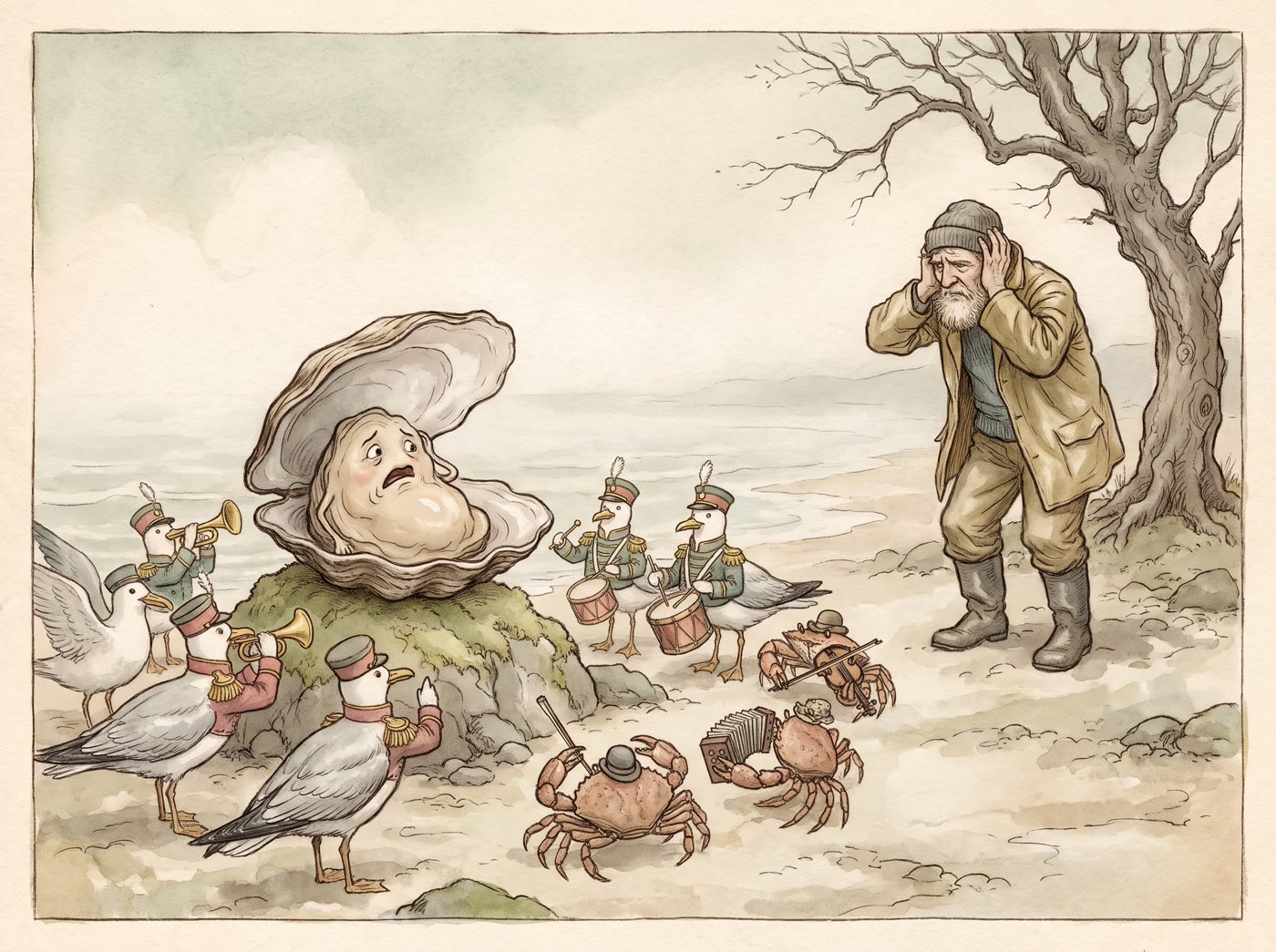
What kind of noise annoys an oyster?
A noisy noise annoys an oyster.
Where the rhyme comes from
Nobody knows who first said it. The twister is anonymous, and the earliest printing we have found is from 1897, in a publication called Wrinkle, where it appears as a little comic verse: a scientist asks what kind of noise annoys an oyster, and a sharp student answers, “A noisy noise annoys an oyster.” That is the earliest we have found, not necessarily the first; an earlier printing may yet turn up.
What the early prints show is a riddle. By 1899 Harper’s Young People was quoting an American newspaper, the Buffalo Express, which asked the question and supplied the answer under the heading “Say This Rapidly”. A report from 1901 describes the party trick: put the question to someone, wait until they have given up guessing, then deliver the answer — and, as the writer puts it, “it’s awful when you say it quickly”. It turns up in a book of riddles in 1905, was used as a shipboard game for children in 1907, and by 1925 a school grammar book was using it as a pronunciation exercise. By the 1920s it was being quoted in passing in British, Australian and New Zealand print as well.
You will also hear it in a longer form — “Any noise annoys an oyster, but a noisy noise annoys an oyster more” — which is common today. We cannot say how old that version is; the early printings we found use the short question and answer, and sometimes end “most” rather than “more”.
Much of the confusion online comes from songs. A music-hall number called A Noise Annoys an Oyster, with words by R. P. Weston and Bert Lee, was published in 1921, and the American entertainer Frank Crumit later recorded a different song built around the same line. Both came after the twister, borrowing a saying already in circulation, and both are separate works from the words above, so we do not reproduce them here. You may also see the twister credited to a famous modern children’s author; that is an unfounded attribution, since the line was in print long before his time.
What does it mean?
Nothing hidden. It is a riddle whose answer is the joke: the question sounds as though it wants a clever reply, and the reply simply hands the question’s own words back, with “noisy” in place of “what kind of”. The pleasure lies in the pun on noise and noisy, and in watching a perfectly easy sentence fall apart the moment you hurry it.
The trouble is in the vowel. Noise, annoys and oyster all carry the same “oi” sound you hear in boy, so the mouth returns to it again and again while the consonants around it keep shifting. And because noisy is almost noise said twice, the tongue is tempted to say “noise noise” or “noisy noisy” instead.
Sharing it with children
Play it the way it was played in 1901: ask the question first, let the child guess, and only then give the answer. Most guesses — a clap of thunder, a seagull — will be wrong and funnier than the real answer.
Then say the answer slowly, a word at a time, and speed up with each round. Try a whispered version and a booming one; saying “a noisy noise” quietly is harder than it sounds. Clap on every “oi” to feel the rhythm, or see how many clean repetitions you can manage in ten seconds.
The twister is also a gentle drill for one vowel. Hunt for other “oi” words together — boy, toy, coin, join, voice, oil — and see who can name the most. For a quieter game, let the child be the oyster: whenever you make a noise, they snap shut and freeze, and open again when it is calm.
Extra verses to sing
These verses aren’t traditional — they’re ours. Try them once the first lines come easily.
What kind of toy annoys a boy?
A noisy toy annoys a boy.
What kind of voice annoys a choir?
A noisy voice annoys a choir.