The Seething Sea Ceaseth
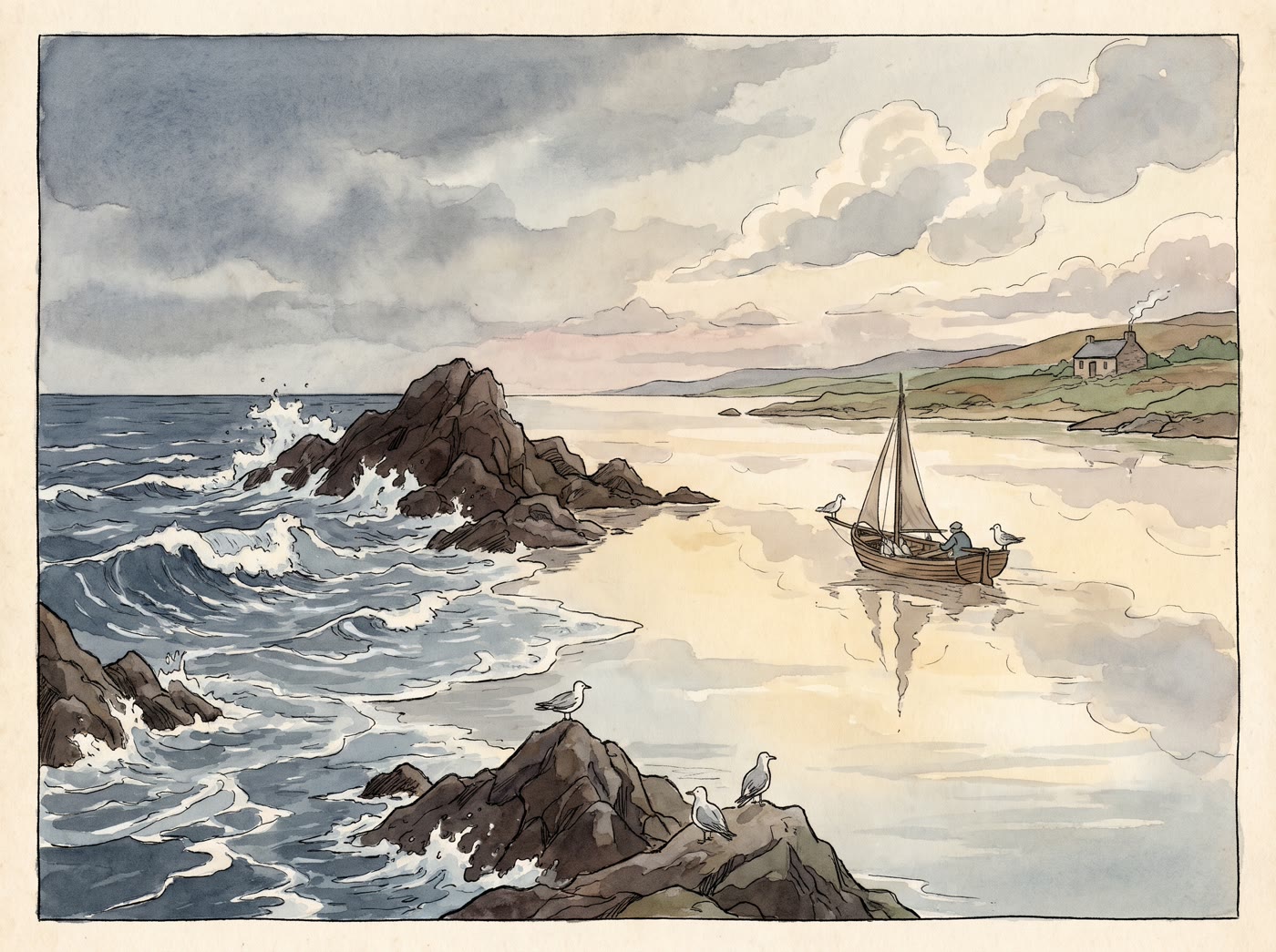
The seething sea ceaseth and thus the seething sea sufficeth us.
That is the famous wording. An older and shorter one runs: The sea ceaseth and it sufficeth us. Other versions turn up too — “and so sufficeth us” is one — because this is a line passed from speaker to speaker rather than a fixed text.
Where the rhyme comes from
Nobody knows who wrote it. The earliest printing we have found is in Abraham Reeser Horne’s Pennsylvania German Manual, for Pronouncing, Speaking and Writing English, a guide for schools and families published in 1875, where the twister sits in a list of articulation drills. The extract we have seen reads “…sea ceaseth and that sufficeth us” — the shorter ending, with “that” in place of “it”. It begins mid-line, so we cannot say what came before “sea”. Nor can we say this is the first appearance, only the earliest we could trace.
From there the short form spreads through the school and elocution world. It is listed in St. Nicholas, the illustrated magazine for young folks, in 1894, as “…sea ceaseth, but it sufficeth us”; in a Friday-afternoon recitation list in the Michigan School Moderator in 1898; in Pattengill’s A Manual of Orthography and Elementary Sounds in 1912 and 1916; and in Woolbert and Weaver’s Better Speech: A Textbook of Speech Training for Secondary Schools in 1922. The company it keeps is telling: “She sells sea shells” and “High roller, low roller, lower roller” appear in several of the same lists. This was a speech exercise first and a party trick second. The earliest printings we traced are American.
The longer “seething sea … thus” wording is later, as far as we can document it. The earliest printings of it that we found are from 1932, in the trade papers The Billboard and The Musical Leader. The Billboard quotes it in a report on the test sentences the broadcaster NBC set for would-be applicants, and both papers say a line was being dropped. We have seen only short extracts, so treat that as a pointer rather than proof of a long tradition. In February 1955 the Library of Congress folklorist Duncan Emrich printed the long form, as sent in by radio listeners, in American Heritage, in an article called “The Ancient Game of Tongue-twisters”.
You will often see it called the hardest tongue twister in English. That title comes from the writer William Poundstone, who declared it “the most difficult of common English-language tongue twisters” on the strength of tests on American speakers; we have not seen the tests, and others have nominated rivals. Enjoy it as a boast, not a fact.
What does it mean?
More than you might think, though the sound clearly came first. Ceaseth and sufficeth are old-fashioned third-person forms of “ceases” and “suffices” — the -eth ending that English later swapped for -s, and one readers know from the King James Bible. Seething means boiling or churning. So: the stormy sea grows calm, and that calm sea is enough for us.
Readers do puzzle over how a sea could “suffice” anyone. The kindest reading is that a calm sea gives us all we need; the plainest is that the sentence was built to be difficult to say, and sense is secondary. One blogger has suggested the phrasing was inspired by scripture; that is a guess, and we have found nothing to support it.
The Leith connection. The twister is often listed alongside The Leith Police Dismisseth Us, which shares its old-fashioned ending and its s-and-th workout.
Sharing it with children
This twister is a drill in one contrast. For s, the tongue tip sits just behind the upper teeth; for th, it slips forward between them. The line alternates the two relentlessly: seething, sea, ceaseth, thus, sufficeth. Say “ceaseth” as SEE-seth, not “ceased”.
Start slowly, a few words at a time, and build the line up like a chain: one person says “seething sea”, the next adds “ceaseth”, and so on round the circle. Then go slow-then-fast, and try a whispered round, which is harder than it sounds.
Add actions. Roll both hands in big, boiling waves for “seething sea”, then lay one flat, quiet palm down for “ceaseth” and hold the hush. Tap the beat on your knees as you go. If a child has trouble with s and th, keep it light and unhurried; it is a tricky pair of sounds for many.
Extra verses to sing
These lines aren’t traditional — they’re ours. They borrow the old -eth style, so try them once the first line comes easily.
The thrashing tide thinneth and thus the thrashing tide thanketh us.
The sulking surf stilleth and so the sulking surf soothes us.