Thomas a Tattamus Took Two T’s
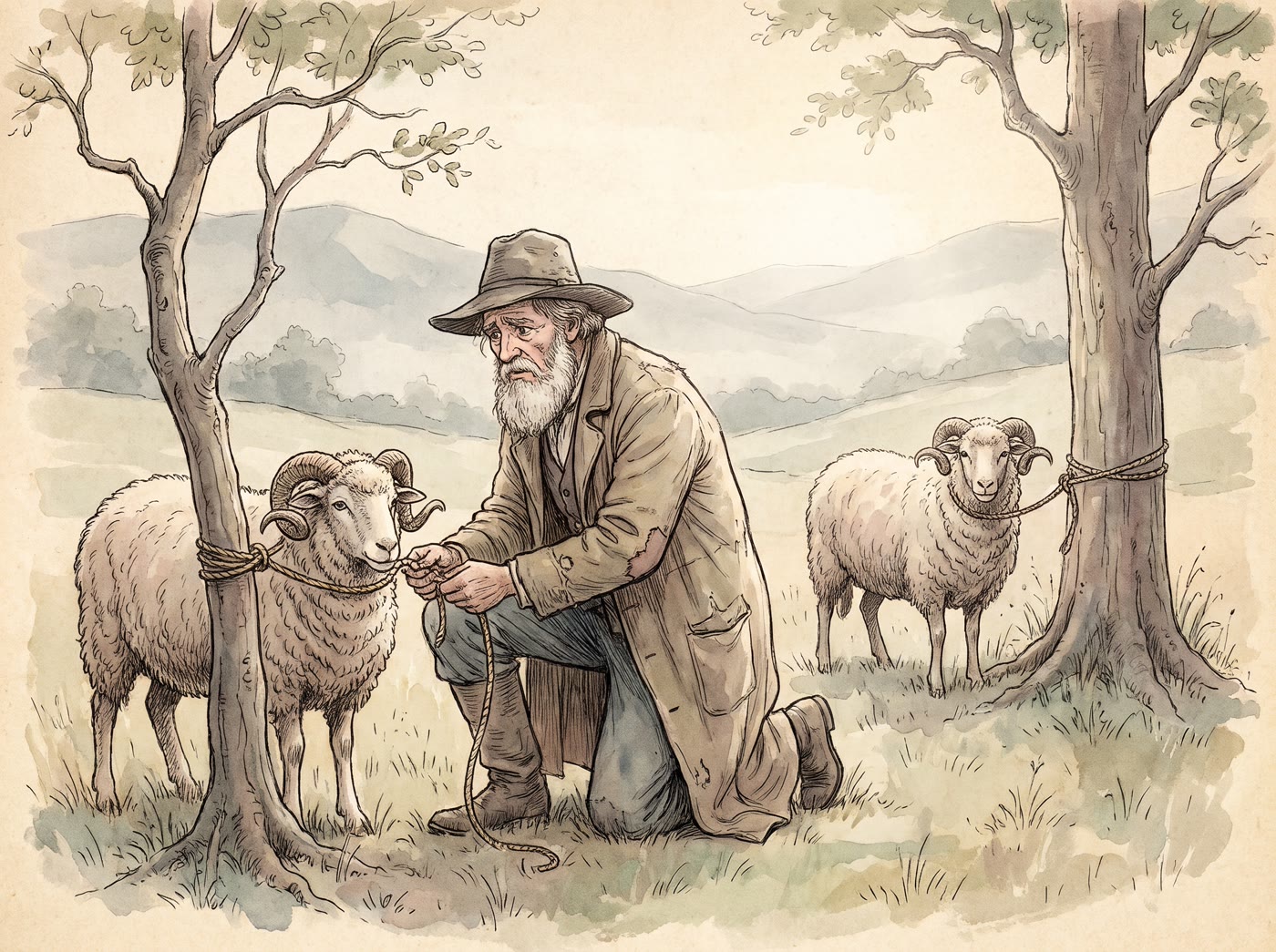
Thomas a Tattamus took two Ts,
To tie two tups to two tall trees,
To frighten the terrible Thomas a Tattamus!
Tell me how many Ts there are in all THAT.
Where the rhyme comes from
This one began its printed life as a riddle, and only later became a tongue twister. James Orchard Halliwell included it in The Nursery Rhymes of England, where it stands in the “Riddles” class of the fourth edition of 1846. It is there again, in the same class and with the same four lines, in the fifth edition of 1886. Later collectors kept it with the puzzles too: Andrew Lang put it among the “Riddles and Paradoxes” of his Nursery Rhyme Book, illustrated by L. Leslie Brooke, and Charles Welsh printed it in A Book of Nursery Rhymes (1901), in a section of child play that includes riddles.
Halliwell’s 1846 edition is the earliest printing we have been able to confirm; whether it appeared in his earlier editions, or anywhere before him, we do not know. Nor does anyone know who Thomas a Tattamus was, who made the rhyme, or where the odd name comes from. The collections give no origin story and no comment, and we have no theory to offer in their place.
The wording drifts a little between books. Halliwell prints “Ts” and ends on a capitalised “THAT”; later collections vary a little in how they spell the letters and in the wording of the last line. The words above are Halliwell’s. Many modern versions respell the letters as “tees”; none of the older books we checked does.
What does it mean?
Very little, and that is rather the point: the lines are there for the sound. Most of the words begin with a T, and the name itself, Tattamus, has three of them.
What is a tup? A tup is an old word for a ram, a male sheep. It is the one word likely to stop a grown-up reader short — it is easily misheard as “tubs” — so say it aloud once before you begin: two rams, tied to two tall trees.
The riddle. The final line asks how many Ts there are “in all that”. The tempting answer is to count every T in the verse. The answer usually given today is two: the Ts in the word that itself, T-H-A-T. Halliwell’s capitalised “THAT” looks like a hint to that reading, though that is our interpretation. Halliwell supplies answers to many of his other riddles but prints none for this one, and neither does Lang, so “two” is the answer people have settled on rather than one the old books record.
Sharing it with children
With a small child, treat it as a sound game. Say it slowly, leaning on each T until the tongue taps the ridge behind the top teeth, then say it again a little faster, and again faster still. Ask them to listen for the “t” and clap each time they hear one.
With an older child, play it as it was collected: as a riddle. Recite the verse straight-faced, ask the last line, and see who sets off counting every T in the verse. Then reveal that the question only asked about the word that. It makes a useful, gentle lesson in reading a question carefully. You can also pull apart the T sounds and the T letters: write the verse out and let a child underline each T, then notice that some words which begin with the letter — the, there, that — do not begin with the sound.
In a classroom, draw the two tups tied to two tall trees, and count them: two, two, two. When the T sounds come easily, try Three Grey Geese, another short twister to say slowly and then faster, which trips the tongue on grey and green instead.
Extra verses to sing
These verses aren’t traditional — they’re ours. Try them once the original is comfortable, and keep the final question.
Tabitha Tuttle took two tin trays,
To tote ten tarts on two tea-time days,
To tempt the tardy, tiny Tabitha Tuttle —
Tell me how many Ts there are in all THAT.