As I Was Going to St Ives
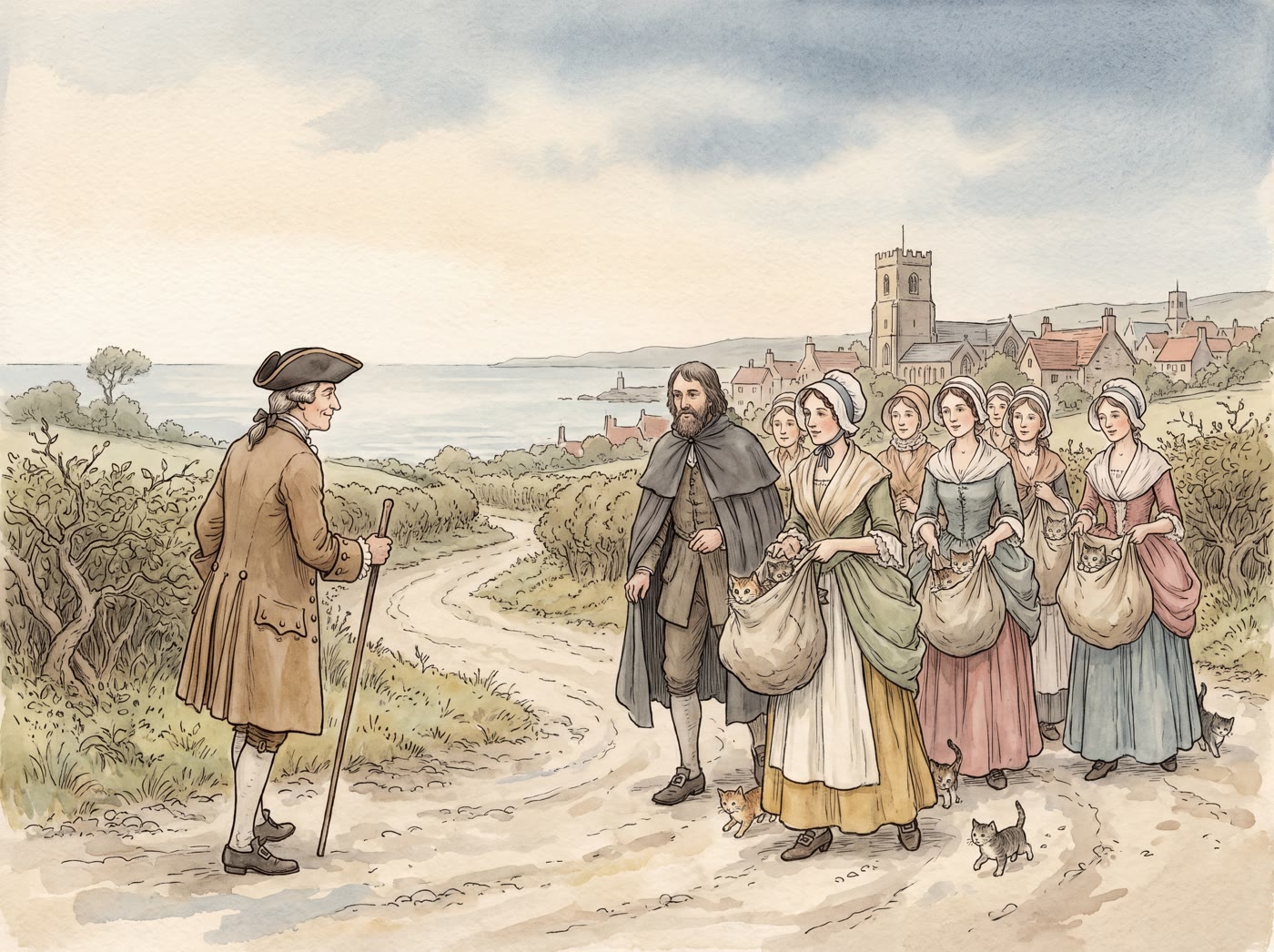
As I was going to St Ives,
I met a man with seven wives,
Each wife had seven sacks,
Each sack had seven cats,
Each cat had seven kits:
Kits, cats, sacks, and wives,
How many were there going to St Ives?
Where the rhyme comes from
Nobody knows who made this riddle, and it is older than its familiar words. The earliest known version is in a manuscript of about 1730, Harley MS 7316 in the British Library — and it counts in nines, not sevens: “As I went to St Ives / I met Nine Wives / And every Wife had nine Sacs, / And every Sac had nine Cats / And every Cat had nine Kittens.” There is no man in it at all.
The sevens arrive in print in Edinburgh. On 4 August 1779 The Weekly Magazine, or Edinburgh Amusement printed the riddle under the title “A Simple Question”: “As I was going to St Ives, / Upon the road I met seven wives; / Every wife had seven sacks, / Every sack had seven cats, / Every cat had seven kits: / Kits, cats, sacks, and wives, / How many were going to St Ives?” The arguing started at once. On 8 September a correspondent signing as “Philo-Rhithmus” sent the magazine a reply in verse, making the case that only the narrator was going there — and adding that even if the wives were, the rest were all being carried, so no more than eight could be said to go.
The man with seven wives is a later arrival still. He is in print by 1837, in Robert Chambers’s “A Hoax Extraordinary” in Chambers’s Edinburgh Journal. By 1912 Arthur Rackham was illustrating it for St Nicholas magazine, and it has kept travelling since: it turns up in places as different as a 1990s action film and a children’s television sketch. Folklorists file it as Roud 19772.
Which St Ives? Nobody can say. It is generally thought to be St Ives in Cornwall, once a busy fishing port where, the argument runs, plenty of cats were kept to stop rats and mice spoiling the fishing gear. Others make the case for St Ives in Cambridgeshire, an ancient market town and just as plausible a place to be walking to. Both arguments were made long after the rhyme was first written down; nothing in the early texts settles the question.
What does it mean?
This is a riddle first and a rhyme second, and three answers can be defended.
One. The traditional answer. Only the narrator is said to be going to St Ives; the man and his household, the reasoning goes, were met coming the other way. The trick is that the listener starts multiplying.
2,801 — or 2,802. The rhyme never actually says the man was coming from St Ives. To “meet” someone on the road can mean falling in with them, travelling the same way. If the whole party is bound for St Ives, the sum is one man, 7 wives, 49 sacks, 343 cats and 2,401 kits: 2,801. Add the narrator and it is 2,802.
None. Read the last two lines strictly and the question asks only about “kits, cats, sacks, and wives”. If only the narrator was going, the answer is zero.
The honest verdict: the words do not choose between them, which is why people have argued since 1779.
Older puzzles with the same shape. The Rhind Mathematical Papyrus, an Egyptian text copied around 1550 BC and now in the British Museum, contains a Problem 79 that lists 7 houses, 49 cats, 343 mice, 2,401 ears of spelt and 16,807 measures of grain. The papyrus gives only the bare table; the story of cats eating mice eating grain is a modern paraphrase. In 1202 Fibonacci’s Liber Abaci set a puzzle of seven old men going to Rome, each with seven mules, each mule carrying seven sacks, with loaves, knives and scabbards in sevens beneath them. These are parallels, not ancestors: the same delight in powers of seven, with no evidence of a line running from either to the English rhyme.
Sharing it with children
Act it out. Seven of everything is a great many toys, so shrink the numbers for small children: a man with two wives, each wife with two bags, each bag with two toy cats. Count everyone out, march the narrator one way and the household the other, and ask the question.
Which way were they going? Once the trick answer is known, ask whether the rhyme really proves it. A child who notices that “met” doesn’t say which direction has spotted exactly what adults have argued about since 1779.
Work out the big number. With older children, build it a line at a time on paper: 7 wives, 7 times 7 is 49 sacks, 49 times 7 is 343 cats, 343 times 7 is 2,401 kits. Then add them up together.
Make your own. Choose a place, a number and a chain of things — three is plenty — and keep the sting in the last line.
Extra verses to sing
These verses aren’t traditional — they’re ours. The first is for anyone who wants to know how the trip turned out; the second is a smaller riddle in the same shape, with numbers young children can count on their fingers.
As I came home from St Ives,
I met that man and his seven wives;
The sacks were empty, the cats had fled,
The kits were curled in a hay-cart bed:
Kits, cats, sacks, and wives,
How many were left in St Ives?
As I was walking to the shore,
I met a cat with kittens four;
Each kitten had a ball of string,
Each ball a silver bell to ring:
Bells, balls, kittens, cat,
How many were walking to the shore at that?