One for the Money, Two for the Show
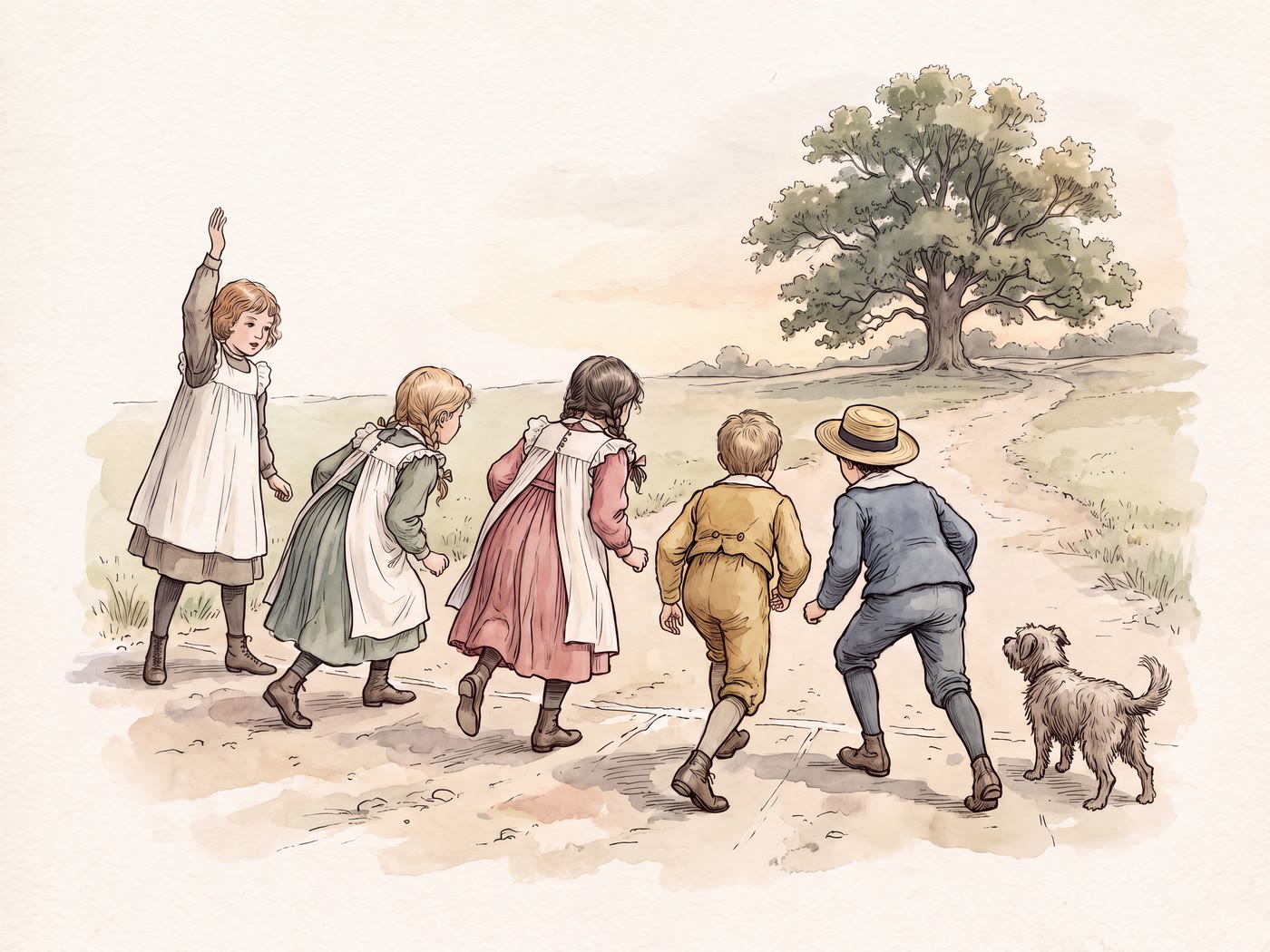
One for the money,
Two for the show;
Three to make ready,
And four to go.
One for the money,
Two for the show;
Three to get ready,
And four to go.
Where the rhyme comes from
Most grown-ups know this line as the opening of a rock-and-roll record. The rhyme is a good deal older than that: it is an anonymous children’s chant, recorded throughout the nineteenth century, for getting a race or a game under way. Who first said it is not known, and no source names an author.
Its four-beat countdown shape appears in print by 1828. The Connecticut Herald of 4 November that year quotes a chant for setting a child swinging: “One to make ready, and two to prepare, / Three to go slam bang, and four to go there!” The words are different, but the scaffolding — four counts, with the “go” saved for last — is already in place. In 1832 the Bristol Job Nott gives a swinging chant of the same kind, and a cousin turns up in The Knickerbocker magazine in March 1856: “One to begin, Two to show; Three to make ready, Four to go!”
The familiar wording is in print by 1872, when the magazine The Little Corporal gives “One for the money, two for the show, three to make ready, and four for to go!” In 1888 Henry Carrington Bolton set it down in The Counting-Out Rhymes of Children, among the rhymes for special games: “One for the money, two for the show; / Three to make ready, four for the go!” He had it from New York and West Tennessee, and noted that it was “used to start children in a game, as a race”.
“Three to make ready” is the older wording, and the one the nineteenth-century printings agree on. “Three to get ready” is how most people say it now. Both are given above; neither is wrong.
The reason the line is so widely known today is Blue Suede Shoes, written and first recorded by Carl Perkins in 1955 and recorded by Elvis Presley for his debut album in 1956. The song opens with a variation on the rhyme. Perkins borrowed it rather than invented it — by then the countdown it belongs to had been in print for well over a century.
What does it mean?
It is a count-in — the playground’s version of “ready, steady, go”. The first two counts hold the runners on the line, the third gets them crouched and set, and the fourth releases them. That is its honest meaning, and it is exactly what Bolton’s note says: a rhyme to start a game.
Why “money”, and why “show”? Nobody knows. No source, early or late, explains why these particular words were chosen; beyond the fact that “show” rhymes neatly with “go”, the choice is simply unexplained.
The horse-racing theory. It is often said online that the words come from betting at the races, where a horse can win, place or “show” — so “money” would be the winning bet and “show” the bet of the same name. It is a tidy idea, but it is folk etymology: it is offered as a guess in forums and phrase blogs, and nobody has traced it to a single document connecting the rhyme to racing terms. The earliest printings, meanwhile, are about children swinging and running, not horses.
Sharing it with children
The starting pistol. Line up two or three children — or a child and a teddy — at one end of the garden or hall and let the rhyme start the race. Say the first three lines slowly and the last one fast, so the “go” comes as a lovely jolt. Children soon want to be the one who calls it, which is half the fun.
The getting-ready chant. The rhyme is built for the moment before leaving the house: one for the coat, two for the shoes, three for the zip, and on “four to go” out of the door. A small ritual like this turns a tussle into a countdown.
The counting march. March on the spot, one stamp for each line, and hold up a finger on each count — one, two, three, four. Then count back down, four to one, for a gentle finish.
What happens on five? Once the rhyme is known, ask what comes next. “Five for the puddle”? “Six for the slide”? Making up a line that rhymes and keeps the beat is good early practice in both, and the sillier answers are usually the best ones.
Extra verses to sing
These verses aren’t traditional — they’re ours. Use them when the counting needs to carry on past four.
One for the coat-peg,
Two for the hat;
Three for the wellies,
And four — that is that.
Five for the puddles,
Six for the rain;
Seven to splash in,
And eight home again.