The Leith Police Dismisseth Us
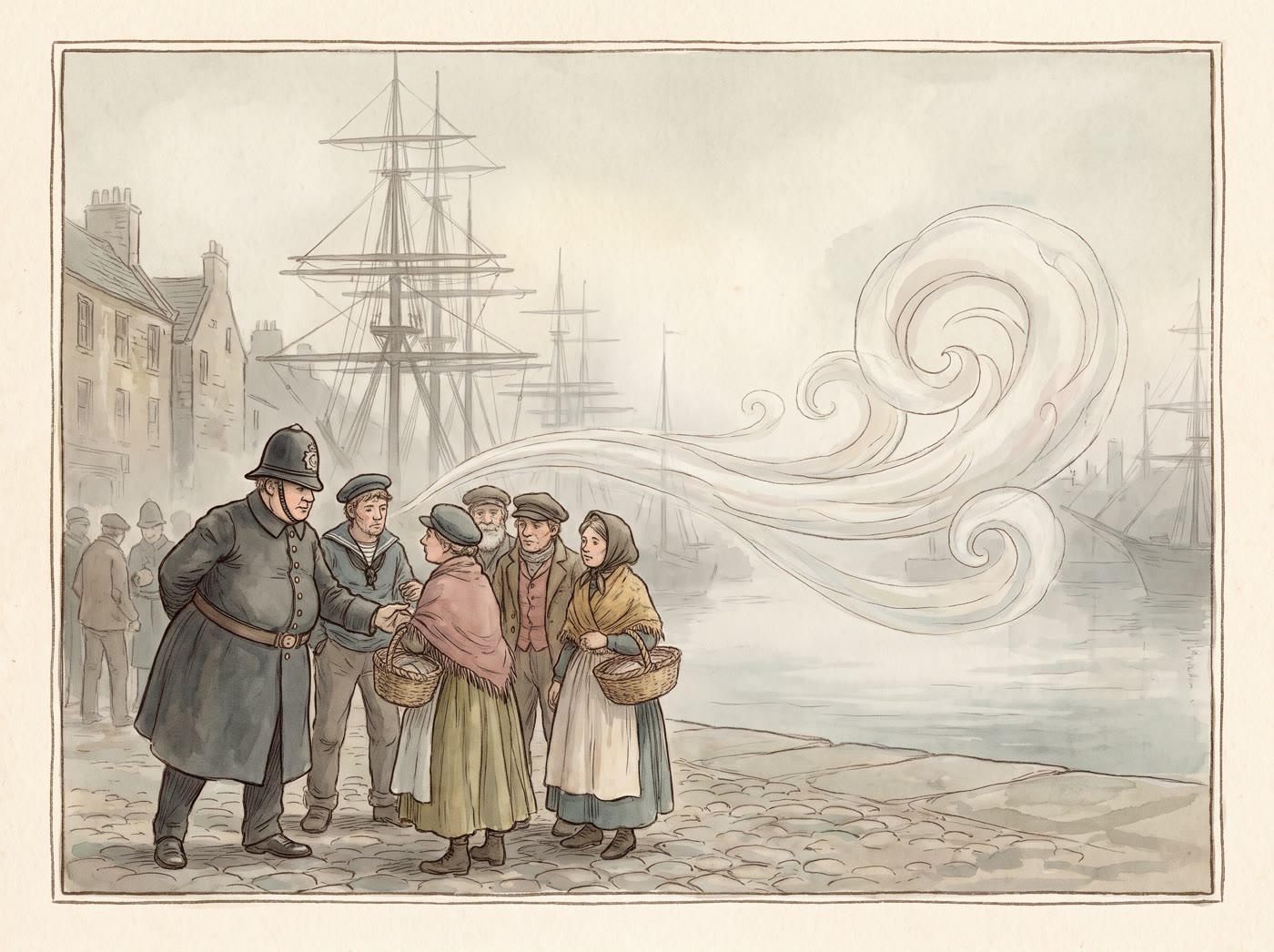
The Leith police dismisseth us.
The Leith police dismisseth us,
I’m thankful, sir, to say;
The Leith police dismisseth us,
They thought we sought to stay.
The Leith police dismisseth us,
We both sighed sighs apiece;
And the sigh that we sighed as we said goodbye
Was the size of the Leith police.
The single line is the older form: the earliest printings give it on its own, in lists of tongue twisters. The verse is a longer, looser relation that turns up in print later. Neither has one fixed text. Some versions — one dated 1927 among them — begin “I’m sorry, sir, to say” rather than “I’m thankful, sir”, some add a line about staying all day, and some end “which caused us many sighs” before the sighs and the size of the police. Treat the words above as one well-circulated wording, not the original.
Where the rhyme comes from
The author is unknown, and the first thing to say about the history is that it may have little to do with Leith. According to newspaper research by the Edinburgh history blog Threadinburgh, the earliest printing found so far is American: the Boston magazine The Youth’s Companion listed the line among “verbal snares” in October 1887. The same research finds it in a British paper, the Irvine Times, that December, sitting in lists beside twisters that are still familiar today. These early dates rest on that one blog’s reading of the newspapers, so they are best held lightly; an earlier printing could yet turn up.
Threadinburgh also notes that the line resembles an earlier American twister, given variously as The Sea Ceaseth and Dismisseth Us With His Blessing or The Sea Ceaseth and That Sufficeth Us, and thinks it likely that such lines were made for elocution practice and inspired by the cadence of biblical verse. That is an inference, not a documented fact, but the archaic “-eth” ending does sound more like a pulpit than a police station.
In 1909, according to the same research, the trade paper Variety announced that the music-hall comedian Wilkie Bard was bringing “a new tongue twister” called The Leith Police Dismisseth Us to London theatres, with an assistant who did “a lisping souse”. That shows him performing it, not writing it; nobody has shown who wrote the words. A fuller version in verse is said to appear in The Children’s Newspaper in 1919.
The police themselves were real. Leith, then a burgh in its own right, had its own burgh police from 1859, until the force was merged into the Edinburgh City Police in 1920 — it paraded for the last time on 2 November that year. Whether the twister was ever really about them, or whether Leith simply makes a good sonorous place name, nobody has established.
What does it mean?
Nothing much, and happily so. The verse is comic nonsense about being politely sent away and sighing sighs as big as the police. The joke is in the sounds: a clutch of s and voiceless th sounds, and “sighs”, “size” and “sighed” all rhyming with each other.
The sobriety-test story. You will often read that Leith police used the line as a test of whether someone could speak clearly. It is widely repeated, but we found no evidence from Leith itself. The earliest discussion we found is an Australian newspaper report of April 1937, in the Morning Bulletin of Rockhampton, which describes the line as a proposed test in a motoring context; a Melbourne magistrate is quoted as declining to try it. That is half a century after the first printing, and it shows the idea was in the air, not that any force used it. Treat it as a tradition and a good story.
Sharing it with children
Begin with the single line, because the trap is in the s and th sounds. Say s with the tongue behind the teeth and th with the tongue tip peeking out between them; “dismisseth” ends on that very swap, and a stray lisp turns it into something else entirely. Threadinburgh notes that the rhyme is still used in elocution for learners of English working on these two sounds.
Then play. Say the line slowly, then at normal speed, then as fast as clarity allows. Pass it round a circle in a whisper, which is harder than it sounds — the same game works with How Many Yaks. Clap the stresses — the LEITH po-LICE dis-MISS-eth US — so the rhythm carries the tongue. For the verse, give each child one line and speed up with every lap, and have everyone take a big pretend sigh on the “sighs” line. For something in the same family, see the sneaky s and th of Theophilus Thistle below.
Extra verses to sing
These verses aren’t traditional — they’re ours. Try them once the first verse runs smoothly.
The Leith police dismisseth us,
We bowed and said goodbye;
The Leith police dismisseth us,
We waved and watched them sigh.
The Leith police dismisseth us,
So off we strolled at six;
And the sighs that we sighed on the harbour side
Were as thick as a thistle-fix.