Theophilus Thistle
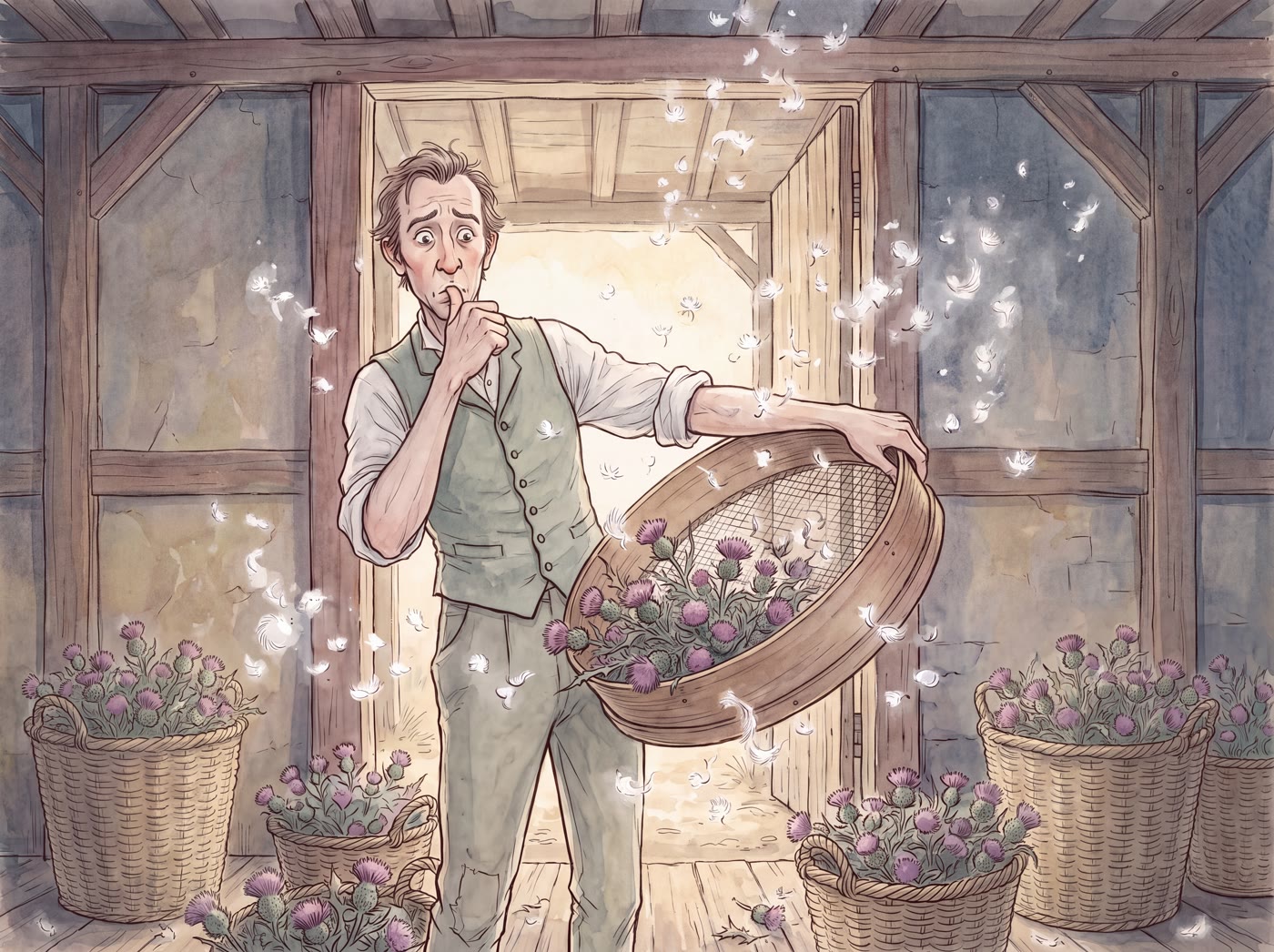
Theophilus Thistle, the successful thistle-sifter,
while sifting a sieve-full of unsifted thistles,
thrust three thousand thistles
through the thick of his thumb.
Now if Theophilus Thistle,
while sifting a sieve-full of unsifted thistles,
thrust three thousand thistles
through the thick of his thumb,
see that thou, while sifting a sieve-full of unsifted thistles,
thrust not three thousand thistles
through the thick of thy thumb.
Success to the successful thistle-sifter!
Theophilus Thistle, the Thistle Sifter,
sifted a sieve of unsifted thistles.
If Theophilus Thistle, the Thistle Sifter,
sifted a sieve of unsifted thistles,
where is the sieve of un-sifted thistles
Theophilus Thistle, the Thistle Sifter, sifted?
Where the rhyme comes from
Two traditional versions circulate, and both are given above. The first is the long one — the thumb, the stern warning to “see that thou” do better, and a closing cheer for the successful thistle-sifter. The second is shorter and ends in a question: where, then, is the sieve? Nobody knows who wrote either of them.
The earliest dated printing we have been able to trace is in Leonard G. Nattkemper and George Wharton James’s Delight and Power in Speech: A Universal Dramatic Reader (Pasadena, 1919), where the long version appears in a chapter of articulation exercises, alongside drills for p, wh, f, th, s and other breathy sounds. That is a lower limit, not a birthday. Elocution books had been printing tongue twisters as drills for decades before — J. W. Shoemaker’s Practical Elocution (Philadelphia, 1878) is one example of the genre — but nothing yet found puts Theophilus himself in print before 1919, and the standard nursery-rhyme scholarship, including the Opies’ Oxford Dictionary of Nursery Rhymes, is silent on him.
By the middle of the century he was firmly established. In February 1955 Duncan Emrich, writing “The Ancient Game of Tongue-twisters” for American Heritage on behalf of the Library of Congress’s Folklore Section, ranked Theophilus Thistle with Bitty Batter (our Betty Botter) as a hardy favourite, nearly as popular as Peter Piper.
Two later appearances explain some of the muddle online. In P. G. Wodehouse’s Jeeves and the Feudal Spirit, Bertie Wooster asks Jeeves to say a garbled cousin of the twister — “Theodore Oswaldtwistle, the thistle sifter, sifting a sack of thistles thrust three thorns through the thick of his thumb” — to prove he is not intoxicated, and Jeeves delivers it perfectly. And the Australian dance act Sonic Animation built a track called “Theophilus Thistler” around the traditional lines, which probably explains why the name is so often given online as “Thistler”. The twister is the older thing; the song borrowed it.
What does it mean?
Nothing beyond the sounds, and that is the honest answer. There is no evidence of a real Theophilus or a real trade of thistle-sifting; the name, like Peter Piper’s, appears to have been chosen purely because it is awkward to say.
A drill, not a story. The 1919 reader says as much by putting it among its articulation exercises. The difficulty is mechanical. For the th in thistle, thick and thumb, the tongue tip sits against the teeth; for the s in sift and sieve, it pulls back just behind them. The twister makes you switch between the two again and again, then adds thr — thrust, three, through — which drags the tongue from the teeth back towards an r almost without pause. That constant switching is exactly why it has been used for articulation practice since at least 1919 — and why it is a real workout for a young speaker.
Sharing it with children
Start with the short version, and say it slowly enough that every th and every s can be heard as a different sound — a fingertip in front of the lips will feel the breath of both. Then try the challenge at its core: who can say “three thousand thistles” three times, cleanly, without it turning into “free fousand”?
Whispering is a good trick here, because a whisper hides nothing: the th and s must be made precisely or they vanish. Children who know the long version can mime it as they go — shaking an imaginary sieve, pricking a thumb with a theatrical wince, wagging a finger at “see that thou” — and the actions help them remember which half comes next. The prickle is pure comedy, and fine for any classroom. Speech therapists and teachers working on the th sound will find the short version a useful drill.
Extra verses to sing
These verses aren’t traditional — they’re ours. Try them once Theophilus is behaving himself.
Theodora Thimble, the thrifty thimble-threader,
while threading a thimble-full of unthreaded thread,
thought three thousand thoughts
through the thick of her thimble,
and thanked the thistle-sifter for the thistle-thread instead.
If Theophilus Thistle sifts thistles on Thursday,
and sifts the same thistles on Saturday too,
then the thistles he thrusts through the thick of his thumb
are a thousand times thicker than thistles should do.