A Flea and a Fly
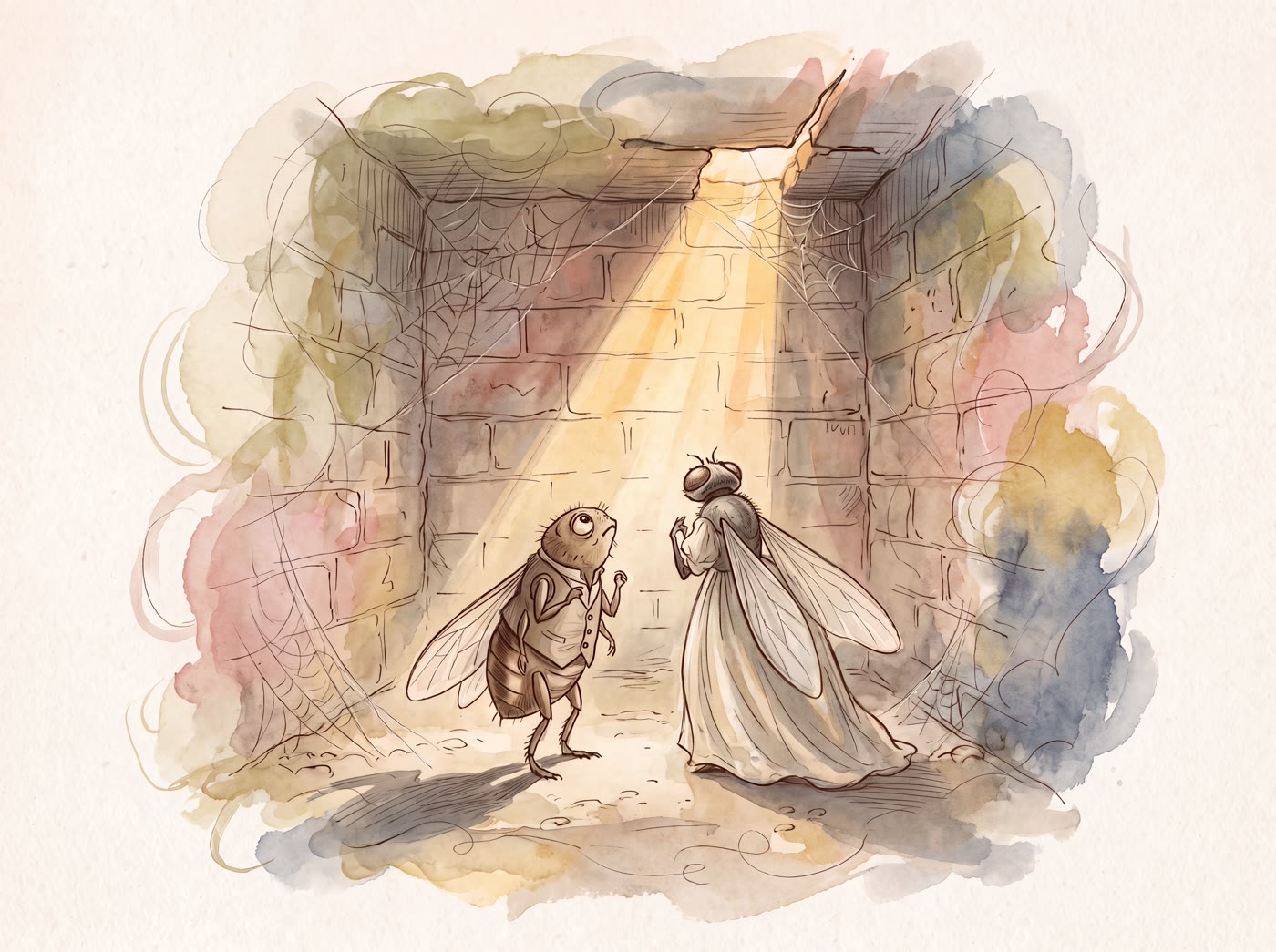
A flea and a fly in a flue
Were imprisoned, so what could they do?
Said the fly, “Let us flee!”
“Let us fly!” said the flea.
So they flew through a flaw in the flue.
Where the rhyme comes from
This is a limerick as well as a tongue twister — five lines with the classic aabba rhyme, all of them built on the same “fl” sound. A version appeared in the American weekly The Independent in 1905 under the title “Flea, Fly, Flue”, which makes it comfortably older than the poet it is most often credited to.
You will see it attributed all over the internet to Ogden Nash, the great American writer of comic verse. Nash was born in 1902, so he was a toddler when the rhyme was already in print; the attribution is best treated as folklore. Like most popular tongue twisters, its true author is unknown, and it circulated in several forms — one longer variant begins “A flea and a fly flew up in a flue” — before settling into the tidy limerick children learn today.
What does it mean?
On the surface it is simply a tiny escape story. A flue is the pipe or chimney shaft that carries smoke away from a fire; two insects find themselves shut inside one, and a flaw — a crack in the brickwork — lets them out.
The real joke is linguistic. “Flee” and “flea”, “fly” the verb and “fly” the insect, sound identical, so each creature gives advice that describes the other. Some teachers offer a moral — keep your head and look for the way out — but there is no evidence the rhyme was written to teach anything. It was almost certainly made for the pleasure of the sounds, and it survives because saying it well is genuinely difficult: the “fl” blend forces the tongue tip and lips to work together at speed.
Sharing it with children
Start slowly. Say one line at a time and let children echo it back, exaggerating the “fl” so the tongue really touches behind the top teeth. Once the whole verse is steady, turn it into a speed challenge: three clean run-throughs before you can play it fast, then race a sand timer or count how many times a child can get through it in thirty seconds without a stumble.
Stumbles are the fun part — make them the prize rather than the penalty. Older children enjoy hunting the homophones (flee/flea, fly/fly, flew/flue/flu) and drawing the crack in the chimney that saved the day. It is a fine warm-up for singing or reading aloud, and a useful practice rhyme for anyone working on the “fl” blend.
Extra verses to sing
These verses aren’t traditional — they’re ours. Try them once the first one is fast and clean.
A flea and a fly on a floe
Were freezing, with nowhere to go.
Said the flea, “We shall float!”
Said the fly, “Fetch a coat!”
So they flew from the floe in the snow.
A fly and a flea in a flask
Were fluttering — who could they ask?
Said the fly, “Flap with me!”
Said the flea, “Flick me free!”
And they flipped off the top of the flask.