Amidst the Mists and Coldest Frosts
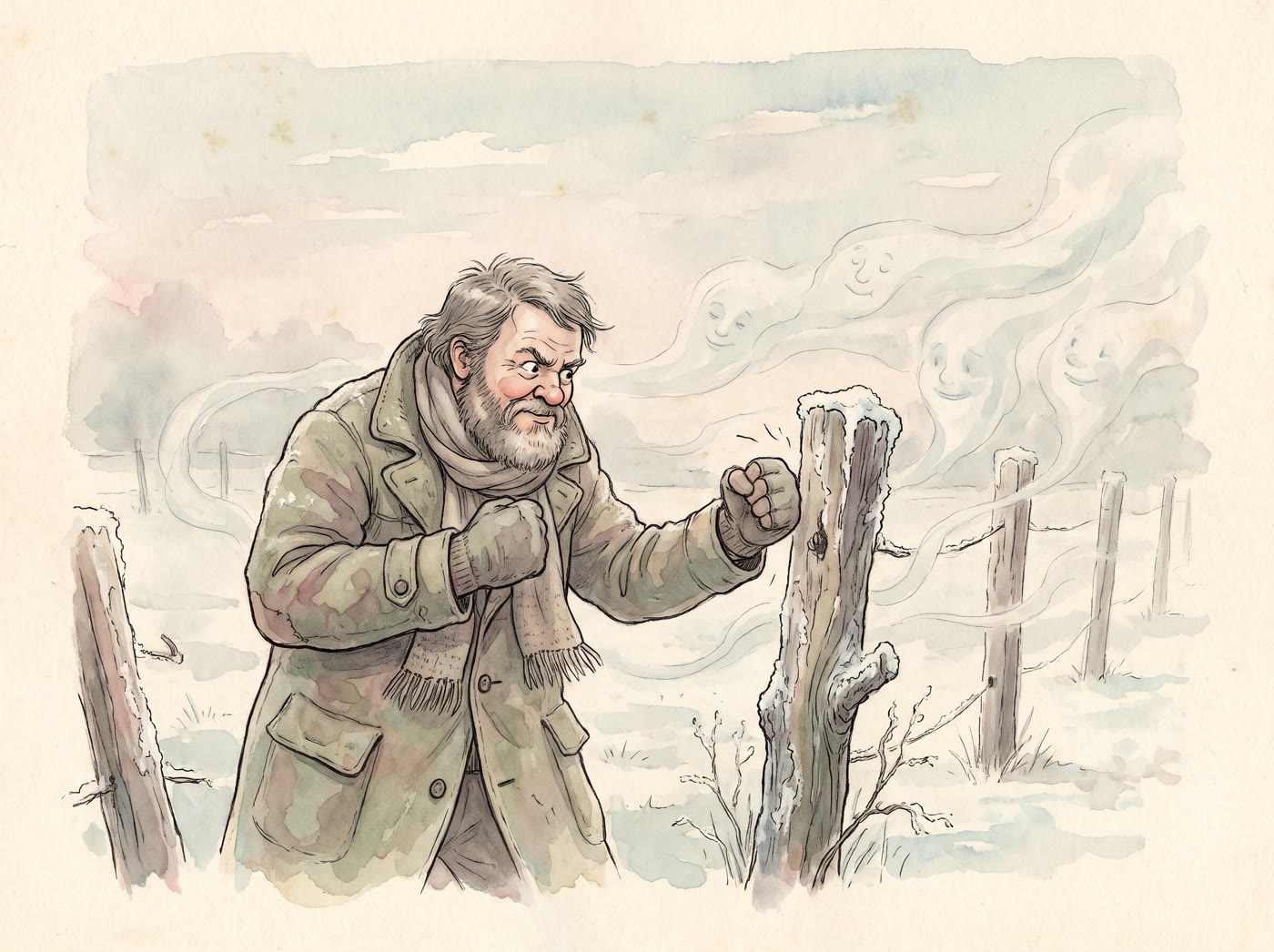
Amidst the mists and coldest frosts,
With stoutest wrists and loudest boasts,
He thrusts his fists against the posts
And still insists he sees the ghosts.
Where the rhyme comes from
People often ask who wrote this, and the honest answer is that nobody knows. In every printing we have found it is anonymous, set down as a stock exercise in books of elocution and school reading rather than as a poem by a named hand.
The earliest printing we have found is in Samuel Niles Sweet’s Practical Elocution (Rochester, New York, 1843; the book was reissued in 1846). It gives only a short form, as an example for articulation practice, in a version printed as “Amidst the mists he thrusts his fists against the posts, and still insists he sees the ghosts.” That is the earliest we have found, not proof that it began there. Sweet names no author, so the couplet may be older than his book, or it may have been written for it — we cannot tell.
The earliest full four-line version we have found is in The Rhode Island Schoolmaster of 1874, in a version printed with “coldest frosts”, “barest wrists” and “stoutest boasts”. By the 1880s and 1890s both that wording and the one above, with “stoutest wrists and loudest boasts”, were circulating side by side in elocution manuals such as John Swett’s School Elocution (1886), and in teachers’ journals. Neither can be shown to be the original. It kept turning up in speech books into the 1920s, usually beside other drills of the same kind, such as “Peter Piper” and “Round the rough and ragged rocks”.
You will also see “fiercest frosts” online. We have found no early printing of that wording; the early books say “coldest”, so treat “fiercest” as a later variant. Smaller differences exist too, such as “he thrust his fists” in the past tense. Our sources for these early wordings are catalogue snippets rather than the page images, so the punctuation and line breaks of the originals may differ from ours.
What does it mean?
Picture a man out in the fog, punching fence posts and insisting that he can see ghosts. That is the whole scene, and it is sound-play rather than a story with a hidden meaning. The words were chosen because nine of them — mists, frosts, wrists, boasts, thrusts, fists, posts, insists, ghosts — end in the same tricky -sts cluster. No source we have seen gives the verse a narrative or a moral; that is an absence of evidence, not a proof, but it fits a drill.
The Robert Frost link. Searches sometimes connect this verse with the poet Robert Frost. As far as we can find, that is wordplay on “frosts” and nothing more: no source attributes the verse to him, or to anyone else.
Sharing it with children
The -sts ending is genuinely hard, for adults as much as children. Do not start with the whole verse. Take the four pairs one at a time — mists, frosts; wrists, boasts; fists, posts; insists, ghosts — saying each word slowly with a tiny gap before the final s, then speeding up. Once the pairs are easy, add the line around them, and only then try all four lines.
Act it out. Make two gentle fists on “fists” and tap an imaginary post on “posts”, then shade your eyes and peer into the fog on “ghosts”. In winter, try a spooky-whisper round: pass the verse around the room one line each, quieter every time, until the last player can barely be heard. A whisper makes the clusters harder still, which is half the fun. Time each other for a family record, or aim for three clean runs in a row.
Extra verses to sing
These verses aren’t traditional — they’re ours. Try them once the first four lines come easily.
Amidst the mists and morning frosts,
With woolly mitts on both his wrists,
He taps his toes against the posts
And still insists he sees the ghosts.
Amidst the mists the friendly ghosts
Float by the fists and frozen posts;
Nobody boasts, nobody roasts,
And all of the ghosts insist on toasts.