Andrew Airpump Asked His Aunt Her Ailment
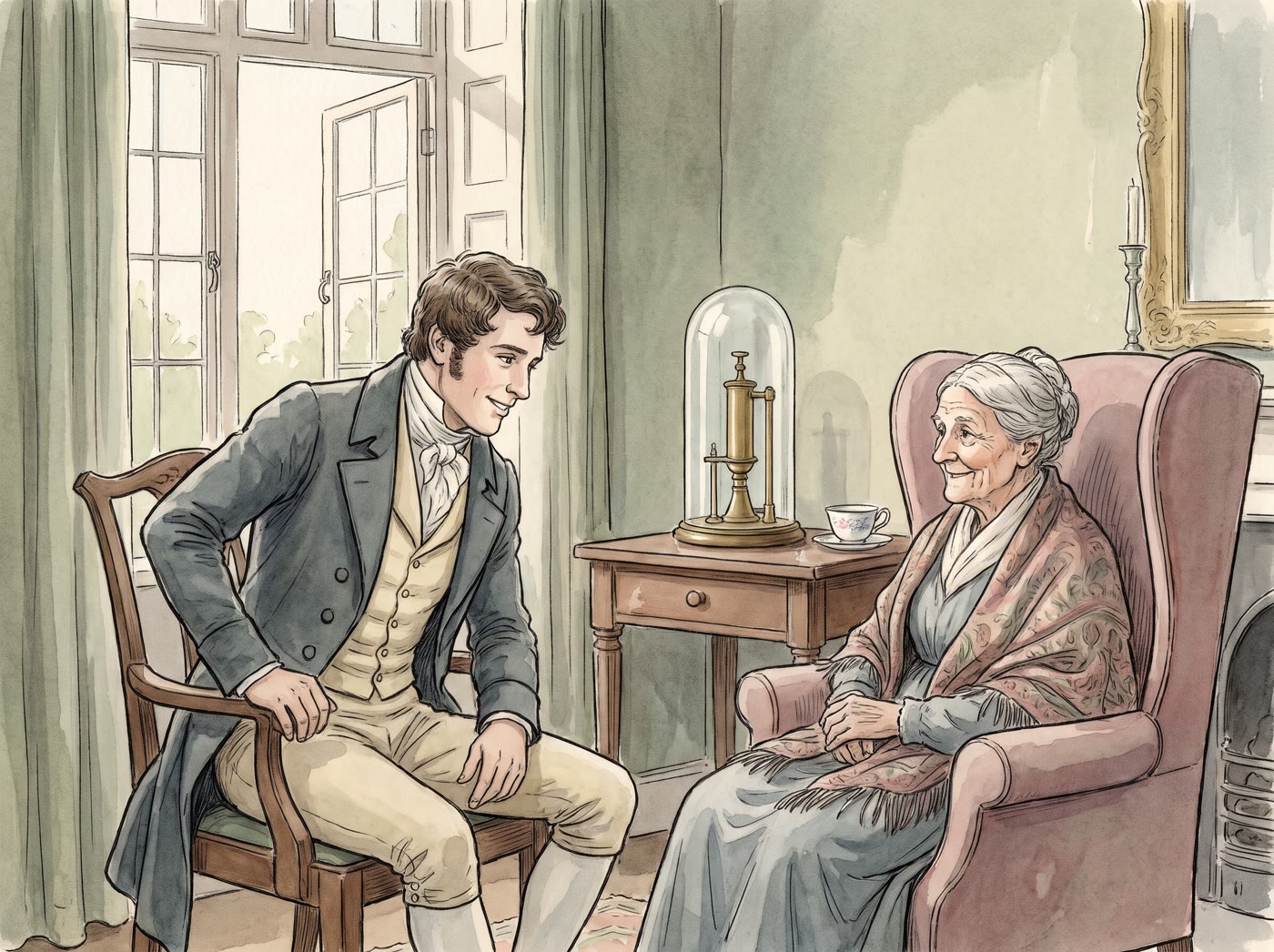
Andrew Airpump ask’d his Aunt her ailment;
Did Andrew Airpump ask his Aunt her ailment?
If Andrew Airpump ask’d his Aunt her ailment,
Where was the Ailment of Andrew Airpump’s Aunt?
Where the rhyme comes from
Andrew Airpump is the “A” entry in Peter Piper’s Practical Principles of Plain and Perfect Pronunciation, published by John Harris in London in 1813. It is the same little book that gave us Peter Piper: each letter of the alphabet gets its own alliterating name, and Andrew, as the first letter, opens the sequence. The book was reprinted in America, and the 1836 Philadelphia edition is the one now freely available as a Project Gutenberg text. Project Gutenberg lists it as anonymous, and the book itself puts “Peter Piper” forward as its teacher, so we name the publisher rather than an author.
The words above are quoted from that American edition printed in Philadelphia in 1836, which is the text we have been able to read in full. Spelling and capitals are as printed there, including the old “ask’d”. Other editions may differ in small details.
Every entry follows one four-line pattern. The first line states something; the second turns the same words into a question; the third begins “If” and says the statement all over again; and the fourth, beginning “Where”, asks after the object of the sentence. Andrew’s object is his aunt’s ailment, and the closer swings the sentence round so that it ends on “Aunt”. The same shape runs through Billy Button’s buttered biscuit, Davy Dolldrum’s dream and the other letters, which is part of the fun: once you know the pattern, you can find your way through any of them.
What does it mean?
Nothing in the verse says what the ailment is, and that is the joke. Andrew asks, the question is asked again, and the answer never comes: the aunt’s complaint stays a mystery, and the words exist to be said, not to be understood. As far as we know, the meaning of the rhyme is simply that there is none beyond the sound.
Our reading, and only ours. An air-pump was a well-known scientific instrument of the period, shown at public lectures in the eighteenth century, and it is tempting to think the surname nods to it. No source we have found says so. The name works perfectly well as pure alliteration: “air”, “Aunt” and “ailment” all begin with an A sound, which is the whole assignment for the letter.
Sharing it with children
Peter Piper and Billy Button drill a consonant. This one drills a vowel, and that may make it trickier than it looks. Read it aloud and notice that the three A-words Andrew, Airpump and Aunt each start with a different sound, and ailment adds a fourth. That is our own observation from saying it, not a sourced claim, but it is easy to check in a moment.
Ask and answer. The verse is built as a conversation, so share it as one. One person says lines one and three, the other says lines two and four. Swap parts and go again, a little faster each time.
Slow, then quick. Say the first line three times slowly, exaggerating every vowel, and then three times at ordinary speed. The sticking points are usually “ask’d his Aunt” and the crowded ending of “Airpump’s”.
Write your own letter. Take a child’s name and build a line in the same pattern: a statement, the question, the “If” repeat, and a “Where” closer. “Molly Mouse mended her mitten” is a good place to start. Keep the mystery gentle: the fun is in the sound, and nobody needs to be unwell.
Extra verses to sing
These verses aren’t traditional — they’re ours. They follow the same four-line pattern, so you can swap them in for a second round.
Molly Mouse mended her mitten;
Did Molly Mouse mend her mitten?
If Molly Mouse mended her mitten,
Where was the Mitten Molly Mouse mended?
Annie Apple asked Andrew an answer;
Did Annie Apple ask Andrew an answer?
If Annie Apple asked Andrew an answer,
Where was the Answer Annie Apple asked?