A Skunk Sat on a Stump
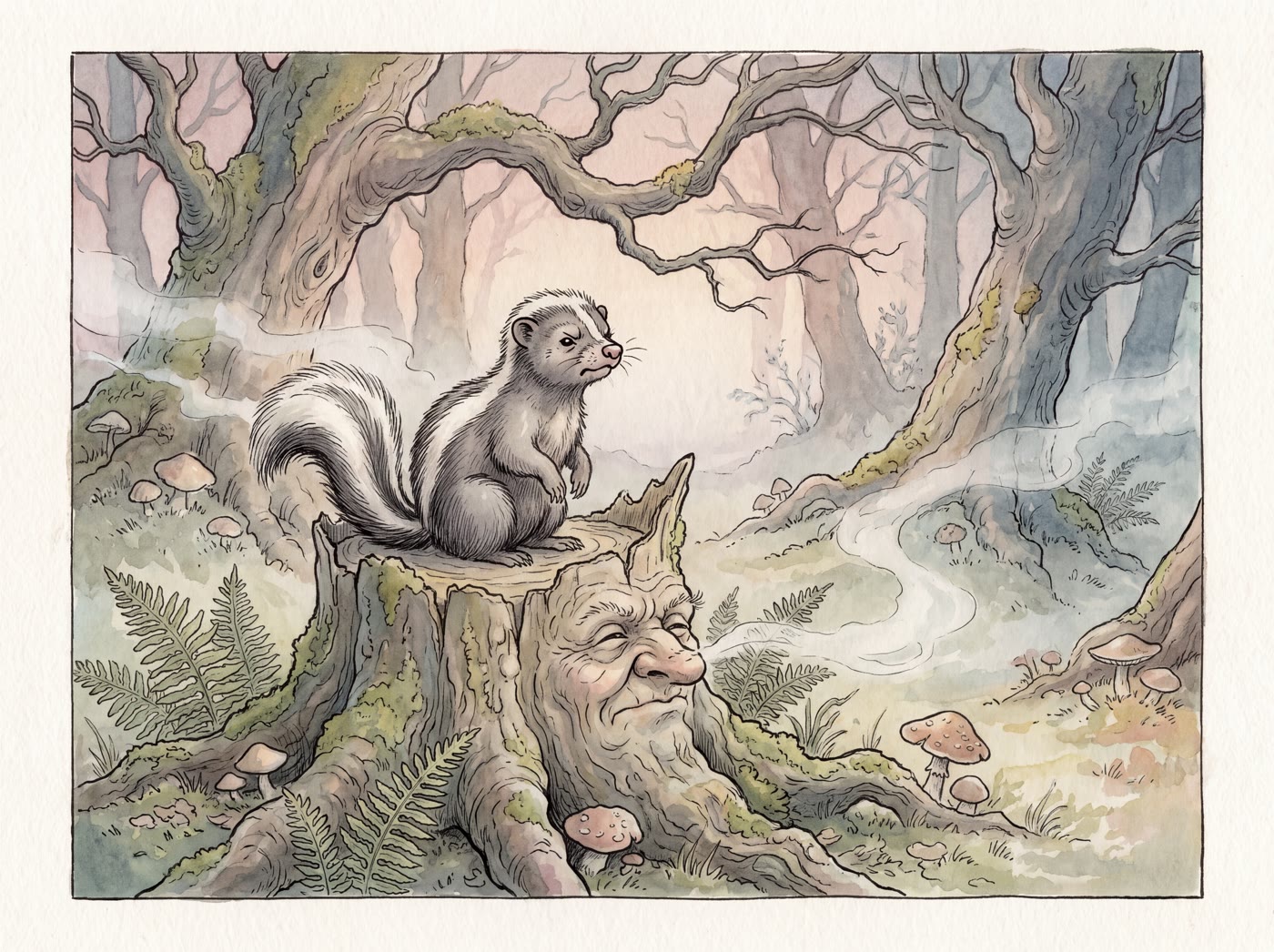
A skunk sat on a stump.
The skunk thunk the stump stunk,
And the stump thunk the skunk stunk.
A skunk sat on a stump and thunk the stump stunk,
But the stump thunk the skunk stunk.
Where the rhyme comes from
There are two common ways of saying it, and both are given above. The first is the three-line form, in which skunk and stump take a line each to pass judgement; the second runs the whole thing together as a single sentence, with a “but” to sharpen the reply. Mama Lisa’s World, a long-established archive of children’s rhymes, files it as a tongue twister from the USA and prints the “but” version, broken into three short lines. Neither is the correct one. Some people swap “thunk” for a plain “thought”, and many finish with a riddling tag: “What stunk, the skunk or the stump?” All of these are genuine variants.
Where it came from is harder to say. We searched the places a first printing ought to turn up — the Opies’ Oxford Dictionary of Nursery Rhymes, Project Gutenberg and digitised joke and tongue-twister collections on archive.org — and found nothing earlier than modern collections. It does not seem to appear in the Opies at all. Like most playground twisters it travelled by ear long before anyone wrote it down, and it circulates today as an anonymous piece, apparently twentieth-century and American, with no known author, no known date and no traceable first printing.
You will sometimes read that tongue twisters “became popular in the 1800s”. That is a claim about the whole genre, not about this rhyme, and nothing ties the skunk to that century. Where it does turn up is exactly where you would expect: on summer-camp handouts and children’s activity pages, unattributed, between “Red Leather, Yellow Leather” and its cousins. It is folk property, passed from child to child.
What does it mean?
Unlike many twisters, this one has a proper joke in it. The skunk sits down and decides the stump smells; the stump decides the skunk smells. Each blames the other, and anyone who knows anything about skunks can guess which of them is right — though it is just possible that they both smell. The closing tag, “What stunk, the skunk or the stump?”, simply hands the argument to the listener.
A child will probably ask about “thunk”. It is a playful, non-standard past tense of think, and it is there for the sound rather than the grammar: “thought” would break the chain of rhymes, while “thunk” clicks neatly into place beside “skunk” and “stunk”. The joke is that “stunk” is perfectly proper. A 2023 Language Log post by Victor Mair, quoting the standard etymologies, sets out that stink comes from Old English stincan, one of the old strong verbs that change their vowel — stink, stank, stunk — so the rhyme borrows a real pattern and bends think to fit it.
Sharing it with children
The difficulty lives in the consonant clusters. The mouth has to move between sk, st and the nasal nk at the end of nearly every word, and because “skunk”, “stunk” and “thunk” all rhyme, it is very easy to put the wrong beginning on the right ending. Teachers and speech therapists use it as a drill for exactly those sk and st sounds. Say it slowly first, tapping one beat per word, then try the classic challenge: three times fast, without the skunk turning into a stump.
With two children it makes a natural call-and-response. One is the skunk, one is the stump. Say the first line together, then let the skunk accuse the stump and the stump fire back, swapping parts each round and getting quicker each time. Whoever stumbles has to answer the riddle: what stunk? Finally, for pure giggles, try the whole thing while holding your nose — the voice goes wonderfully pinched, and nobody manages it with a straight face.
Extra verses to sing
These verses aren’t traditional — they’re ours. Try them once the skunk and the stump stop swapping places.
A skunk sat on a trunk.
The skunk thunk the trunk stunk,
And the trunk thunk the skunk stunk.
The skunk slunk off the stump
And sank in a bunk with a bump,
But the bunk thunk the skunk stunk.