Robert Rowley Rolled a Round Roll Round
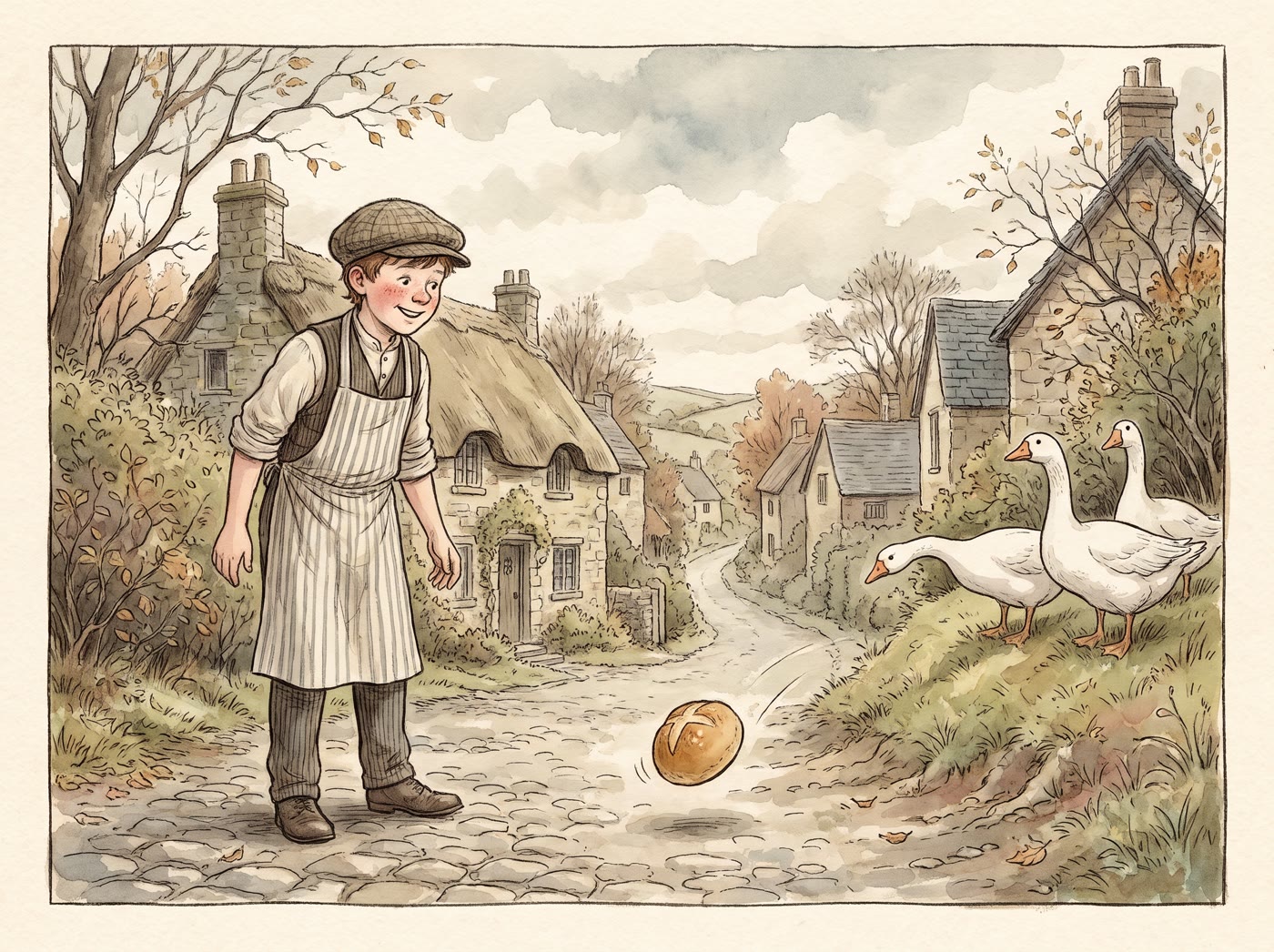
Robert Rowley rolled a round roll round,
A round roll Robert Rowley rolled round;
Where rolled the round roll Robert Rowley rolled round?
Where the rhyme comes from
The earliest printing we can point to is in James Orchard Halliwell’s The Nursery Rhymes of England. The index of the first edition, published by the Percy Society in 1842, lists “Robert Rowley rolled a round roll round”, and the words themselves can be read in the fourth edition of 1846, where it is number 159 on page 83. Halliwell filed it in his class of “Charms”, alongside other twisters such as “Swan swam over the sea” and “Peter Piper”. He gives no author and no explanation of the words. No source we have found names an author either: nobody knows who first said it, and there is no evidence of a real Robert Rowley behind it. We have not found an earlier printing, but that is not the same as proving there was none.
Halliwell’s version is three lines long. The form most often recited today has four, with an extra “If Robert Rowley rolled a round roll round…” line slipped in before the question. That shape — a statement, a reversal, an “if”, then a question — is the pattern of Peter Piper, and it is probably no accident that the two have grown alike, though that is our inference rather than a documented fact. The words above are Halliwell’s, and you will meet small variants elsewhere.
A correction worth making: it is often assumed that Robert Rowley belongs to Peter Piper’s Practical Principles of Plain and Perfect Pronunciation, the alphabet book of tongue twisters. It does not appear to. In the 1836 printing, the only text we have read, the entry for R is Rory Rumpus and his raw-boned racehorse, and Robert Rowley appears nowhere in the book.
What does it mean?
Very little, and that is the point. The natural reading is that a “roll” is a small round loaf of bread, and that someone has rolled it along and then lost track of it — though Halliwell offers no gloss, so this is the obvious reading rather than a documented one. The question at the end is not meant to be answered. The pleasure is in the sound: the r and l sounds tumble over one another much as the roll does.
The thunder guess. The folklorist Lina Eckenstein, in Comparative Studies in Nursery Rhymes (1906), grouped this rhyme with those that depend on alliteration alone, and remarked that “Robert Rowley is perhaps a name for thunder”, citing a northern thunder charm that begins “Rowley, Rowley, Rattley-bags”. It is one scholar’s speculation, offered with a “perhaps”, and she gave no evidence that the twister itself was ever about thunder. We would not repeat it as fact.
Sharing it with children
This is a good twister for practising the English r, with the l of Rowley, rolled and roll waiting to trip it up. Begin with one line at half speed, letting the lips round a little and the tongue pull back for each r, then add the second line, and leave the question until both are steady. It is also a rhythm worth clapping: the first two lines roll along on the same beat, and the question stretches out like a hill.
Then play with it. Time each other over three clean repetitions in a row, with a stumble sending you back to the start; pass it round a circle one line at a time, quicker with every lap; or try it in a whisper, which is surprisingly harder than shouting. Best of all, act it out: roll a ball, or a bread roll (one you do not mind losing), across the floor, and let the child chase it while chanting “Where rolled the round roll?”.
Extra verses to sing
These verses aren’t traditional — they’re ours. They follow Halliwell’s three-line pattern, so try them once the original comes easily.
Rosie Rudd reared a red rooster round,
A red rooster Rosie Rudd reared round;
Where roosted the red rooster Rosie Rudd reared round?
Ruth Ruddock raked the russet leaves round,
The russet leaves Ruth Ruddock raked round;
Where rustled the russet leaves Ruth Ruddock raked round?