Eeny, Meeny, Miny, Moe
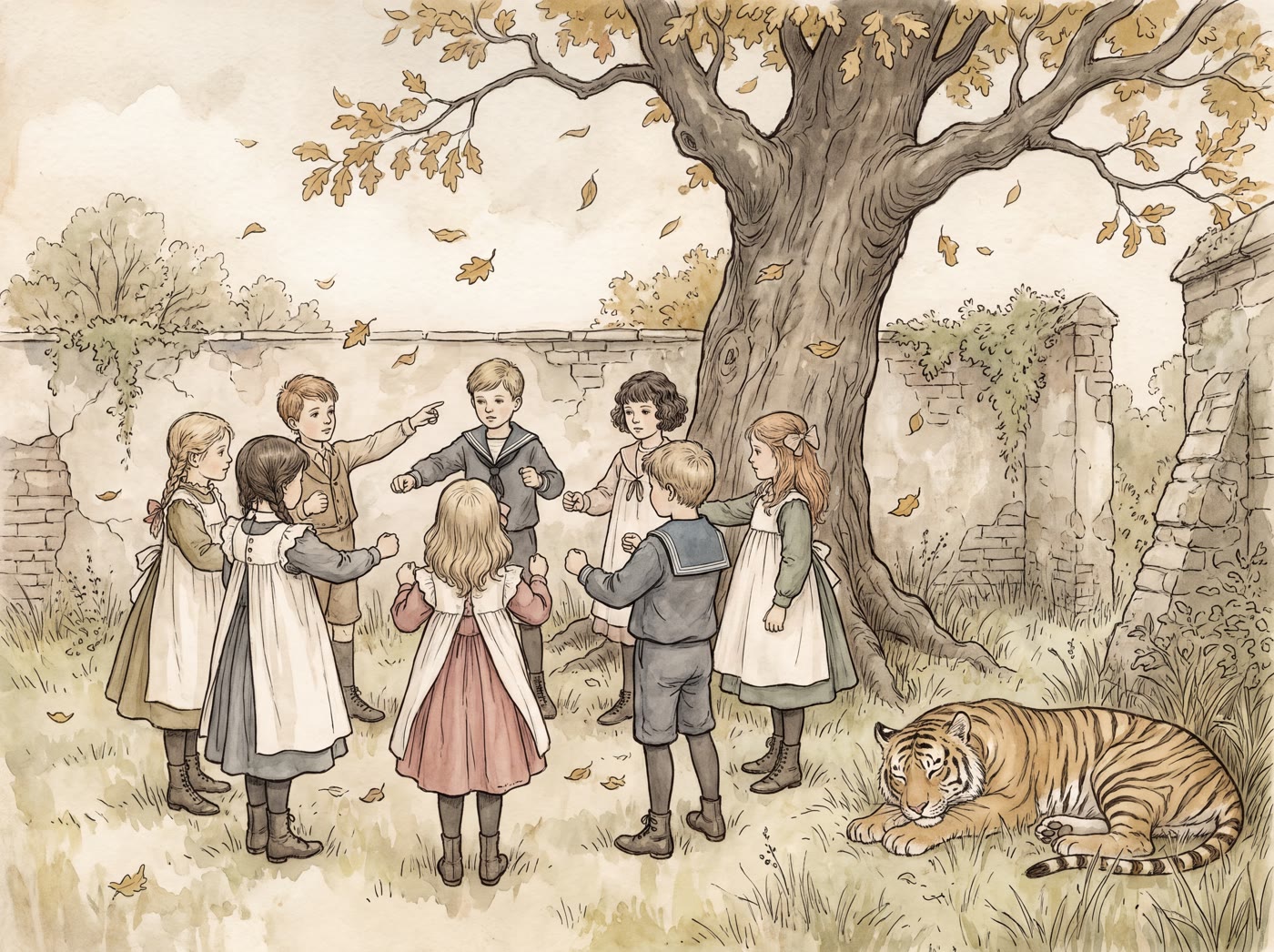
Eeny, meeny, miny, moe,
Catch a tiger by the toe.
If he hollers, let him go,
Eeny, meeny, miny, moe.
My mother told me
To pick the very best one,
And you are not it.
Where the rhyme comes from
Eeny, Meeny, Miny, Moe — also spelled eenie meenie miney mo, eeny meeny miny mo and several other ways — is the rhyme playgrounds reach for when somebody has to be “it”. Nobody knows who made it, and it is one voice in a large chorus of nonsense counting-out rhymes. Versions were being collected in Britain and America by the mid-nineteenth century, and in 1888 Henry Carrington Bolton gathered some 870 counting-out rhymes, in English and many other languages, into The Counting-Out Rhymes of Children — “Eeny meeny mony my” among them.
The history is not spotless, and it is better said plainly. Versions in which the second line carried a racial slur were being collected in America by Bolton’s day, and children in both America and Britain went on saying that version well into the twentieth century. It was never the only one — mice, monkeys and piggies have all been caught by the toe, and the Opies remarked that the word was “unknown in any English traditional rhyme or proverb”. During the twentieth century “tiger” displaced it, and it is now the standard line. So was the rhyme “originally racist”? Its origin is unknown, and the nonsense-counting family it belongs to is older and found in many languages; the slurred version is a well-documented chapter in its life, not its birth.
What does it mean?
Nothing hidden. The rhyme is a way of choosing — fairly, or at least seeming to. One syllable is allotted to each child round the circle, and whoever is pointed at on the last word is out, or chosen. Bolton noted that children use the word “it” in exactly this technical sense. As Adrienne Raphel put it in The Paris Review, “the rhythm and ritual of the whole are more significant than the meaning of each individual component”.
The endings. The “full saying” is really a set of tags children add to stretch the count. “My mother told me to pick the very best one, and you are not it” is one; others spell out “O-U-T”, and an American variant has the catcher “make him pay / Fifty dollars every day”. Bolton called the “O-U-T spells out” tag “a peculiar ending, attached at will by the children to almost any of the doggerels”.
The shepherds’ score. The best-known theory holds that the nonsense words descend from old counting numbers — the “yan, tan, tethera” once credited to Northern English shepherds, or Cornish and Welsh numerals. Fred Jago’s Glossary of the Cornish Dialect (1882) records a version beginning “Ena, mena, mona, mite”. It is an appealing idea, but folklorists generally regard it as unproven, and it may run backwards: the anthropologist Michael Barry could not find anyone who remembered a shepherd actually counting sheep with the score, and its earliest recorded uses are in counting-out rhymes themselves.
Divination by lots. Bolton’s own theory was that counting-out began in superstitious practices of choosing by lot. It is a theory, not a finding — and Bolton was wary of the wilder derivations of his day, warning that “the fact that an inscription cannot be deciphered does not prove its antiquity”. Similar-sounding chants turn up in other languages — French children say “Une, mine, mane, mo” — which suggests a family of rhymes rather than one ancestor.
Sharing it with children
Play it properly. Stand in a circle with everyone’s fists held out, or sit with feet in the middle and count shoes. The counter points to one fist or shoe on every beat, counting their own along with everyone else’s, and whoever lands on the final word — “moe”, or “it” if you add the ending — is chosen or out. For a longer game, that fist goes behind its owner’s back and the count begins again until one is left.
Find the trick. The rhyme is not as fair as it looks: with the same number of players and the same starting point, it always lands on the same person. One of Bolton’s correspondents admitted that “in the hands of a skilful counter it could be fixed to suit circumstances”. Older children love working out where to start so the count lands on themselves.
Keep the beat. Clap or tap along slowly with smaller children, one point per beat, so the counting and the chanting stay together. It is a handy way to settle whose turn it is at the slide, or who chooses the next story.
Extra verses to sing
These verses aren’t traditional — they’re ours. Use them when the circle wants another round.
Eeny, meeny, miny, mack,
Catch a duckling by the back.
If she quacks, then let her go,
Eeny, meeny, miny, moe.
Eeny, meeny, miny, moe,
Round the circle, off we go,
Fist by fist and row by row,
Eeny, meeny, miny, moe.