Hinx, Minx, the Old Witch Winks
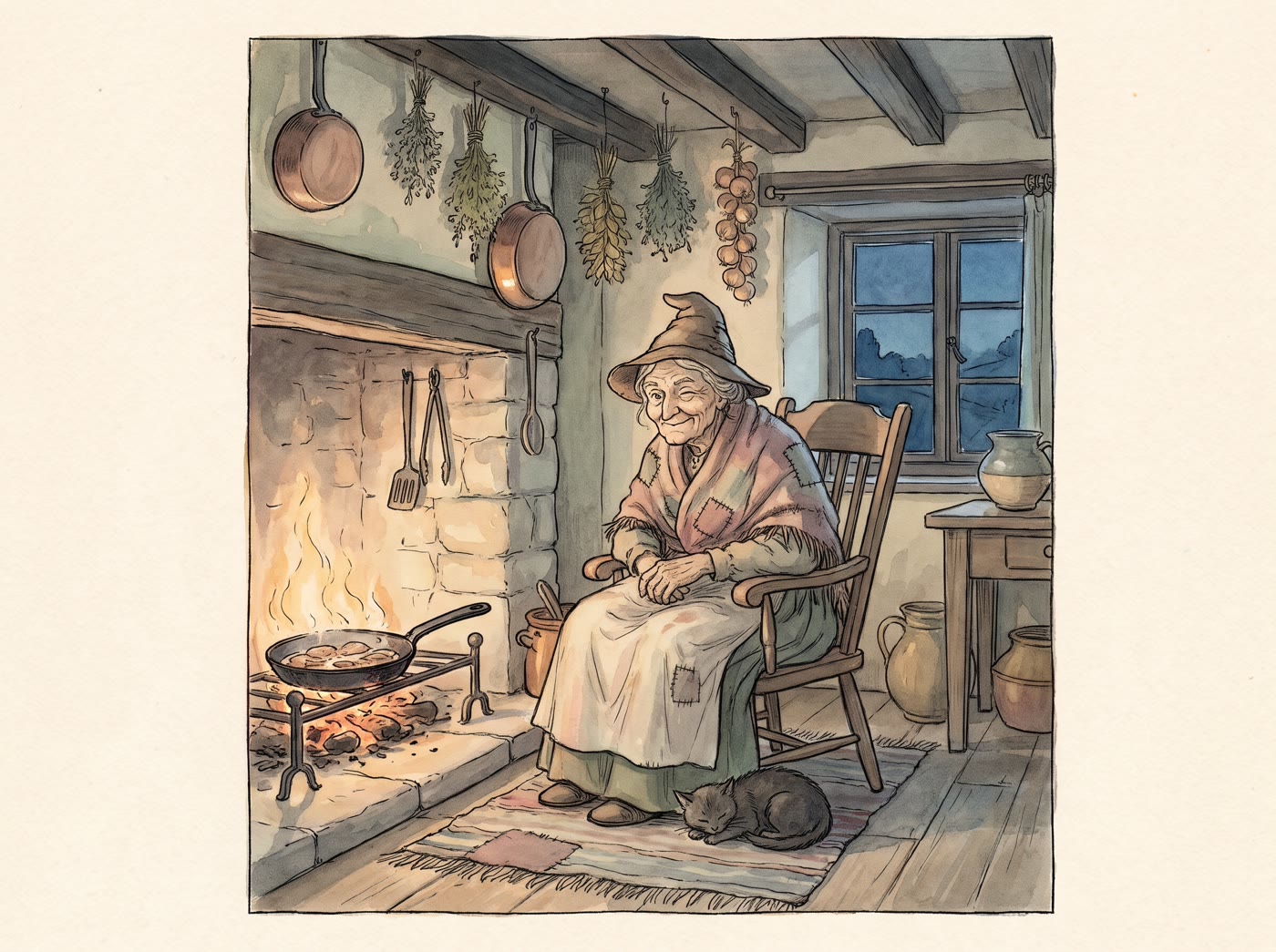
Hinx, minx, the old witch winks,
The fat begins to fry.
Nobody at home but Jumping Joan,
Father, mother and I.
Stick, stock, stone dead,
Blind man can’t see,
Every knave will have a slave,
You or I must be he.
Where the rhyme comes from
The firmest evidence is in James Orchard Halliwell’s The Nursery Rhymes of England, which went through several editions in the 1840s. The second edition (1843) prints a four-line version in its appendix, opening “Hink, minx! the old witch winks” and ending at “Father, mother, and I!” It carries no note and is not filed with the games. The fourth edition (1846) has the full eight lines in its chapter on games, placed straight after One-ery, Two-ery under the heading “Rhymes used by children to decide who is to begin a game”. So by the 1840s it was already filed as a counting-out rhyme, and the second half of our verse, “Stick, stock, stone dead”, was part of it.
It is almost certainly older than Halliwell. The long form also appears in Joseph Ritson’s Gammer Gurton’s Garland, in the enlarged edition, so it was in print in the early nineteenth century at the latest. Whether it was in the original 1784 edition of that book we have not been able to establish, so we make no claim for an earlier date.
The words wander. Halliwell’s 1846 text begins “Hink spink, the puddings stink” rather than “Hink, minx”; another old collection, of uncertain date, spells it “Hinks minks”; today “Hinx, minx” is the usual spelling, and online you will often see “winks” misspelt as “winx”. The 1843 text begins its third line “There’s nobody at home”, and some modern versions say “little Jumping Joan”. The version above is the traditional eight-line wording in its most familiar form.
What does it mean?
No meaning has been recorded. The scene is a household one: fat heating in a pan, and nobody at home but Jumping Joan, “father, mother and I”. That the opening sounds change from one printing to the next (hink minx, hink spink, hinks minks) suggests to us that they are sound-play rather than words with a fixed sense, but that is our observation, not a documented fact.
A witch story. The witch is often presented as the key to the rhyme, and it is now a favourite at Halloween. We found no source that explains her; the Halloween association looks modern, and nobody has shown what the old witch was doing, or why she winked.
Jumping Joan. A separate short rhyme about a lonely “little jumping Joan” (“Here am I, little jumping Joan; when nobody’s with me, I’m always alone”) is printed in the same Halliwell collection. We know of no source that connects the two, so we do not claim a link.
“Stick, stock, stone dead” is best read as a stock formula. Halliwell prints the same words in a rhyme for a game played on a slate, and in counting-out they are the sound of the beat, not a grim statement.
Sharing it with children
Halliwell explains how rhymes like this were used: “Children stand round, and are counted one by one, by means of this rhyme. The child upon whom the last number falls is out” — he was writing of Hickory, Dickory, Dock, but the method is the same. On our reading, the last line here, “You or I must be he”, means the child it lands on becomes “he”, the catcher in a game of chase.
Our suggestion, and not a recorded tradition: sit the children in a circle, tap one child for each word or beat, and see where the final “he” lands. With a small group, simply keep going round the circle until the words run out; tapping on syllables instead of words makes a longer count. Whoever is chosen can be the witch for a game of tag, a cosy one with no cackling required.
For younger children, skip the choosing and play with the sounds: make a long “sssss” sizzle on “the fat begins to fry”, wink slowly on “winks”, and see who can wink back. A winking game works well in a circle: one child winks, the child who spots it winks in turn.
Extra verses to sing
These verses aren’t traditional — they’re ours. Chant them in the same bouncing beat once the choosing is done.
Hinx, minx, the old witch winks,
The kettle starts to sing.
Somebody’s home, so come on in,
And hear what the evening will bring.
Hinx, minx, the old witch winks,
The pan begins to spit.
Round the circle, one by one,
And the last to be tapped is it.