One-ery, Two-ery, Ickery Ann
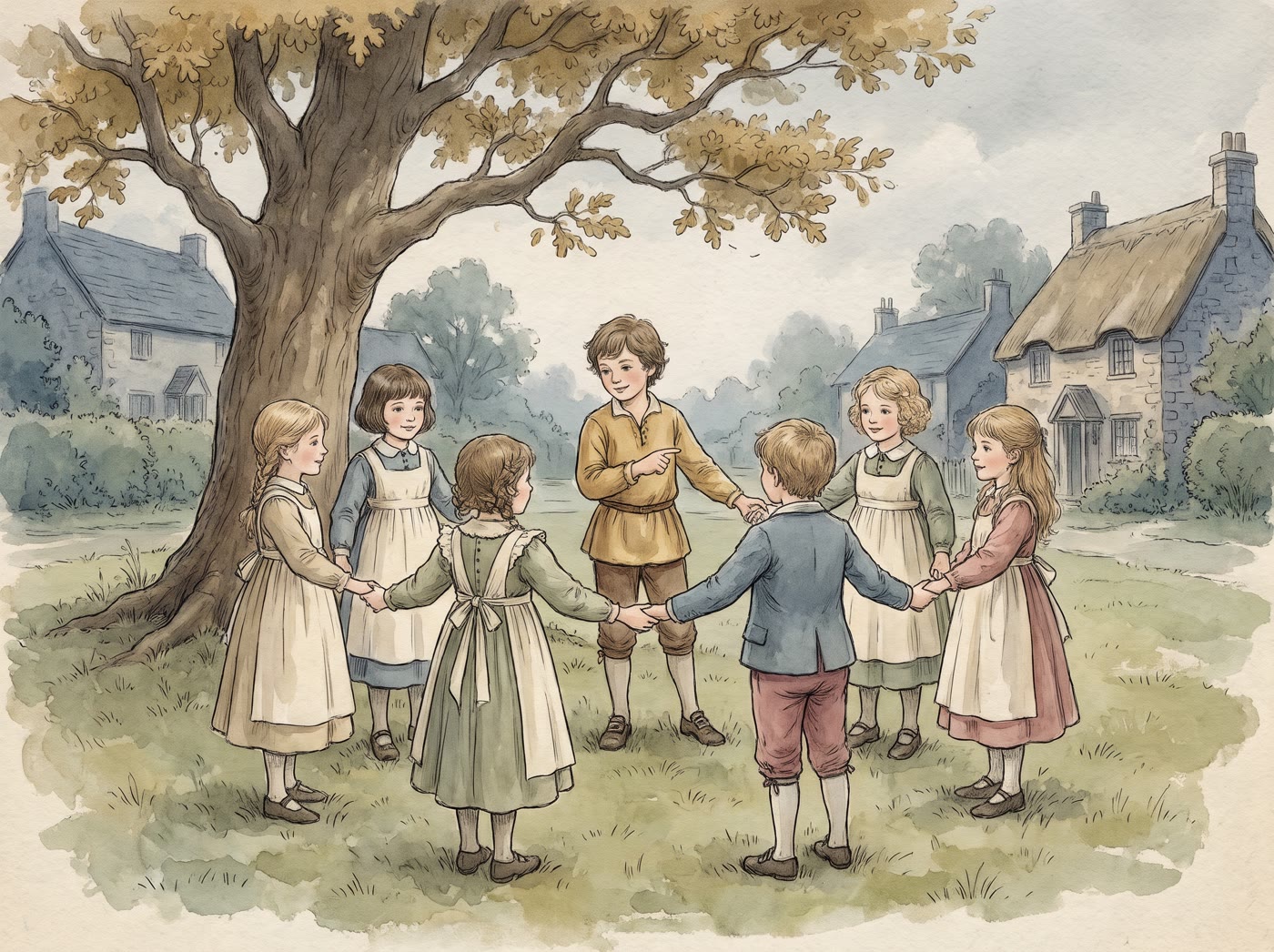
One-ery, two-ery, ickery, Ann,
Phillisy, phollisy, Nicholas John,
Quever, quaver, Irish Mary,
Stickeram, stackeram, buck!
Where the rhyme comes from
This is a counting-out rhyme. The children stand in a ring, one of them points at each in turn on every beat, and whoever is pointed at on the last word is out — or, depending on the game, is the one who must be it. The words above are the form many people remember, but they are not copied from any single book: they are a common spoken version assembled from variants that collectors have recorded.
The earliest printing we have verified is in James Orchard Halliwell’s The Nursery Rhymes of England, in the 1840s. Halliwell gives it with the note “Used in Somersetshire in counting out in the game of pee-wip or pee-wit”, and his words are already recognisably ours, if not quite the same: “One-ery, two-ery, hickary, hum, / Fillison, follison, Nicholson, John, / Quever, quauver, Irish Mary, / Stinkarum, stankarum, buck!” We have not found an earlier printing, but that does not prove there was none.
After Halliwell the rhyme turns up everywhere. In 1888 the collector Henry Carrington Bolton published The Counting-out Rhymes of Children, which gathers a large family of variants of this one from England, Canada and the United States, and Michigan variants were printed in 1918. The differences are the best part. Halliwell’s own editions disagree with each other — “Stinkarum” in one, “Stenkarum” in another. The folklore collector Charles G. Leland, who learned the rhyme as a boy in Philadelphia, began it “Ekkeri (or ickery), akkery, u-kéry an” and ended it “Stingle ’em — stangle ’em — buck!” And some people who learned it in the playground remember “English navy” where this version has “Irish Mary”. Every child who learned it by ear passed on a slightly different rhyme, and none of these is the “right” one.
Halliwell prints a quite separate counting-out rhyme that begins in the same way, “One-ery, two-ery, Ziccary zan”. Openings like this one move freely from rhyme to rhyme, so a family memory of “one-ery, two-ery” may be a different verse from the one above.
What does it mean?
Nothing that anyone can show. The words are nonsense, and the meaning is unknown. Even the collector who made the best-known attempt to explain them admitted that “Nicholas John has really no meaning”.
The Romani-spell theory. You will often read that this is a Gypsy magic spell. The idea comes from Charles G. Leland, an American collector of Romani folklore, who set the rhyme beside Romani words in the nineteenth century (for instance, ek or yek for “one”). But Leland was far more careful than the way his idea is repeated. He wrote that he “should be justly regarded as one of the seekers for mystery in moonshine” if he declared that he “positively believed this to be Romany”, and some of the words he examined he could not explain at all. It is a proposal, not an established origin.
Counting scores. A different idea, that counting-out rhymes descend from old shepherds’ counting scores, is sometimes attached to rhymes of this kind in general. We know of no evidence that connects it to this one.
The safest reading is the plain one: children enjoy strings of invented, rolling syllables that tell them when to stop, and this is one of them.
Sharing it with children
The obvious use is the original one: choosing who is it. Stand the children in a ring, point to each in turn on every beat — including yourself — and let the child pointed at on “buck” be out, or be it. In this form there are fifteen beats, so change where you start if you want to land on a particular child.
For younger children, drop the pointing and simply clap the strong syllables: ONE-ery TWO-ery ICK-ery ANN. The rhyme has an easy trochaic bounce, and the long run of nonsense words makes a good tongue-tangling game when you speed up. Try whispering it, then chanting it, then going as fast as you can without tripping.
On a lap, bounce a toddler gently on each beat and finish with a bigger (safely caught!) bounce on “buck”. That is an idea for the nursery, not a tradition we can document.
Extra verses to sing
These verses aren’t traditional — they’re ours. Chant them in the same bouncing rhythm when the first has done its work.
One-ery, two-ery, ickery, bee,
Honey and heather and old oak tree,
Robin and thrush and a sleepy brown hen,
Stickeram, stackeram — out, and again!
One-ery, two-ery, ickery, ten,
Count them all out and begin again,
Round goes the finger and round goes the rhyme,
Stickeram, stackeram — next time!