Intery, Mintery, Cutery Corn
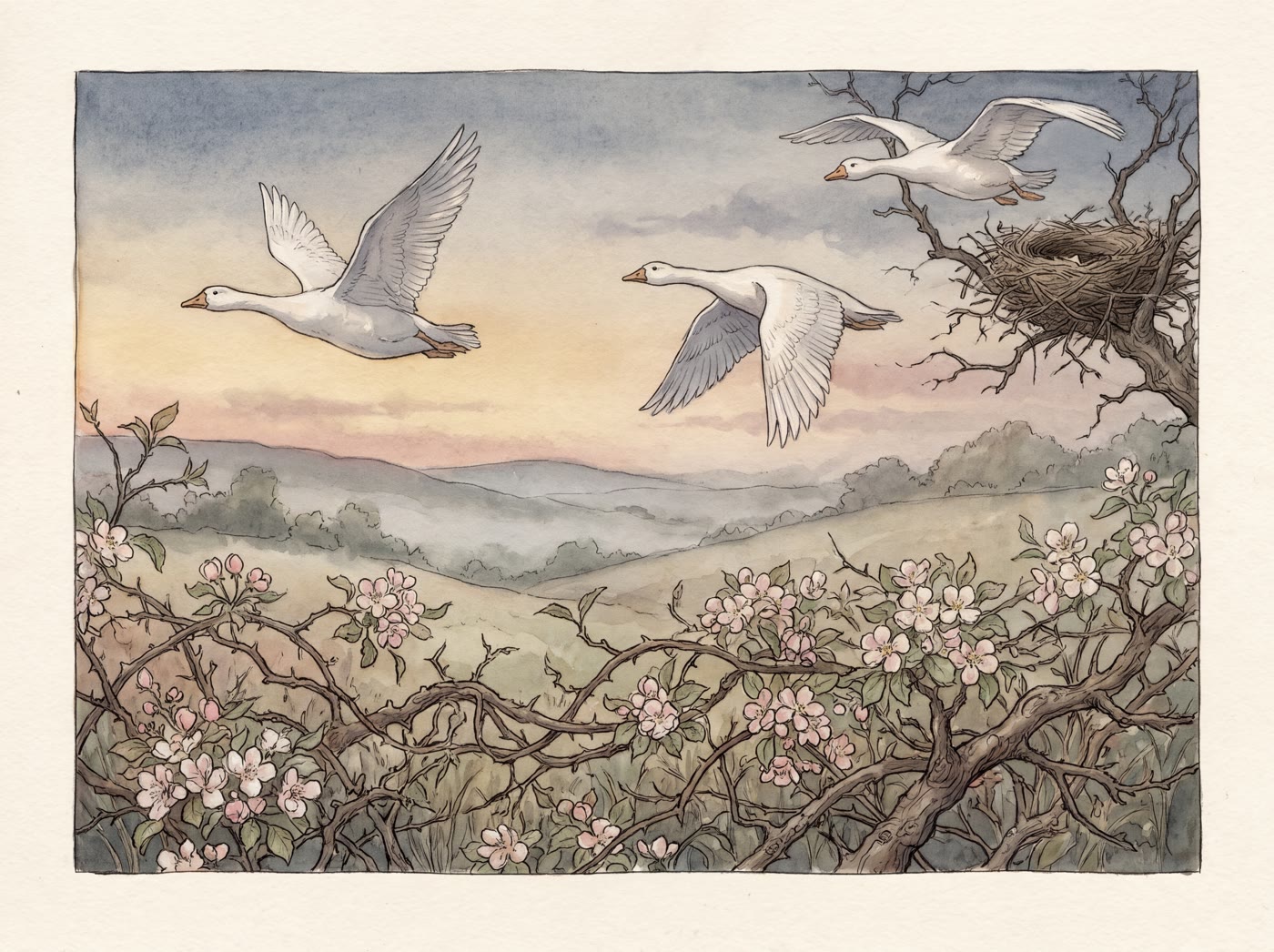
Intery, mintery, cutery corn,
Apple seed and apple thorn;
Wire, brier, limber lock,
Three geese in a flock,
One flew east and one flew west,
And one flew over the cuckoo’s nest.
Where the rhyme comes from
This is a counting-out rhyme: a rhyme children recite to choose who is “it” or who is “out”. It is recorded in print in the nineteenth century. The Ballad Index gives its earliest date as 1844, in James Orchard Halliwell’s collection, and lists it in the Opies’ Oxford Dictionary of Nursery Rhymes and in William Wells Newell’s Games and Songs of American Children. We have relied on the Ballad Index for those references, so treat the 1844 date as reported rather than checked against the book itself. You may see earlier dates quoted elsewhere online; none of them comes with a source we could trace, so we have left them out.
The words have never been fixed. The version above, with its three geese and its cuckoo’s nest, is the one most people look for, but the same opening turns up with other endings. One recorded text has five geese in a flock who “sit and sing by a spring”, and finishes by spelling out the game: “O-U-T, and in again”. Another has twelve geese, “some fly east an’ some fly west”. A text printed in 1920 adds a stranger: “Along came Tod, / With his long rod, / And scared them all to Migly-wod.” The opening shifts too — “Vintery” for “Intery”, “briar thorn” for “apple thorn” — and the Ballad Index notes that collectors have found the “wire, briar” lines on their own, and combined with lines borrowed from other rhymes. It is better thought of as a family of texts than as a single poem.
What does it mean?
Counting-out nonsense. The opening line is made of sounds, not sense, and that is what counting-out rhymes are for: the words give a steady beat to point along, and nobody minds what they mean. Collectors and indexes file this one alongside “Eeny, Meeny, Miny, Moe” as a rhyme of the same kind. We have found no evidence that the two share a common ancestry, and none for any ancient or foreign origin for the opening words, so we make no such claim.
The rest is unknown. Nobody can say what “limber lock” or “wire, briar” refers to, or where “intery”, “mintery” and “cutery” came from. Apple seeds, thorns and briars are plain country words, and they may simply have been chosen because they sound good in a string. The honest answer is that the meaning is not known.
The cuckoo’s nest. Many people come to this rhyme by way of a novel. The title of Ken Kesey’s One Flew Over the Cuckoo’s Nest (1962) is the rhyme’s last line, and the rhyme is quoted in the book, in the “Vintery” form. That is the extent of what we can say: the novel’s title comes from the rhyme, but this page does not read the rhyme itself as being about anything beyond three geese in flight.
Sharing it with children
Counting out in a circle. Gather the children in a ring and point at one child on each beat as you say the words, moving round the circle. Whoever is pointed at on “nest” is out, or is “it”. Don’t worry about the count coming out evenly; children soon learn to stretch or squeeze a line to land on the player they have in mind, which is half the fun. For a longer count, run straight on into the five-geese ending and finish on “O-U-T”.
Fingers on the table. One account describes players resting their forefingers on a table while the rhyme picks one finger at a time to be taken out, until a single player is left. The Ballad Index doubts that so long a rhyme was ever used this way round after round, so this is better as a game to try than as a record of how it was played.
Three geese. Let the children be the flock. Flap arms through the first four lines, then on the last two send one goose to the east, one to the west, and one high over the “nest” — arms stretched up, or a hand cupped like a nest for the third goose to fly over. It is a good way to talk about left, right and up, and to find out which way is east.
Extra verses to sing
These verses aren’t traditional — they’re ours. Use them to count out when the first has run its course.
Three geese out on the village green,
Fattest geese you’ve ever seen;
One went left and one went right,
And one stayed home to say goodnight.
Three geese up in the morning sky,
One flew low and two flew high;
One flew home to the farmyard gate,
And you are out — so don’t be late.