One, Two, Three, Four, Mary at the Cottage Door
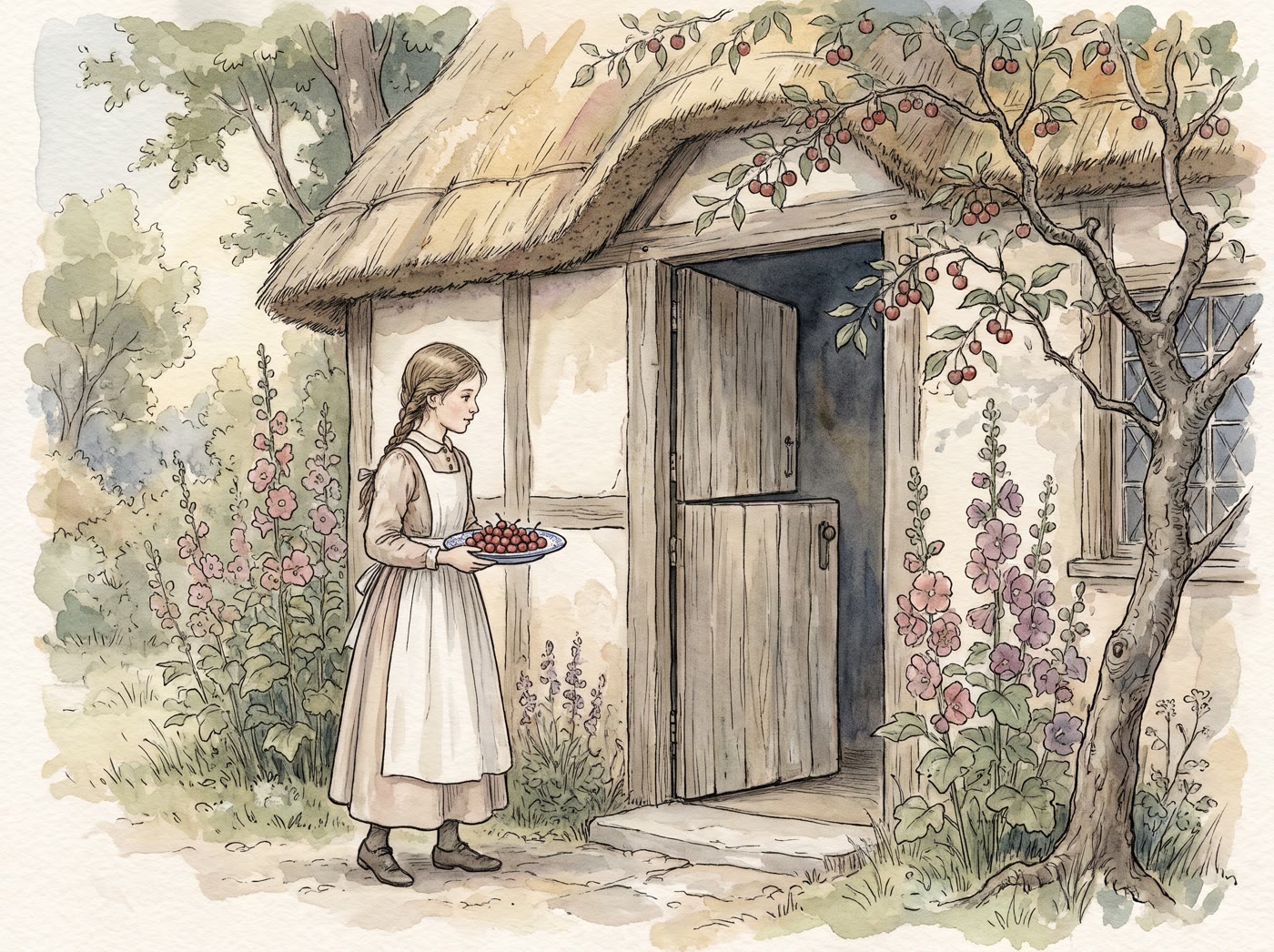
One, two, three, four,
Mary at the cottage door,
Eating cherries off a plate,
Five, six, seven, eight.
Where the rhyme comes from
The earliest printing we have actually read is in Percy B. Green’s A History of Nursery Rhymes (London, 1899). Green gives it in his chapter on games, as a counting-out rhyme — one of those chants used to decide who is “he” or who begins a game — and calls it “another and more generally known rhyme” than the one before it. He says nothing about where it came from or what it means.
Later transcriptions point to earlier appearances, which we have not seen in the originals. A Scots form, “Ane, twa, three, four”, is reported in the Aberdeen Journal in March 1880, under the heading “Countings Out”, and a version with “Mary at the cottage gate, / Eating grapes off a plate” is reported in Notes and Queries in January 1885. That note adds that “plums” is sometimes given for the grapes, and “garden gate” for the cottage gate. By 1912 the rhyme was in a children’s book, The Little Mother Goose, in a variant that ends with the tag “O-U-T spells out!”.
So the honest answer is “earliest found”, not “first published”. If those reports are right, it was in circulation by the 1880s, and by 1899 Green could call it “more generally known”. It may well be older by word of mouth, but we have not found a firm earlier date, and we do not know where it began.
What does it mean?
As far as we can tell, nothing. No source we have found links Mary, her door or her cherries to any person, event or hidden message, and we are not going to invent one. Mary is simply a common girl’s name, and the fruit changes from version to version — cherries, grapes, plums — which suggests the words were chosen to rhyme rather than to signify.
What the rhyme does have is a neat piece of mechanics. The counting stops at four and picks up at five because “door” has to rhyme with “four” and “plate” with “eight”; the little picture in the middle is there to make the numbers rhyme. It is a counting-out rhyme and a counting rhyme at once, and that is all it claims to be.
Sharing it with children
Count along on your fingers: one hand for one to four, the other for five to eight. Knock gently on a table, or a real door, on the word “door”, and let your child answer with the knock.
For a more tangible version, set out eight real cherries (or eight paper ones) and a plate, and move one onto the plate at each number. Counting back from eight to one is a good second round. Clapping or stepping on every number keeps the beat for children who are not yet counting reliably.
And use it as it was used. Gather the children in a ring, point to a different child on each number, and the one pointed at on “eight” is out — or is “it”, depending on the game. With a larger group, simply go round again until one child is left.
Extra verses to sing
These verses aren’t traditional — they’re ours. They carry the count on to twelve, then back down to one, in the same bouncing metre.
Nine, ten, eleven, twelve,
Mary’s found a basket shelf,
Picking cherries, ripe and red,
One, two, three, and off to bed.
Twelve, eleven, ten, nine,
Mary counts them back in line,
Eight, seven, six, five, four,
Three, two, one — and shut the door.