A Fisher Named Fisher
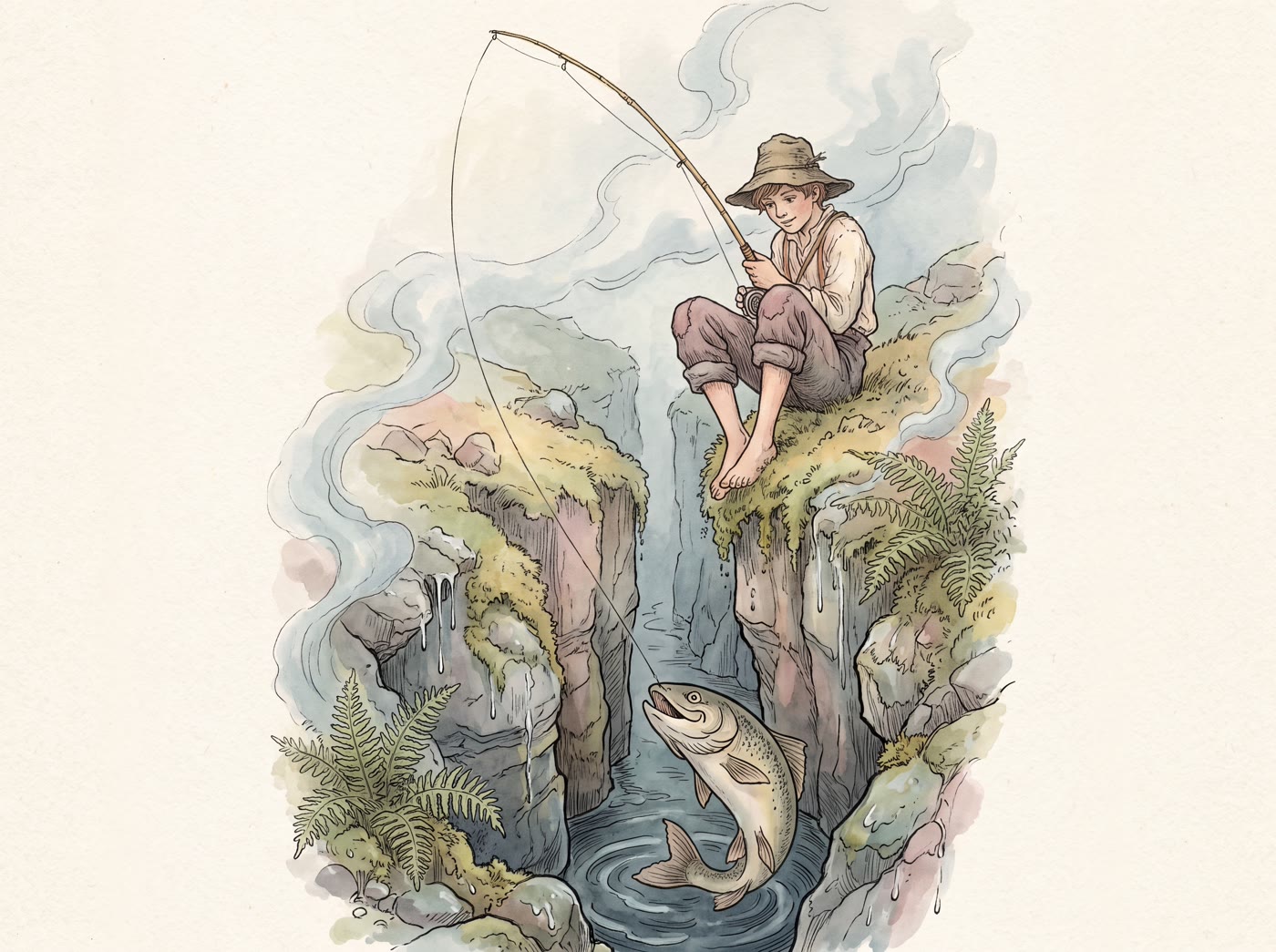
There was a young fisher named Fisher
Who fished from the edge of a fissure.
A fish with a grin
Pulled the fisherman in—
Now they’re fishing the fissure for Fisher.
Where the rhyme comes from
No author’s name travels with this one. It circulates as an anonymous American parlour limerick, printed and reprinted through the 20th century in newspaper humour columns, joke books and school readers, usually with small variations — some versions open “A canny young fisher named Fisher,” others “There was a young fisher named Fisher,” and the fourth line is sometimes “Pulled the fisherman in.” That drift is the ordinary signature of an oral verse: it has been passed mouth to mouth far more often than it has been credited.
The form it is written in has a much clearer history. The five-line AABBA verse first appears in English collections around 1820, in books such as The History of Sixteen Wonderful Old Women and Anecdotes and Adventures of Fifteen Gentlemen. Edward Lear made it famous with A Book of Nonsense in 1846, though he never called his verses limericks — he called them “nonsenses.” The word limerick for the form is not recorded until the 1880s–1890s, its earliest well-known use being a letter by the illustrator Aubrey Beardsley in 1896.
Why “limerick” at all? The usual explanation, though it is a theory rather than a proven fact, links the name to an Irish party song whose chorus ran “Will you come up to Limerick?” — each guest improvising a verse before everyone sang the refrain. Others credit the 18th-century Maigue Poets of County Limerick. Neither claim can be demonstrated from the record.
What does it mean?
This limerick isn’t a riddle or a coded piece of history; it is a joke built almost entirely out of one sound. Fisher, fissure and fisher chime so closely that the last line — “fishing the fissure for Fisher” — stacks all three on top of each other. Much of the pleasure is in the mouth rather than in the meaning.
The second joke is the reversal. The angler becomes the catch, and the search party is left doing to Fisher exactly what Fisher was doing to the fish. That neat turning of the tables is the classic limerick shape: three lines to set a scene, a quick pair of short lines to spring the trap, and a fifth line that lands the punchline.
You will sometimes see the verse attributed to a named humourist, or dated to a particular magazine. Treat such claims as unverified folklore unless a source is shown — anonymous verses attract confident attributions the way old rhymes attract legends.
Sharing it with children
Limericks live on rhythm, so start by letting children hear the bounce: three long lines, two short ones, then a long one to finish. Clap the beat lightly on your knees while you recite, and children will feel the shape before they can explain it.
Then make it a game. Say it slowly, then a little faster, then as fast as the tongue will allow — “fishing the fissure for Fisher” makes a fine miniature tongue-twister. Give the grinning fish a voice. Ask what happened next, and whether Fisher deserved it. Older children can try swapping the name and keeping the rhyme: a baker named Baker, a hunter named Hunter, a digger named Digger. Writing one new limerick to the same meter is one of the friendliest first poetry exercises there is.
Extra verses to sing
These verses aren’t traditional — they’re ours. Add them if the story deserves an ending.
They lowered a lantern and line,
And they called down the crack, “Are you fine?”
A voice, rather wet,
Said, “I haven’t drowned yet—
But the fish says the fissure is mine!”
So Fisher came up with a grin,
And a tale of the trout he’d been in,
And he fishes there still
From the top of the hill—
With a rope round his middle, and a tin.