A Young Lady From Cork
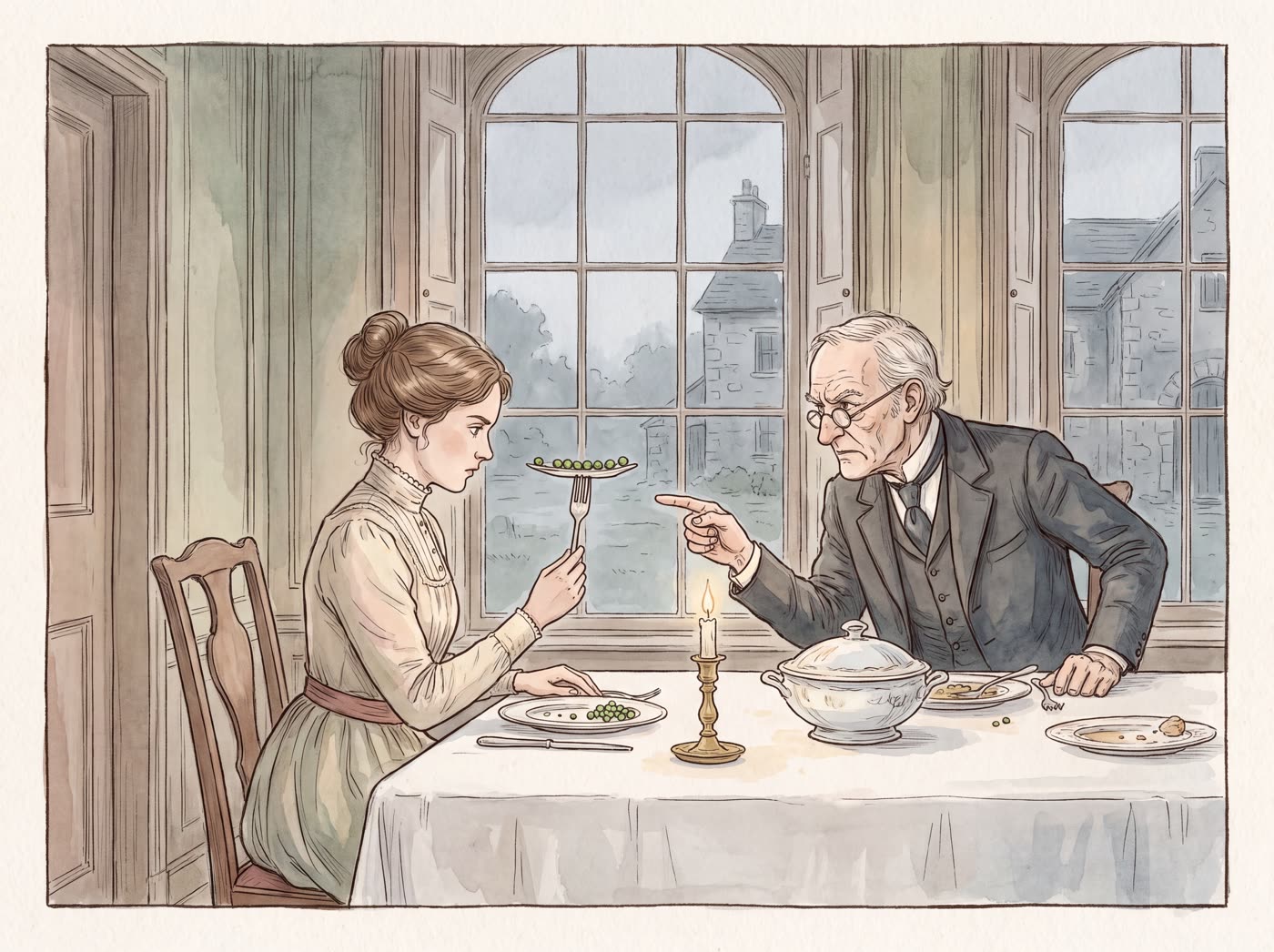
There was a young lady from Cork,
Whose Dad made a fortune in pork;
He bought for his daughter
A tutor who taught her
To balance green peas on her fork.
Where the rhyme comes from
This limerick is anonymous, and no author has ever been traced. It is, however, older than most of the joke-book verses it now keeps company with: it appears — unsigned — in The Smile on the Face of the Tiger: A Collection of Limericks, published in Boston by Bacon and Brown in 1908 and generally attributed to the editor Charles Knowles Bolton. There the opening line runs “There was a young lady of Cork, whose Pa made a fortune in pork”; the “from Cork” and “Dad” wording we print above is the version that has settled into modern children’s collections. That kind of drift is completely normal for limericks, which have always travelled by word of mouth, postcard and playground rather than by careful publication. Bolton’s own preface admitted the difficulty: limericks, he wrote, “achieve an enormous circulation — verbally”, which makes both authorship and accurate text hard to pin down.
The form has a clearer story. The first English collections of these five-line comic verses appeared around 1820, in little books such as The History of Sixteen Wonderful Old Women (1821) and Anecdotes and Adventures of Fifteen Gentlemen (c. 1822). Edward Lear read the latter and borrowed the shape for A Book of Nonsense in 1846, illustrating every verse himself, and it was that book which made the form famous. Lear never used the word “limerick” — he called his verses “nonsenses” — and the name is not recorded for this kind of poem until the 1890s, after his death.
Why the Irish city of Limerick gave its name to the form is genuinely uncertain. The explanation most often repeated, and one Bolton himself passed on in 1908, is that at Irish drinking parties guests would improvise verses in turn while the company sang the refrain “Will you come up to Limerick?” between them. It is a charming account, but it has never been documented, and scholars treat it as tradition rather than established fact.
What does it mean?
Unlike an old nursery rhyme, this verse hides no politics and no buried history. It is a joke about money and manners, and the joke is entirely in the last line. A pig farmer grows suddenly rich, and the first thing his new fortune buys is not a house or a horse but a private tutor — whose great achievement, after all that expense, is teaching the daughter to balance peas on the back of a fork.
That was a real Victorian and Edwardian point of etiquette: polite diners were expected to eat peas from the convex back of the fork rather than scoop them, an absurdly difficult rule that quickly became a byword for fussy gentility. The verse is gently mocking the newly-wealthy for buying the outward polish of good breeding — and getting very little for the money. It is worth saying plainly that there is no evidence the rhyme refers to any real Cork family or merchant; Cork is there because it rhymes with pork and fork, which is how limericks nearly always choose their places.
The craft is in the shape: five lines rhyming AABBA, with the long first, second and fifth lines carrying a bouncing da-da-DUM anapaestic beat, and the two short middle lines (“He bought for his daughter / A tutor who taught her”) quickening the pace and making you wait. Those two lines also carry the sneakiest rhyme in the poem — daughter and taught her — a trick of splitting a phrase to make it rhyme that limerick writers have always loved.
Sharing it with children
Limericks live on timing, so say it aloud rather than reading it silently. Take the first two lines at a steady jog, run the two short lines quickly together, then pause for a beat before delivering “to balance green peas on her fork” slowly and with a completely straight face. The pause is what gets the laugh. Let children tap the da-da-DUM beat on their knees to feel why the rhythm is so catchy, and notice how the short lines have fewer taps.
Then try it. A plate of peas, a fork held upside down, and a solemn tutor’s voice make this one of the few poems that comes with a built-in game — see who can carry the most peas across the kitchen without a spill (dried peas and a tray save a good deal of mopping). Older children can hunt for the hidden rhyme in “daughter / taught her”, then write their own five lines: give them a first line ending in an easy place name, remind them of the AABBA pattern and the two short lines, and let the silliest ending win.
Extra verses to recite
These verses aren’t traditional — they’re ours. Add them if the story deserves a proper ending.
The tutor was paid in fine style,
And taught her to curtsey and smile;
But the peas, being round,
Kept escaping to ground,
And rolling for half of a mile.
So she laid down her elegant fork,
And went back to her father’s good pork;
“You may teach her,” said he,
“How to pour out the tea —
But a pea is a pea, here in Cork.”