Young Lady of Kent
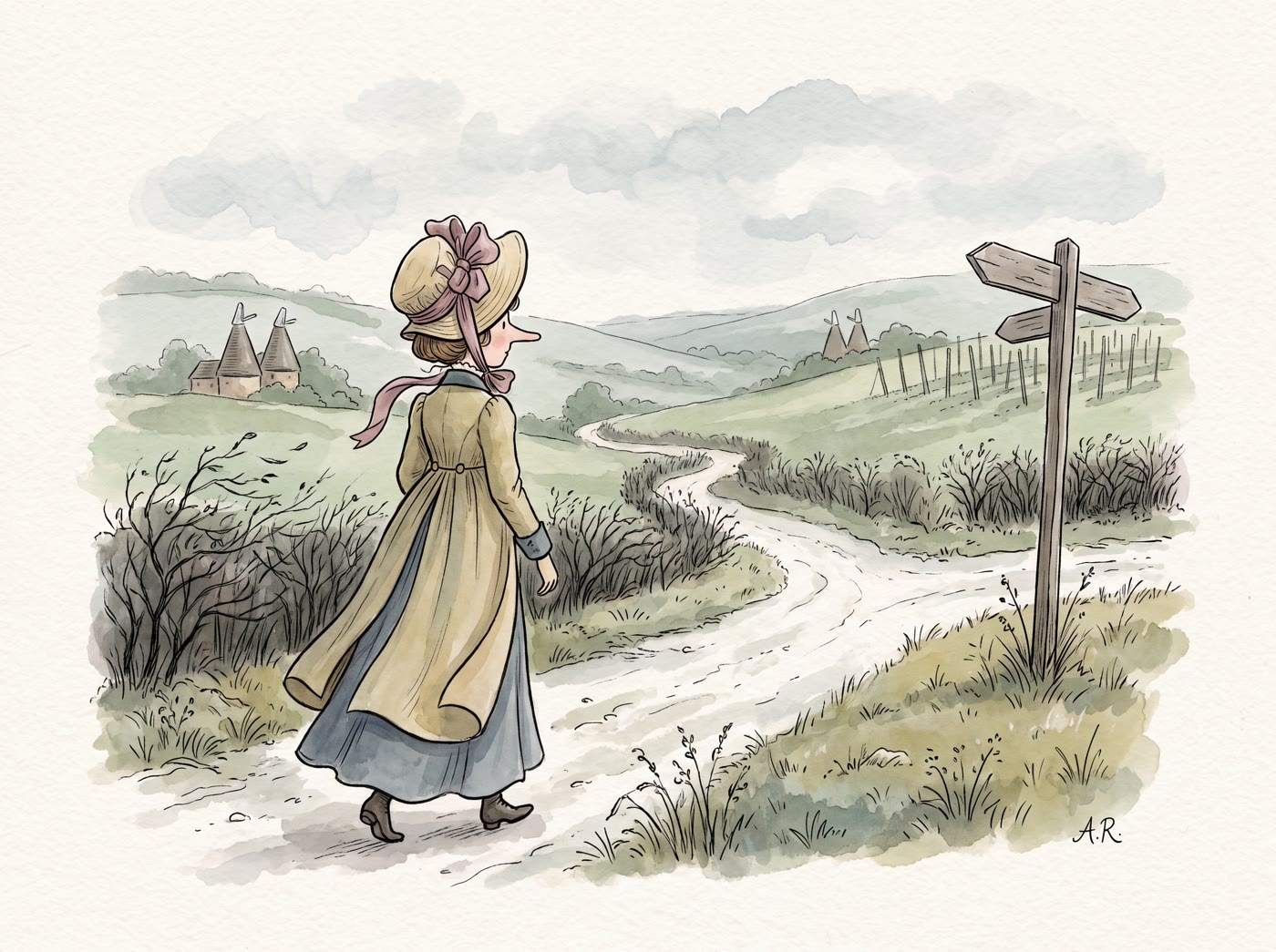
There was a young lady of Kent,
Whose nose was most awfully bent.
She followed her nose
One day, I suppose,
And no one knows which way she went.
Where the rhyme comes from
No author is known for this little verse, and no first printing has been pinned down. It belongs to the enormous anonymous stock of “There was a young lady of —” limericks that circulated in Victorian and Edwardian comic papers, schoolyards and party-piece collections, and it survives today mostly in anthologies of children’s and pub limericks. Any confident claim about who wrote it, or about a real lady of Kent, should be treated as guesswork.
The form itself has a firmer history. The five-line, AABBA shape was made famous by Edward Lear in A Book of Nonsense (1846), although Lear did not invent it — earlier examples appear in The History of Sixteen Wonderful Old Women (1820) and Anecdotes and Adventures of Fifteen Gentlemen (c. 1821). Lear’s verses opened almost exactly as this one does, naming a person and a place in the first line, and several of his best-loved examples are about remarkable noses — including “There was a Young Lady whose nose / Was so long it reached to her toes.” The name “limerick” for the form is not recorded until the 1890s, and why the Irish city’s name attached itself to it is still unsettled; the popular link to a party song with the chorus “Will you come up to Limerick?” is a plausible theory rather than a proven one.
What does it mean?
This is nonsense verse, and it means very little on purpose — but the joke is neatly built. It hangs on taking a common English idiom absolutely literally. To “follow your nose” means to go straight ahead, or to trust your instincts. If your nose points sideways, then following it faithfully must lead you somewhere unexpected, and the punchline simply shrugs: no one knows where she ended up.
The throwaway “I suppose” in the fourth line is doing quiet work too. The narrator admits he is making the whole thing up, which is the characteristic limerick manner — mock seriousness collapsing into a shrug. Readers sometimes look for a moral about vanity or about blindly following instinct; there is no evidence the verse was ever meant that way, and reading it as pure wordplay is the safer bet.
Kent, it should be said, is doing nothing but rhyming. Like most limerick place names it was chosen because it chimes with “bent” and “went”, not because the county has any particular claim on crooked noses.
Sharing it with children
Limericks live or die on rhythm, so read it out loud and lean into the bounce: two strong beats in the short middle lines, three in the long ones. Children pick the pattern up astonishingly fast if you clap or tap the beats on your knees while you recite.
Then pause before the last line and let them guess it — the surprise ending is the whole pleasure of the form. Once they know the verse, it makes a lovely first writing game: keep the opening “There was a young lady of …” and swap in your own town, then hunt for two rhymes to finish it. Wobbly rhymes and silly endings are entirely in the spirit of the thing. Younger children enjoy acting it out, walking around the room following a pointed finger held crookedly in front of their face and bumping gently into the furniture.
Extra verses to sing
These verses aren’t traditional — they’re ours. Recite them if you’d like to know where she got to.
They searched all the lanes and the shore,
They knocked on each Canterbury door.
But her nose, bearing left,
Had her hopelessly deft—
She was three counties over by four.
She writes to us now, and she’s content:
“I never once knew where I went,
But a nose on the skew
Finds a marvellous view,
And I’ve seen rather more than of Kent.”