A Painter From Great Britain
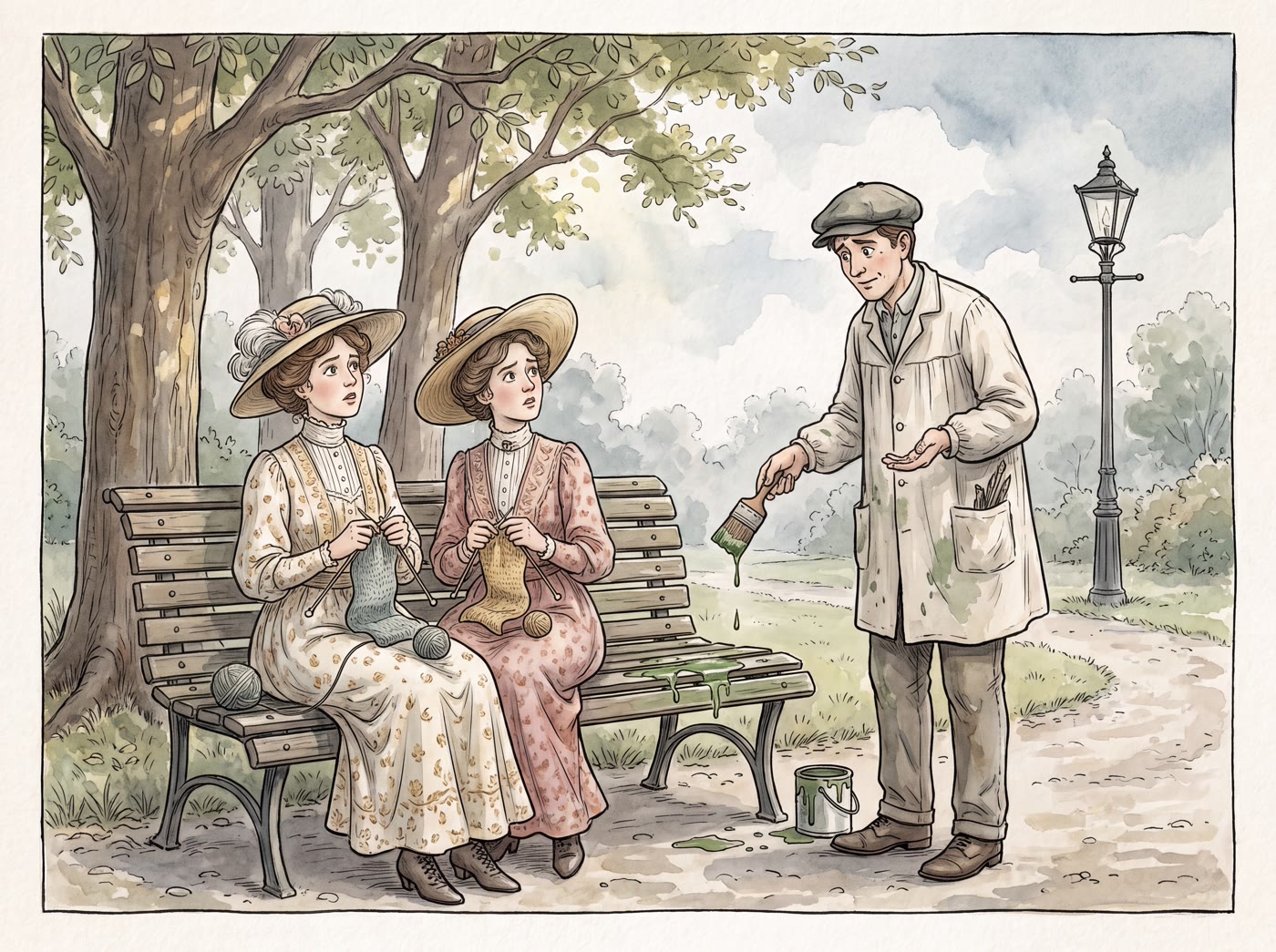
A painter, who lived in Great Britain,
Interrupted two girls with their knittin’.
He said, with a sigh,
“That park bench — well I
Just painted it right where you’re sittin’.”
Where the rhyme comes from
This little verse is anonymous. It circulates today in schoolbooks, joke collections and children’s poetry anthologies with no author’s name attached, and no first printing has been traced — which is entirely normal for limericks, a form that has always spread by word of mouth, postcard and playground rather than by publication.
The form itself has a much clearer history. The first English collections of these five-line comic verses appeared around 1820, in little books such as The History of Sixteen Wonderful Old Women (1821) and Anecdotes and Adventures of Fifteen Gentlemen (c. 1822). Edward Lear read the latter and borrowed the shape for A Book of Nonsense in 1846, illustrating every verse himself; that book, and the two hundred-odd nonsense verses that followed it, made the form famous. Curiously, Lear never called them limericks — he called them “nonsenses”. The word limerick for this kind of poem is not recorded until the 1890s, after his death, the earliest known use being in a letter of 1896 by the illustrator Aubrey Beardsley.
Where the name came from is genuinely uncertain. The most commonly repeated suggestion links it to a Victorian party game in which each guest improvised a nonsense verse and the company sang the refrain “Won’t you come up to Limerick?” between turns — a plausible theory, but one nobody has been able to document.
What does it mean?
Unlike an old nursery rhyme, this verse hides no history and no politics. It is a joke, and the joke is the last line. For four lines the painter is merely polite and apologetic; the rhyme scheme sets up Britain, knittin’ and then, after the short third and fourth lines have kept us waiting, lands on sittin’ and the realisation that the news has come far too late.
That structure is the whole craft of a limerick: five lines, rhyming AABBA, with the long first, second and fifth lines carrying a bouncing da-da-DUM anapaestic beat and the two short middle lines quickening the pace before the punchline. The dropped g in “knittin’” and “sittin’” is doing real work — it forces the rhyme and gives the painter a casual, conversational voice, which makes his terrible timing funnier still.
You will sometimes see the verse presented as an old British folk rhyme or attributed to Edward Lear. There is no evidence for either claim; the tone and the punchline-driven ending are modern rather than Learian, and it is safest to treat it simply as an anonymous comic limerick of the sort that has been written by the thousand since the 1900s.
Sharing it with children
Limericks live on timing, so read it aloud rather than silently. Take the first two lines at a steady pace, speed up through the two short lines — “He said, with a sigh, / That park bench — well I” — then pause for a beat before delivering the last line slowly and with a straight face. The pause is what gets the laugh. Let children clap or tap the da-da-DUM beat on their knees to feel why the rhythm is so catchy.
Once they know it, they can act it out: two children knitting with imaginary needles on a row of chairs, one child arriving with an imaginary brush and a very apologetic sigh. Ask them what the painter should have said, and when. Older children can try writing their own: give them a first line ending in an easy place name, remind them of the AABBA pattern and the two short lines, and let the silliest ending win.
Extra verses to recite
These verses aren’t traditional — they’re ours. Add them if the story deserves a proper ending.
The girls rose in horror from sittin’,
With two stripes of green on their knittin’.
They said, “Never mind,
We’re sure you were kind —
But a sign would have been rather fittin’!”
So the painter went home to Great Britain
And painted a board, neatly written;
Now it stands in the park
Where it shines in the dark:
WET PAINT — and no lady gets bitten.