A Young Rustic Named Mallory
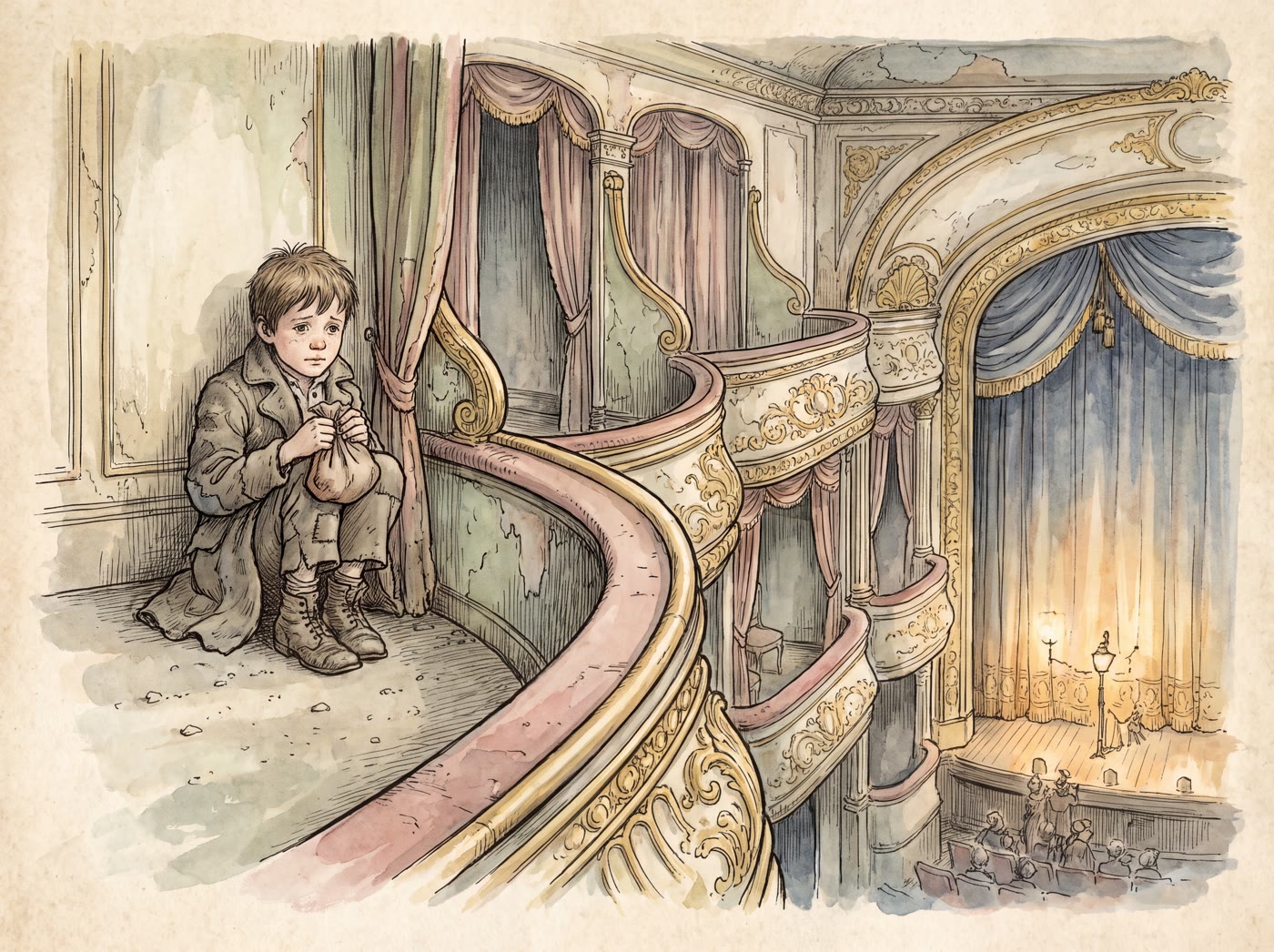
There was a young rustic named Mallory,
Who drew but a very small salary.
When he went to the show,
His purse made him go
To a seat in the uppermost gallery.
Where the rhyme comes from
Most limericks are anonymous and undatable. This one is a rare exception, and it matters far more than its modest joke suggests: it is the verse attached to the earliest known use of the word limerick for this kind of poem.
It was printed in the St John Daily News of New Brunswick, Canada, on 30 November 1880, followed by the instruction “Tune, wont you come to Limerick.” The discovery is credited to Stephen Goranson, a librarian at Duke University, whose find pushed the written record of the word back by sixteen years. Before that, the first known appearance of limerick as the name of the form was a letter of 1896 by the illustrator Aubrey Beardsley. A variant of the Mallory verse also turns up in the Canadian magazine Grip in December 1880, credited there to the New York News, so the rhyme was clearly circulating in North American papers that season.
The form itself is much older than its name. Five-line AABBA verses appear in English collections from around 1820 — The History of Sixteen Wonderful Old Women and, in 1822, Anecdotes and Adventures of Fifteen Gentlemen, the very book Edward Lear came across at Knowsley Hall. Lear made the shape famous with A Book of Nonsense in 1846, but he never called his verses limericks; he called them “nonsenses.” Nobody who wrote the early ones used the word at all.
What does it mean?
The verse’s own meaning is plain and gentle. Mallory is a country lad on poor wages who loves the theatre, and his thin purse decides where he sits: right at the top, in the cheapest bench of the highest balcony — what Victorian audiences called “the gods.” There is no cruelty in it. The joke is simply that his money, not his choice, sends him up the stairs, and the pleasure is in the long tumbling triple rhyme of Mallory — salary — gallery.
Its real interest is what it tells us about the word limerick. The 1880 note “Tune, wont you come to Limerick” points to a party custom described in Notes and Queries in 1898 and later echoed by the Oxford English Dictionary: guests took turns improvising a nonsense verse, and everyone joined a chorus of “Will you come up to Limerick?” On that account the poems took their name from the song, and Mallory is a surviving example of one such improvised turn.
Two rival explanations are commonly repeated, and both should be treated as theory rather than fact. The first traces the form to the 18th-century Maigue Poets of County Limerick, whose verses were translated in John O’Daly’s The Poets and Poetry of Munster (1850); the difficulty is that nobody called the verses limericks then, and the name surfaces only much later. The second, argued from this very newspaper item, is that the name arose in North America from the US Civil War slang phrase “come to Limerick,” meaning come to the point or submit — an intriguing idea, but a large edifice of conjecture resting on one isolated Canadian citation. The lexicographer Michael Quinion judged a British origin the likelier. No one can prove the matter either way.
Sharing it with children
Limericks are built out of rhythm, so let children hear the bounce first: three long lines, two short quick ones, then a long one to land the joke. Tap the beat on your knees as you recite, and exaggerate the short middle pair — “When he went to the show, / His purse made him go” — so the gear-change is unmistakable.
Then play with the rhyme. Mallory, salary and gallery are a lovely three-syllable chime, and children enjoy hunting for more words that ride the same pattern. Ask what the topmost gallery would look like: how many stairs, how small the actors, whether Mallory could see anything at all. Older children can keep the meter and swap the name and the place — a young farmer named Hillary, a young baker named Salisbury — which is one of the friendliest first exercises in writing verse there is. Since this rhyme was sung rather than spoken in 1880, you can also try chanting it to a jig beat and adding a shouted chorus of “Will you come up to Limerick?”
Extra verses to sing
These verses aren’t traditional — they’re ours. Add them if Mallory deserves a better seat.
He climbed till the staircase was over,
Past the boxes of velvet and clover,
And the stage, far below,
Was a candle’s worth of glow,
With the actors no bigger than plover.
But he sang every word of the ballad,
And he wept when the ending was pallid,
And he said, climbing down,
“There’s no better seat in the town—
For up there, sirs, the tunes arrive valid!”