Young Girl Named Heather
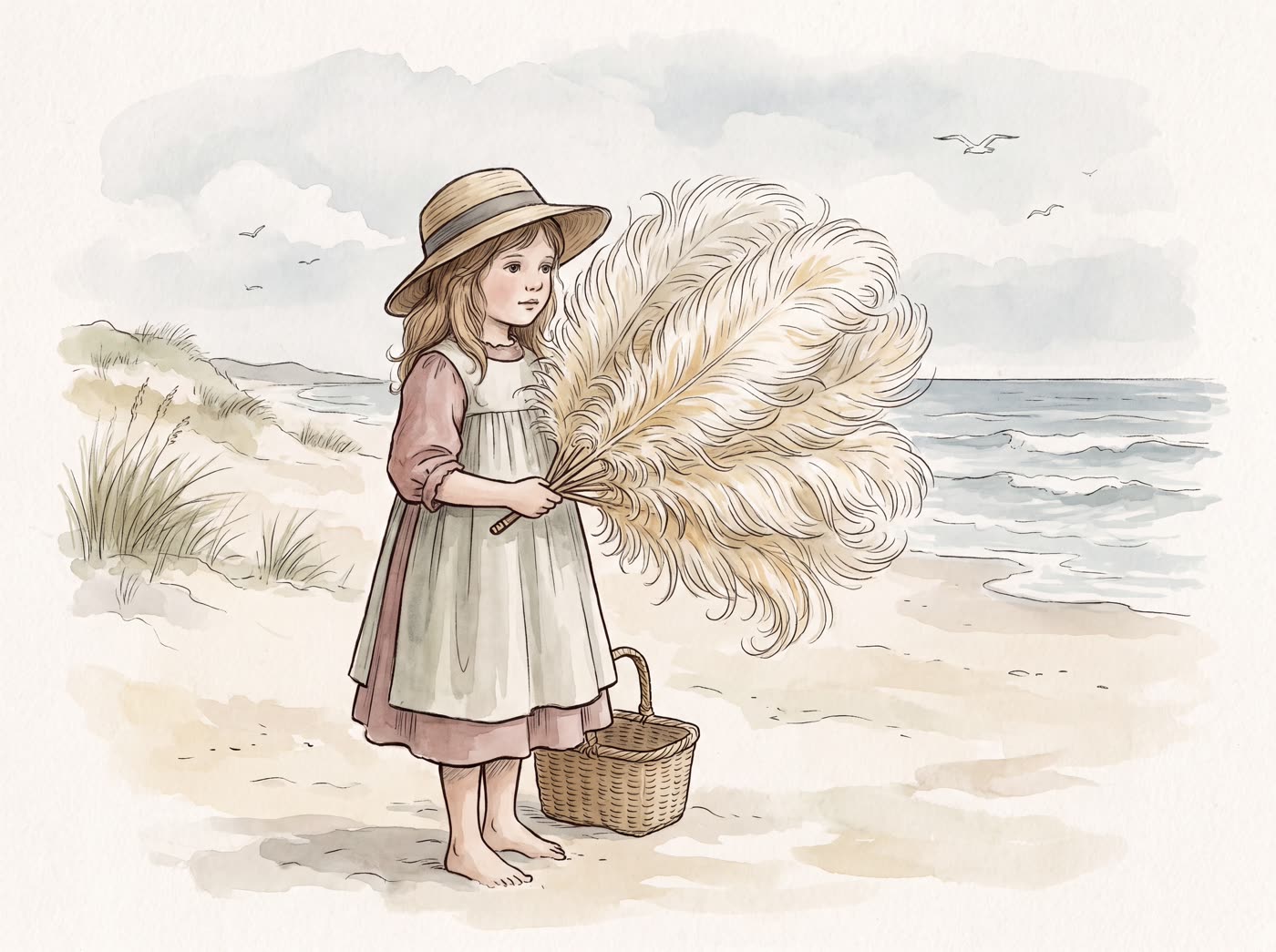
There was a young girl named Heather,
Who played on the beach in hot weather.
She thought it a sin,
Just dressed in her skin,
So covered herself with a rather large feather.
Where the rhyme comes from
No author’s name travels with this verse. It belongs to the enormous anonymous stock of seaside limericks that circulated in Britain and America through the late 19th and 20th centuries — in comic annuals, holiday postcards, newspaper competitions and schoolyard recitation. Like most oral verses it drifts: you will meet it as “a young lady named Heather,” with her sitting “on the sands” rather than playing on the beach, and with a final line that is sometimes trimmed to the tidier “so covered herself with a feather.” That variation is the ordinary signature of a rhyme passed mouth to mouth far more often than it was ever printed.
Its subject dates it fairly well. Jokes about modesty at the seaside belong to the age of bathing machines, chaperones and strict beach etiquette — roughly the 1880s to the 1930s — when what one might decently wear in the water was a genuine public argument. The ostrich plume, a fashionable accessory of exactly that era, is the perfect absurd prop.
The form it is written in has a much clearer history. The five-line AABBA verse appears in English collections around 1820, in books such as The History of Sixteen Wonderful Old Women and Anecdotes and Adventures of Fifteen Gentlemen. Edward Lear made it famous with A Book of Nonsense in 1846, though he never called his verses limericks — he called them “nonsenses.” The word limerick for the form is not recorded until the 1880s–1890s, its best-known early use being a letter by the illustrator Aubrey Beardsley in 1896.
Why “limerick” at all? The usual explanation is a theory rather than a proven fact: it links the name to an Irish party song whose chorus ran “Will you come up to Limerick?”, each guest improvising a verse before everyone sang the refrain. Others credit the 18th-century Maigue Poets of County Limerick. Neither claim can be demonstrated from the record.
What does it mean?
There is no hidden history here, and no coded scandal — this is a joke about modesty, and the whole of it turns on one comic mismatch. Heather is so concerned about propriety that she will not be seen undressed; her solution is a single feather, which conceals almost nothing at all. The punchline lands because her remedy is both perfectly sincere and completely useless.
The sound does half the work. Heather, weather and feather are a near-perfect triple rhyme, soft and feathery in the mouth, and the two short middle lines — “She thought it a sin, / Just dressed in her skin” — snap by quickly so that the long last line can take its time and spring the trap. That is the classic limerick shape: three lines to set the scene, two quick ones to wind the spring, and a fifth to deliver the joke.
You will sometimes see verses like this attributed to a named humourist, or dated to a particular magazine. Treat such claims as unverified folklore unless a source is actually shown — anonymous rhymes attract confident attributions the way old nursery rhymes attract legends.
Sharing it with children
Limericks live on rhythm, so let children hear the bounce first: three long lines, two short ones, then a long one to finish. Tap the beat lightly on your knees as you recite and they will feel the shape long before they can explain it. Lean hard into the pause before the last line — the whole joke is in the delay.
Then make it a game. Act it out with a real feather, or a paper one cut from a sheet, and let a child try to hide behind something far too small: a leaf, a postage stamp, a teaspoon. The absurdity is the humour, and children find it instantly. Ask them what else Heather might have hidden behind — a seashell, a crab, a very small dog — and you are already writing new verses together.
Older children can keep the rhyme and swap the name: a boy named Trevor, a girl named Bess. Hunting for words that rhyme with a chosen name, then bending a story to fit, is one of the friendliest first poetry exercises there is.
Extra verses to sing
These verses aren’t traditional — they’re ours. Add them if the story deserves an ending.
But a gust came along off the sea,
And it carried her feather to me,
So she borrowed instead
A striped hat for her head—
And a very large towel, out of courtesy.
Now Heather goes down to the shore
With a bathing-gown, buttoned before,
And she paddles all day
In the properest way,
With the feather kept safe in a drawer.