Young Lady Named Hannah
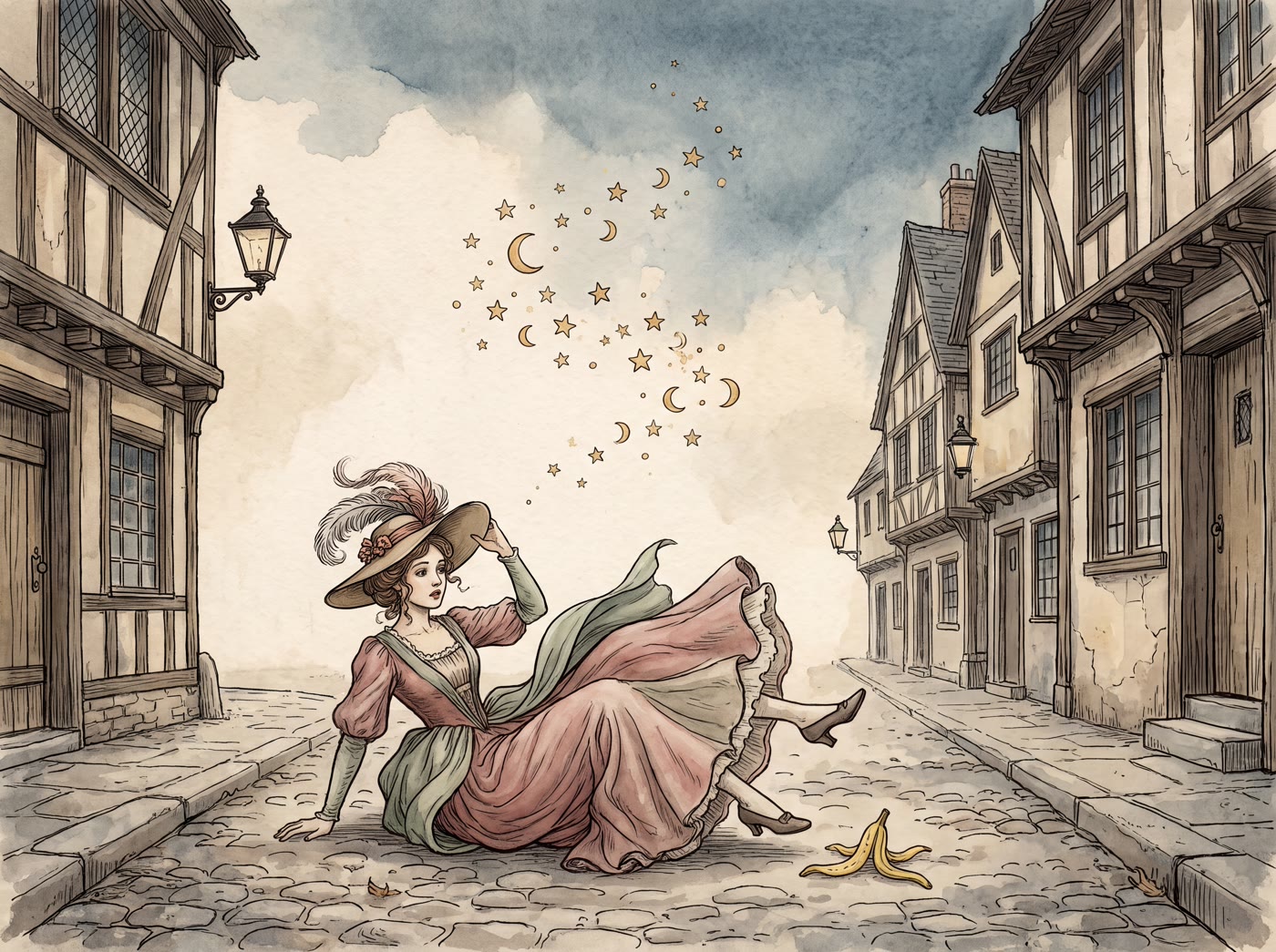
There was a young lady named Hannah,
Who slipped on a peel of banana.
As she lay on her side,
More stars she espied
Than there are in the Star-Spangled Banner.
Where the rhyme comes from
This is an anonymous American limerick that has been copied from anthology to anthology for well over a century. No author has ever been credibly attached to it: like most of the best-travelled limericks, it belongs to the long line of comic five-liners popularised by Edward Lear’s A Book of Nonsense (1846) and then written in enormous quantities by amateurs for newspapers, magazines and schoolroom collections.
Its internal clues place it firmly in America, and most likely in the late 19th or early 20th century. Bananas only became a cheap, everyday fruit in American cities after the 1870s, and the discarded banana skin quickly became the great comic prop of the age — music-hall sketches, comic postcards and silent films all made a running joke of it. The closing line leans on The Star-Spangled Banner, which was already a hugely popular patriotic song long before Congress made it the national anthem in 1931.
What does it mean?
The limerick has no hidden history, and any claim that Hannah was a real person should be treated as invention rather than fact. Its meaning is simply the joke it makes.
The pun on “stars”. The whole verse exists to set up its last line. Hannah sees “stars” in the cartoon sense of a bump on the head — and the poet then measures them against the stars on the American flag that the anthem celebrates. A small domestic mishap is compared to a national emblem, and the mismatch is the humour.
The banana-skin tradition. Some writers suggest the rhyme is a piece of gentle social comment on littering, which was a genuine urban complaint of the period. That is a plausible reading, but there is no evidence the author meant anything of the kind; it is best treated as theory, not history.
The shape of the joke. Note how the rhyme bends the pronunciation of “banana” and “Banner” to fit “Hannah”. Stretching a word to force a rhyme is a classic limerick trick, and part of the fun is hearing the poet get away with it.
Sharing it with children
Limericks live or die on rhythm, so read this one aloud with a bounce: three strong beats in lines one, two and five, and two quick beats in the short middle lines. Tap the beat on a table or clap the long lines and whisper the short ones — children hear the shape of the poem long before they can name it.
Play up the comedy. Pause dramatically before “Star-Spangled Banner” so the punchline lands, and let children act out the slip in slow motion (with cushions, and never on a real peel). Then try writing your own: keep the first line “There was a young lady named —” and let each child fill in a name, hunting for two more words that rhyme with it. Silly rhymes are welcome; the sillier the better.
Extra verses to sing
These verses aren’t traditional — they’re ours. Recite them if Hannah deserves a sequel.
The grocer came running to Hannah,
With apologies grand as a manor.
She said, from the ground,
“There’s no need to look round —
Just sweep up the rest of that banana!”
Now Hannah walks slowly and steady,
With an eye on the pavement, and ready.
But she keeps, for a lark,
One peel in the park,
For a friend who thinks slipping is heady.