Bobby Shafto
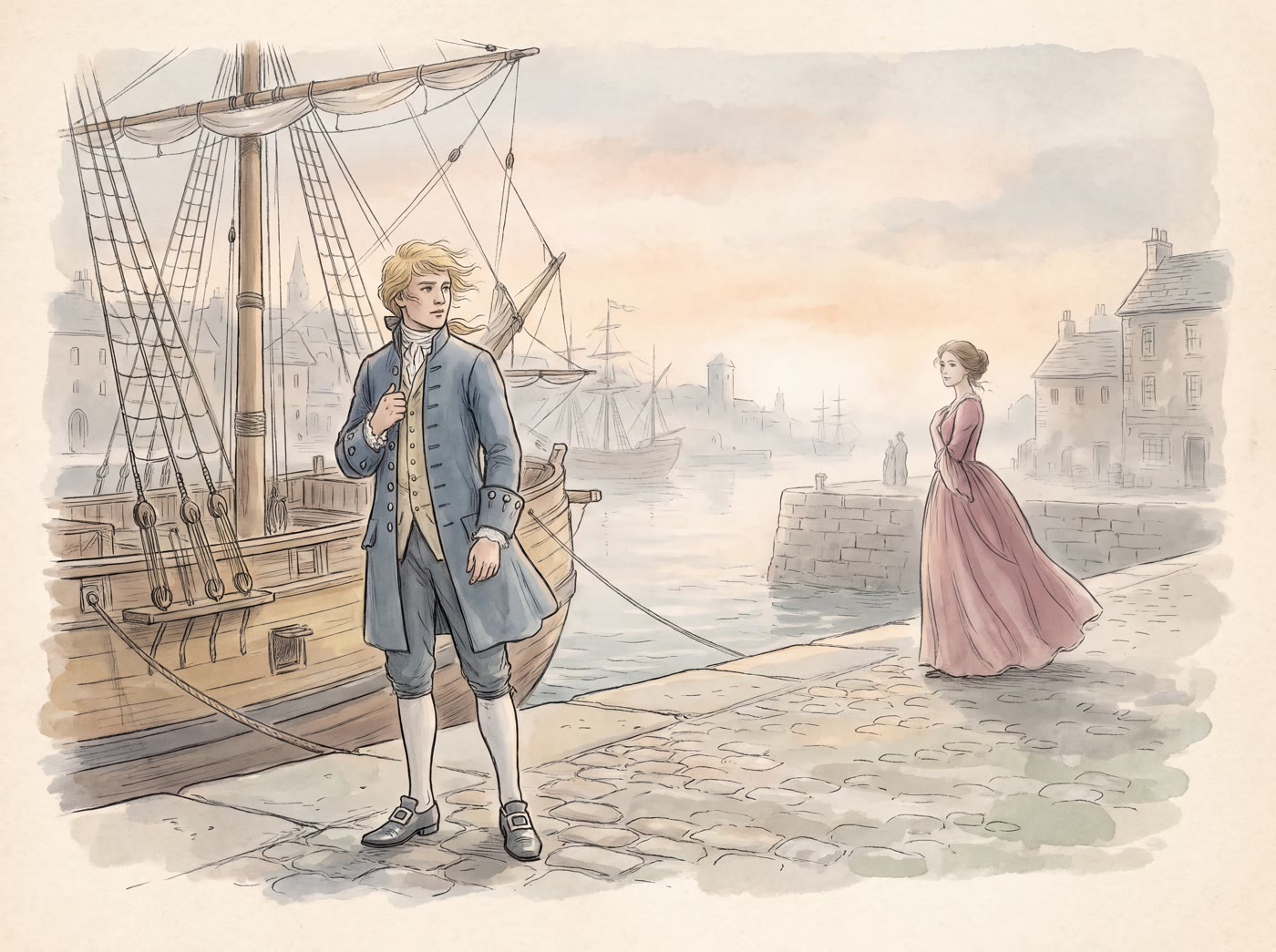
Bobby Shafto’s gone to sea,
Silver buckles at his knee;
He’ll come back and marry me,
Bonny Bobby Shafto!
Bobby Shafto’s bright and fair,
Combing down his yellow hair;
He’s my love for evermore,
Bonny Bobby Shafto!
Where the rhyme comes from
Bobby Shafto is a folk song from the north-east of England, catalogued as number 1359 in the Roud Folk Song Index, and the name is just as often spelled Shaftoe. According to the Opies, it first appears in print in 1805, in a collection called Songs for the Nursery, and the words most of us sing today are very close to that early text. We have not seen that book ourselves, so the date rests on the Opies’ account of it.
Other wordings survive. An American Mother Goose of 1946 has “fat and fair” where we have “bright and fair”, and Northumbrian versions are in dialect — “gyen to sea”, “kaimin’ doon his yellow hair”. John Bell’s Rhymes of Northern Bards (1812) is reported to add verses of its own, including one in which Bobby is “tall and slim” and always “neat and trim”. A different, later verse is said to have been added for an election: “Bobby Shafto’s looking out, / All his ribbons flew about, / All the ladies gave a shout, / Hey for Bobby Shafto!”
The tune is older than any of these words can be shown to be. It is related to a north-eastern air called “Brave Willie Forster”, which turns up in manuscripts of the 1690s and 1730s — so whoever Bobby was, the melody was not composed for him.
What does it mean?
On the surface the meaning is simple: a girl sings about her sweetheart, a sailor who is handsome, fair-haired and fine in his silver buckles, and who has gone to sea but will come back to marry her. Nothing deeper is evidenced. The usual question is a different one: whether Bobby Shafto was a real person.
Robert Shafto, MP. The most common answer is Robert Shafto of Whitworth, near Spennymoor in County Durham, who was a Member of Parliament for County Durham from 1760 to 1768. He is generally described as the likely subject, not a proven one. He used the nickname “Bonny Bobby Shafto” and the song when standing for election, and the “looking out” verse is almost certainly an election verse from around 1761. He died in 1797 and is buried in the Shafto crypt at Whitworth church. Nothing suggests he ever went to sea; he was a landowner and politician.
Other Shaftos. The Opies point to a Bobby Shafto of Hollybrook, County Wicklow, who died in 1737, before the MP, though the older tune means the song need not be about him. John Stokoe, in Northumbrian Minstrelsy (1882), recorded a tradition linking it to one of the Shaftoes of Bavington, who ran away to sea to escape a lady who was in love with him. Another Shafto has also been proposed, and the sources disagree about who he was.
The jilted sweetheart. A popular story says the song concerns Bridget Bellasis (the name is spelled several ways) of Brancepeth Castle, who is said to have been heartbroken when Robert Shafto married Anne Duncombe in 1774. This is local tradition, and the evidence for it is thin: the accounts disagree about what happened to her, and we have found no contemporary evidence. It is also hard to square with a tune from the 1690s. Treat it as a story told about the song, not as its history.
Sharing it with children
Bobby Shafto makes a good boat song. Sit a child on your lap, or sit facing each other holding hands, and rock slowly forwards and back as if rowing through the first two lines, then give a bigger rock on “Bonny Bobby Shafto”. A cushion makes a fine boat for a toy sailor.
The story of going away and coming back suits a goodbye game: wave to a favourite toy as it “sails” behind the sofa, then welcome it home on “he’ll come back”. Or swap the name — “Mummy’s gone to work”, “Daddy’s gone to the shops”, or the child’s own name — and change the buckles for whatever the person is wearing. The “silver buckles” are also a good prompt to talk about shoes and old-fashioned clothes.
Extra verses to sing
These verses aren’t traditional — they’re ours. Sing them to the same tune when the sailor needs to come home.
Bobby Shafto’s sailing home,
Over waves and white sea foam;
Now he’s here, no more to roam,
Bonny Bobby Shafto!
Wave goodbye from harbour wall,
Watch the ship grow small, so small;
Wave hello when sails appear,
Bonny Bobby Shafto’s here!