How Many Miles to Babylon
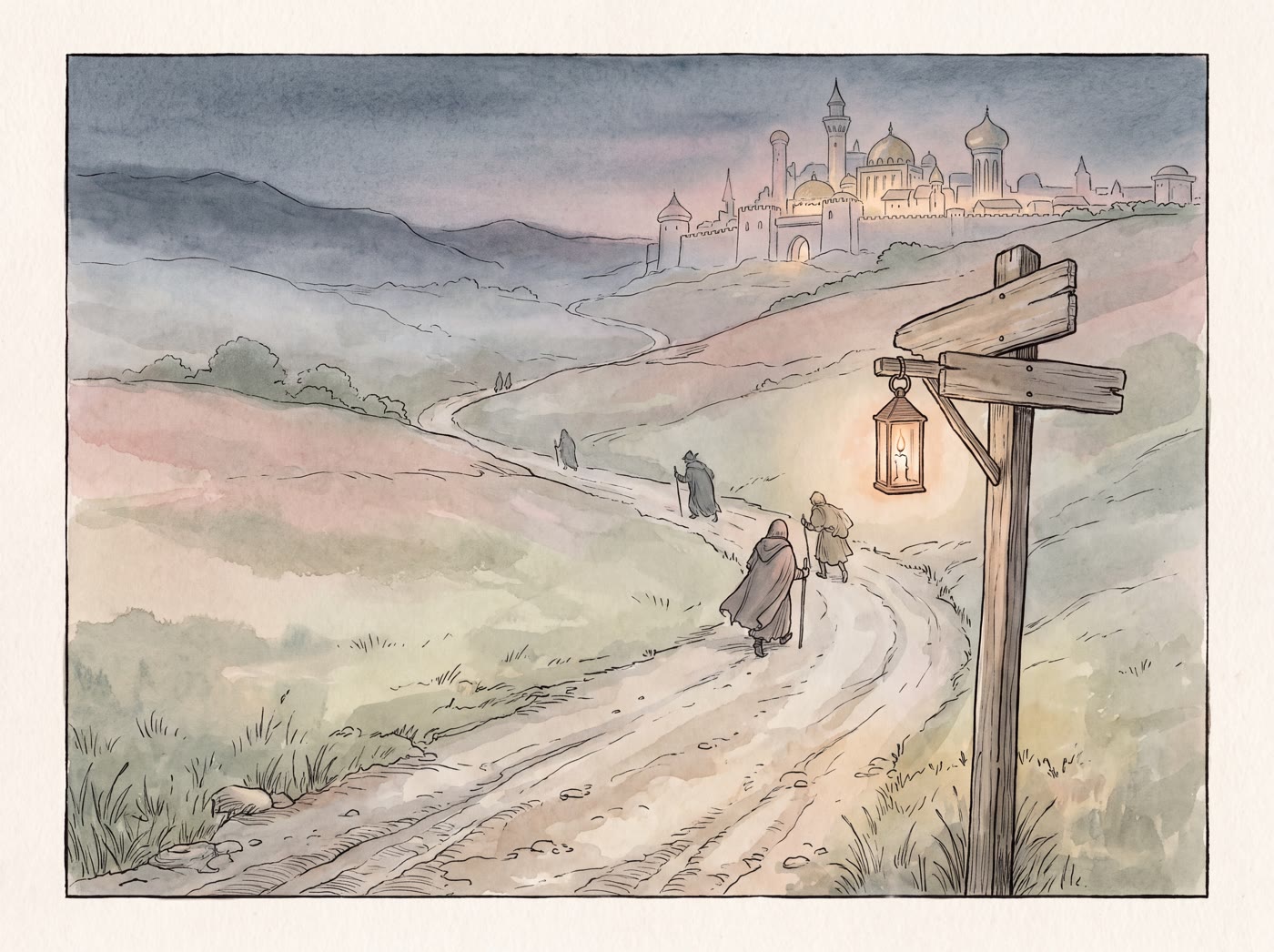
How many miles to Babylon?
Three score miles and ten.
Can I get there by candle-light?
Yes, and back again.
If your heels are nimble and your toes are light,
You may get there by candle-light.
Where the rhyme comes from
The Opies, whose Oxford Dictionary of Nursery Rhymes is the standard reference, report that the rhyme was not recorded until the nineteenth century. The exact date and the book it first appeared in are not known to us, and several websites that give a precise year do not say where it comes from, so we do not repeat one. The Roud Folk Song Index files the rhyme under number 8148.
One of its lines echoes something older. According to the Opies, “Can I get there by candlelight?” was a common saying in the sixteenth century. It refers to the hour at which a candle must be lit as daylight fades, so the question is really whether you can reach your destination before dark. They also note that the city of Babylon was a common allusion, particularly in seventeenth-century England.
And the words are not fixed. A longer Scottish version begins “King and Queen of Cantelon, / How many miles to Babylon?” and answers “Eight and eight, and other eight”, with “If your horse be good and your spurs be bright” in place of our nimble heels. It ends with a challenge: “How mony men have ye? / Mae nor ye daur come and see.” An 1824 edition of The Scottish Gallovidian Encyclopedia describes the rhyme and its game, giving the distance as “six, seven or a lang eight”. In some versions Babylon is swapped for London Town, Barberry or Berry Bright.
What does it mean?
Three score miles and ten. A score is twenty, so three score and ten is seventy: three times twenty, plus ten. It is simply the old-fashioned way of saying seventy miles.
Why “Babylon”? Nobody knows. Some have guessed that Babylon is a corruption of “Babyland”; that is speculation, and no evidence has been offered for it. The word “Cantelon” in the Scottish version has led some people to suggest Caledon in the time of the Crusades; that too is a guess, not a documented origin. Other readings circulate, but none is supported by anything we could find. The honest answer is that the meaning is unknown, and the rhyme is none the worse for it.
You may come across claims that this is a dark or sinister rhyme. The traditional words contain nothing of the kind: someone asks how far it is, is told, and is promised they can get there in time if their feet are quick. The first line has been borrowed since — Jennifer Johnston’s 1974 novel How Many Miles to Babylon? takes its title from it — but the novel is its own story.
Sharing it with children
The old game. The rhyme was once a chasing game. Two lines of players face each other with one child in the middle; at the end of the rhyme everyone has to run across to the opposite side, and anyone caught joins the player in the middle to catch the rest. The Opies suggest the game seems to have fallen out of use in the twentieth century. Red Rover, whose earliest form has the same rules, may have taken its place, though that link is necessarily speculative. A Scottish form uses a tree as base, with two catchers calling the rhyme while the others run from the tree to “Babylon”. For a group, the question-and-answer layout suits it well: one side asks the questions, the other answers.
A lap journey. Sit a child on your knees and bounce gently, as if on horseback, through the questions. On “Yes, and back again” lean right back, then forwards, and finish with a quick, light jiggle through the last two lines.
Counting to seventy. Older children can count out the miles in tens — ten, twenty, thirty, up to seventy — clapping or stepping once for each ten, and then count back down for “back again”. It makes “three score and ten” something they can feel in their feet.
Extra verses to sing
These verses aren’t traditional — they’re ours. Sing them in the same bouncing tune once the old words are familiar.
How many miles to the harvest moon?
Seven times seven and one.
Can I get there by lantern-light?
Yes, if you hurry and run.
How many miles to the sleepy town?
Not so very far.
Can I get there by candle-light?
Yes, and we’ll follow the star.