Lavender’s Blue
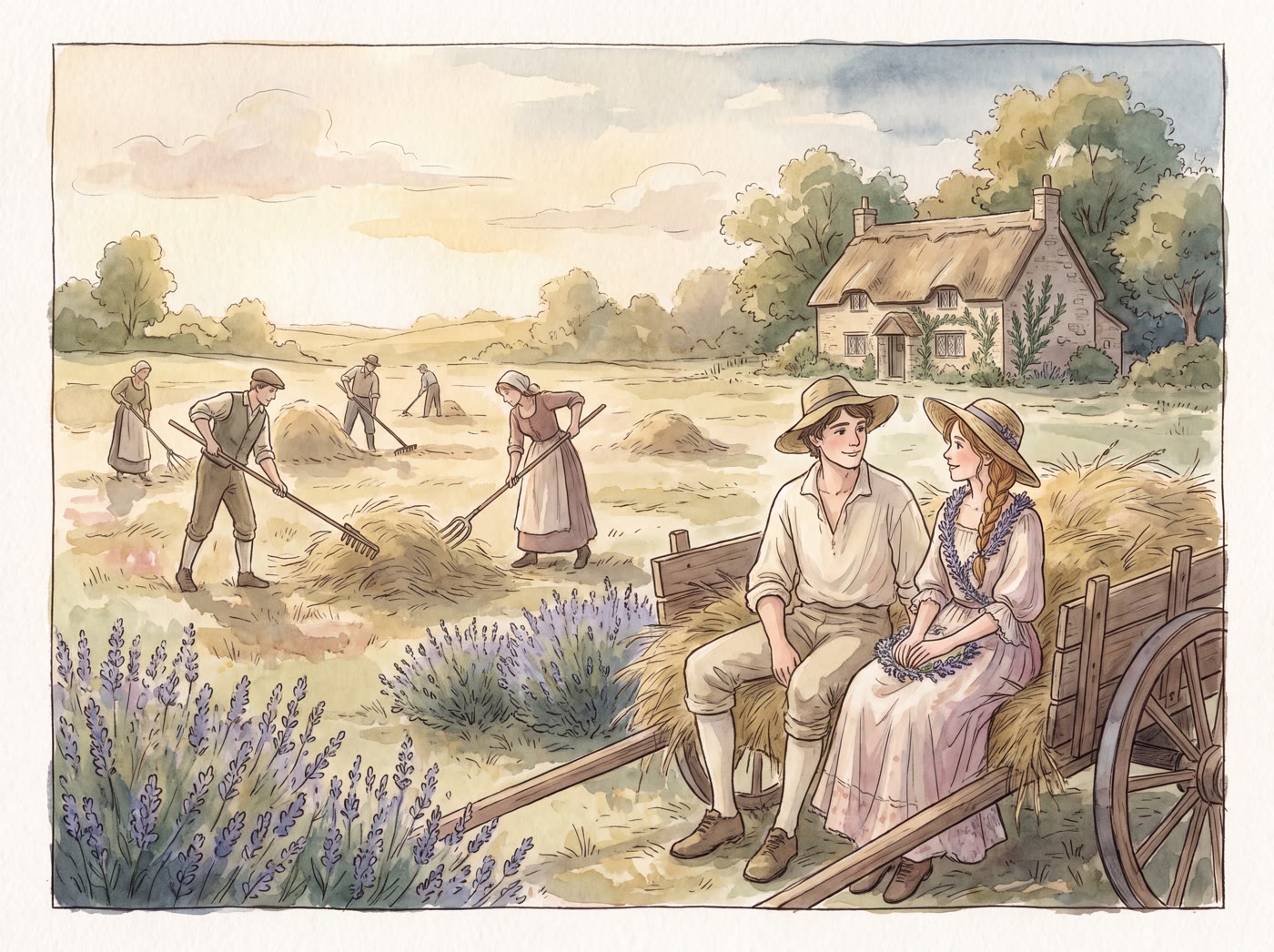
Lavender’s blue, dilly dilly, lavender’s green,
When I am king, dilly dilly, you shall be queen:
Who told you so, dilly dilly, who told you so?
’Twas mine own heart, dilly dilly, that told me so.
Call up your men, dilly dilly, set them to work,
Some with a rake, dilly dilly, some with a fork;
Some to make hay, dilly dilly, some to thresh corn,
Whilst you and I, dilly dilly, keep ourselves warm.
Where the rhyme comes from
These are the words as Halliwell printed them in Popular Rhymes and Nursery Tales (1849), a typical version rather than the only one. The song has no known author, and it has been sung in many forms — there are said to be many more verses than the two above. Film and pop versions of the twentieth century are separate songs with their own writers, and their words differ from the traditional ones given here.
The earliest surviving version is not a nursery rhyme at all. It is a London broadside called “Diddle, Diddle, or The Kind Country Lovers”, printed in the 1670s and licensed “with allowance, Ro. L’Estrange”, to be sung to a tune called “Lavender Green” — which suggests the tune was already known. It was a bawdy country courting song, and it was not meant for a child. It has the same lavender, the same refrain and the same order to call up the workers to the hay and the corn; only it spells the refrain “diddle, diddle”, and opens with green before blue. The scholars who have dated it do not quite agree on the year, so we say only the 1670s.
By 1805 a cleaned-up form had reached a children’s book. The Opies, in the Oxford Dictionary of Nursery Rhymes, give it from Songs for the Nursery (1805) as six lines beginning “Lavender blue and Rosemary green”. We cannot say it was the first nursery printing, only that it was in print for children by then. Walter Crane included a “diddle, diddle” arrangement in The Baby’s Opera (1877), with a plough and a cart where Halliwell has a rake and a fork. In the Roud Folk Song Index it is number 3483.
What does it mean?
A courting song turned lullaby. This is the plain history rather than a theory: a seventeenth-century song of country lovers, trimmed over the generations until it was safe for the cradle. What remains is a small story of two people, a promise and a farm at work.
King and queen. “When I am king … you shall be queen” has been linked with Twelfth Night, when a king and queen of the festivities were chosen. Halliwell and later writers have noted the association. It is only an association: nothing proves that the song began as a Twelfth Night game, and the words may simply be a lover’s promise.
Dilly dilly. The refrain is a nonsense filler, there to carry the tune, and we know of no evidence for any hidden meaning. The older spelling is “diddle”, and Walter Crane still printed “diddle” in 1877; “dilly” is the form Halliwell gives.
Sharing it with children
As a lullaby. The refrain makes it easy to rock to. Hold the child close and sway slowly, a gentle rock on each “dilly dilly”, and slow the tune right down by the last line.
Colour and scent. If you can find real lavender, let the child hold a sprig, crush a flower between the fingers and smell it. The 1805 text also names rosemary, so a sprig of that makes a good partner. Ask what colour each one is — blue-grey, green — and see whether the child can match the colours to the first line.
King, queen and workers. The second stanza is a game waiting to happen. Choose a king and a queen (paper crowns will do), and let the rest of the family be the workers. On “Call up your men” the monarchs point; on “some with a rake” everyone rakes, on “some with a fork” they fork, and on “some to make hay” and “some to thresh corn” they toss and beat. Swap the crowns round for the next go.
Extra verses to sing
These verses aren’t traditional — they’re ours. One for the lavender, and one for winding down at the end of the day.
Lavender’s blue, dilly dilly, rosemary’s green,
Smell them both, dilly dilly, the sweetest you’ve seen;
Rub them gently, dilly dilly, between your hands,
Then we’ll sing, dilly dilly, of faraway lands.
Hay is all raked, dilly dilly, the day is done,
Lay down your fork, dilly dilly, the work is won;
Close your eyes, dilly dilly, the sky turns blue,
Lavender dreams, dilly dilly, are coming for you.