Curly Locks
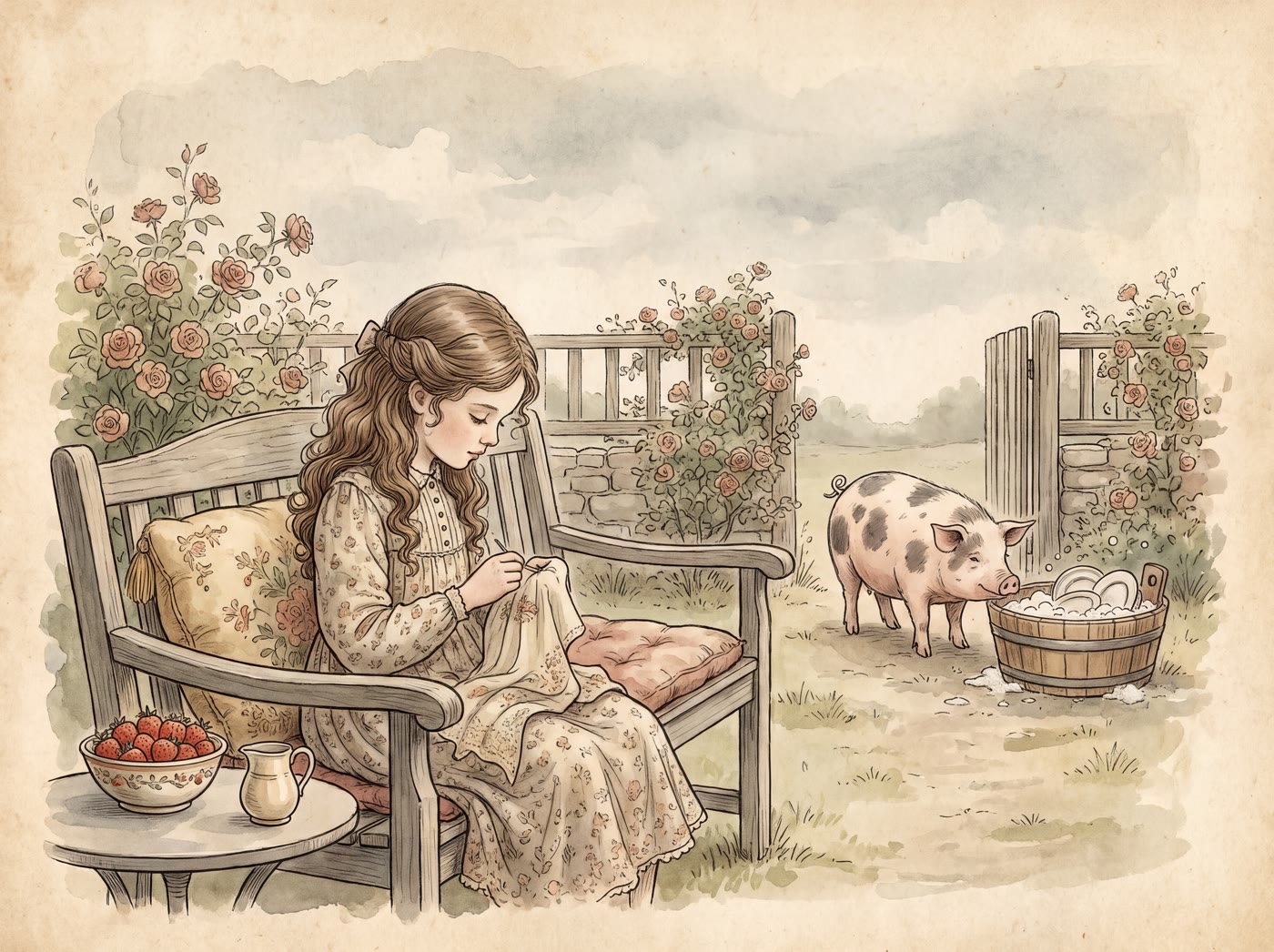
Curly locks, curly locks,
Wilt thou be mine?
Thou shalt not wash dishes,
Nor yet feed the swine;
But sit on a cushion,
And sew a fine seam,
And feed upon strawberries,
Sugar and cream.
Where the rhyme comes from
Nobody knows who first made up “Curly Locks”, and its early history is thinly documented. The rhyme was recorded by the end of the eighteenth century — Iona and Peter Opie, in The Oxford Dictionary of Nursery Rhymes, are reported to cite 1797 — and it was well known to Victorian collectors, who printed it more than once. The words above are the standard Victorian wording, as found in National Rhymes of the Nursery, the collection introduced by George Saintsbury.
The wording has never been quite fixed. Some modern versions give “Will you be mine? You shall not wash dishes, nor feed the swine”, and the last-but-one line wanders between “feed upon” and “sup upon” strawberries. A Cumberland dialect version quoted by Alice Bertha Gomme in The Traditional Games of England, Scotland, and Ireland (1894) begins “Bonny lass, canny lass, wilta be mine?” and promises that she shall “nowder wesh dishes nor sarra the swine” — the same offer in northern speech.
Gomme also records that the verses belonged to a game. A girl and a boy stepped away from the other children, and the boy, stroking the girl’s curls, sang the verses to her. In her words, the game was “evidently a dramatic representation of wooing”. That is a piece of history, not a suggestion for the nursery.
What does it mean?
The plain sense is the whole sense: a suitor asks a girl to be his, and sweetens the offer with a life of ease. “Curly Locks” is simply an affectionate nickname for a child or young woman with curly hair. No hidden meaning has ever been evidenced, and we have found no reputable source that claims one.
Sound over sense. Saintsbury made the best-sourced comment on the rhyme in his introduction to National Rhymes of the Nursery. He did not think the housewifely “fine seam” was meant as a bait: “Sew” and “seam” went naturally together, they made a pleasing alliteration, and “seam” rhymed with “cream”. It is a persuasive reading, and a good reminder that nursery rhymes are often chosen by ear.
The old words are worth a moment with children. Wilt thou means “will you” and thou shalt not means “you will not have to”. Swine are pigs, and feeding them was an ordinary farm chore. A seam is the join where two pieces of cloth are stitched together, and a fine seam is a small, neat one. Our own observation is that the rhyme reflects the domestic expectations of its day: its picture of the good life is a cushion, some needlework and a bowl of strawberries.
Sharing it with children
Brush a child’s hair, or a favourite doll’s, while you say the first two lines, and let them answer the question themselves — the rhyme asks for a reply. Dress-up works well too: a cushion and a piece of cloth to “sew” with (a mimed needle is safest) are all the props needed for the second half.
A “what would you rather do?” game follows naturally. Offer the chores from the rhyme (washing dishes, feeding the pigs) against the treats (sitting on a cushion, sewing, strawberries and cream), then swap in chores and treats from your own house. Children usually have firm opinions, and it is a gentle way to talk about who does what at home. Or simply read the rhyme at snack time with a bowl of strawberries and a little cream.
Extra verses to sing
These verses aren’t traditional — they’re ours. Sing them in the same bouncing rhythm as the old words.
Curly locks, curly locks,
Say what you’ll do:
Will you hang out the washing
Or tidy a shoe?
Or sit on a cushion
And read me a rhyme,
And eat buttered toast
At tea-time?
Curly locks, curly locks,
Clever and kind,
Thou shalt choose the story,
And I’ll not mind;
Thou shalt pick the berries
And thou shalt have the cream,
And we’ll share them together
In the sun’s warm gleam.