There Was a Little Girl
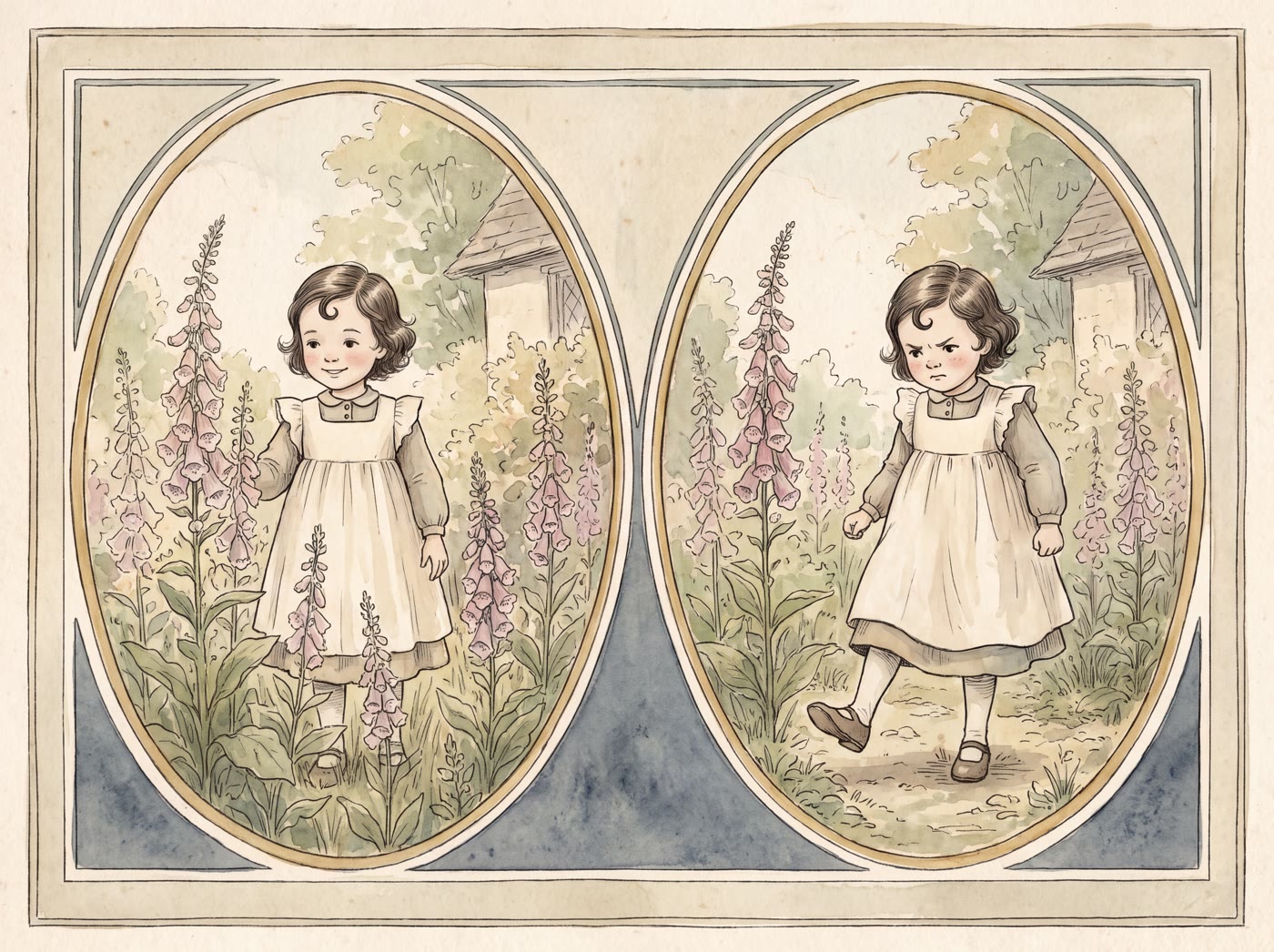
There was a little girl,
Who had a little curl
Right in the middle of her forehead.
When she was good,
She was very, very good,
But when she was bad she was horrid.
Where the rhyme comes from
The rhyme is usually credited to the American poet Henry Wadsworth Longfellow, who died in 1882. The credit rests on family recollection rather than on a text printed in his lifetime. The main witness is his son Ernest, who wrote in Random Memories (1922) that his father, walking up and down with a baby daughter in his arms, “composed and sang to her the well-known lines”. Ernest adds that “many people think this a Mother-Goose rhyme, but this is the true version and history” — so by the time he wrote, the verse had already drifted into the nursery.
The Oxford Essential Quotations reference points the same way. It prints the verse under Longfellow, dates its composition to 1850, and cites B. R. Tucker-Macchetta’s The Home Life of Henry W. Longfellow (1882). We have relied on that citation rather than on the book itself, so we cannot say precisely what Tucker-Macchetta wrote. Neither account is a manuscript in the poet’s hand, and we have not found one. The sensible reading is that Longfellow may well have made it up for his own child, that the case is a family tradition, and that it is not proven beyond doubt.
The wording varies. Ernest’s own version says “very good indeed” where the popular nursery version says “very, very good”, and that is the one printed above. Longer versions with extra verses also circulate, sometimes credited to Longfellow too. Their authorship is unknown, and we have left them out here.
What does it mean?
Nothing hidden, as far as anyone has recorded. No source we know of gives the rhyme a secret meaning, and we would rather say so than invent one. It is a parent’s affectionate joke about a child’s moods, and its charm is in the last line: the sudden drop from “very, very good” to a single, wonderfully expressive word. Nor have we found any evidence that the curl belonged to a real child; it is simply a vivid detail, and it makes the girl easy to picture.
Read warmly, it is about the fact that every child has good days and bad ones, and that both are part of the same person. It works best when the horrid part is delivered with a grin, so that the child hears a joke about a mood rather than a verdict on themselves.
Sharing it with children
The curl. Draw a finger in a small spiral on the child’s forehead for “a little curl”, or let them twirl a finger at their own brow. Trace it again on “right in the middle of her forehead”.
Good face, horrid face. For “very, very good” put on the sweetest face you can manage, with hands clasped and a halo smile. For “horrid”, drop your voice into a growl and pull the most dramatic scowl. Then swap, and let the child do the faces while you say the words. Most children soon want to be the horrid one, and a theatrical stamp and a laugh at the end keep it playful.
Swap in a name. “There was a little boy” works just as well, as does the name of a child in the room, or a teddy or a puppet. A puppet who is good, then horrid, then good again gives a small child a safe way to talk about feelings that are otherwise hard to name.
Speed it up. Say the first three lines slowly and dreamily, and rush the horrid line. The shift in pace is the joke, and older children enjoy hearing how the rhythm changes after “When she was good”.
Extra verses to sing
These verses aren’t traditional — they’re ours. They follow the same bouncing rhythm and give the little girl a happy ending.
There was a little girl,
Who had a little curl
That bounced when she danced in the garden.
When she was cross,
She stamped like a horse,
But she soon said a cheerful “pardon”.
There was a little girl,
Who had a little curl,
And a cuddle to end every sorry.
When the day had been grim,
She was tucked in with a hymn,
And was good again in the morning.