Three Little Kittens
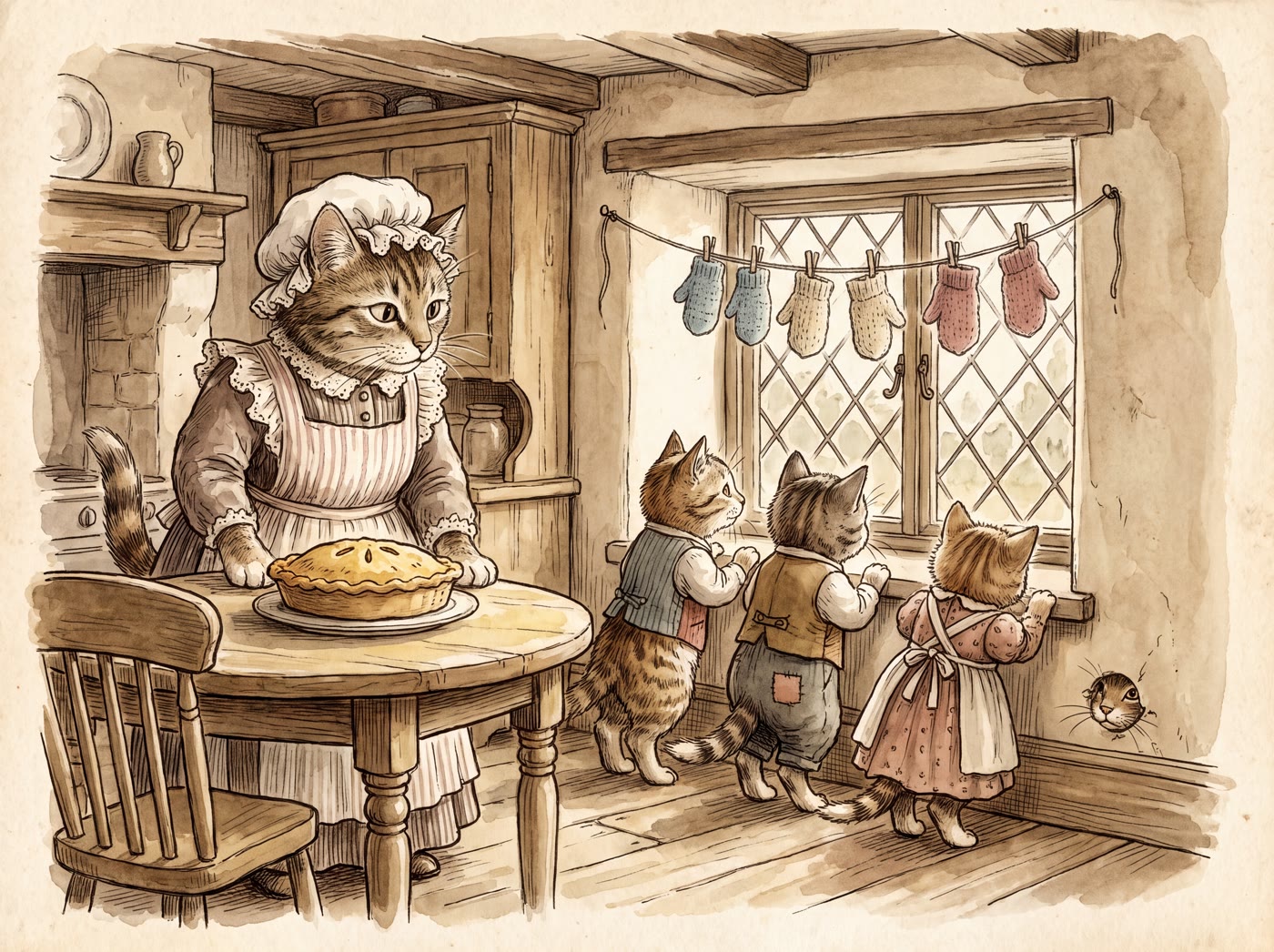
Three little kittens lost their mittens;
And they began to cry,
O mother dear,
We very much fear
That we have lost our mittens.
Lost your mittens!
You naughty kittens
Then you shall have no pie
Mee-ow, mee-ow, mee-ow.
No, you shall have no pie
Mee-ow, mee-ow, mee-ow.
The three little kittens found their mittens,
And they began to cry,
O mother dear,
See here, see here;
See, we have found our mittens.
Put on your mittens,
You silly kittens,
And you may have some pie
Purr-r, purr-r, purr-r,
O, let us have the pie,
Purr-r, purr-r, purr-r.
The three little kittens put on their mittens,
And soon ate up the pie;
O mother dear,
We greatly fear
That we have soil’d our mittens.
Soiled your mittens!
You naughty kittens!
Then they began to sigh,
Mee-ow, mee-ow, mee-ow.
Then they began to sigh,
Mee-ow, mee-ow, mee-ow.
The three little kittens washed their mittens,
And hung them out to dry;
O mother dear,
Do not you hear,
That we have washed our mittens?
Washed your mittens!
O, you’re good kittens.
But I smell a rat close by:
Hush! hush! mee-ow, mee-ow.
We smell a rat close by,
Mee-ow, mee-ow, mee-ow,
Where the rhyme comes from
Most nursery rhymes have no author anyone can name. Three Little Kittens has one — and she disowned it. The rhyme is usually attributed to Eliza Lee Follen (1787–1860), a Boston Sunday-school teacher, abolitionist and author of the children’s novel The Well-Spent Hour. Her Little Songs, for Little Boys and Girls was published in Boston by Leonard C. Bowles in 1833. In the preface to the book’s first American edition, signed at Cambridge in 1832, she said she meant “to catch something of that good-humored pleasantry, that musical nonsense, which makes Mother Goose so attractive”.
The kittens’ first appearance in print is usually dated to 1833, in an English edition of that book, where the poem seems to have been added — probably by the publisher. When Follen revised the collection in 1856 she was candid about it: “Two captivating little songs, by some unknown hand, appended to the English edition, are retained.” The kittens, listed in her contents as “A Cat’s Tale”, are generally taken to be one of those two. She went on printing the poem under her name all the same, and editions after her death left the disclaimer out. The poem’s first American printing is usually given as 1843, in a retitled edition, New Nursery Songs for All Good Children, though that date rests on secondary accounts.
The idea may be older still. A rougher cat-and-kittens verse is reported in The Eton Miscellany, a schoolboy periodical printed at Eton in 1827: “The cat and her kittens / They put on their mittens, / To eat a Christmas pie.” Its kittens lose their mittens and are called naughty, but nobody finds, soils or washes anything. The scholar Janet Sinclair Gray, in Race and Time (2004), reads the familiar poem as a polished, parlour version of an older and rougher folk piece and thinks it more likely that Follen “developed and refined an existing but rude version” than wrote it from nothing. That is an interpretation rather than a proven history.
The words above are the four verses as Follen printed them in 1856, the earliest full text we have been able to read. The version most often sung today has drifted: its mother cat asks “What! Lost your mittens?”, and greets the found pair with “You darling kittens! Then you shall have some pie”. Follen’s mother is brisker — “Put on your mittens, you silly kittens”.
What does it mean?
Nothing hidden, and we have found no evidence of any secret history. It is a small moral tale in four acts — lost, found, soiled, washed — about owning up and putting things right. The kittens report every mishap to their mother, and her verdict swings with their behaviour (no pie, then pie, then “naughty kittens” again, then “good kittens”). Then, in the last lines, the poem drops its moral entirely: there is a rat close by, and cats are cats.
Sharing it with children
Go on a mitten hunt. Before you start, hide three mittens or gloves around the room. Sing the first verse with a sorrowful face, then send the child searching, and save the second verse for when all three are found.
Play the mother cat’s two moods. Her lines swing from cross to pleased and back again. Give “Lost your mittens!” a folded-arms frown and “O, you’re good kittens” a beaming purr, then swap roles so the child can be the mother.
Count the kittens. Hold up three fingers for the three kittens and wiggle one at a time on “mee-ow, mee-ow, mee-ow”.
Save it for the cold. This is the rhyme for the first chilly morning of autumn, when the mittens come out of the drawer — and for the day one goes missing.
Extra verses to sing
These verses aren’t traditional — they’re ours. A winter coda, in which for once nobody loses anything.
The three little kittens put on their mittens,
And went out in the snow;
O mother dear,
Come out, come here,
See, we have warm, dry mittens.
Warm, dry mittens!
You careful kittens,
Then out to play you go.
Purr-r, purr-r, purr-r.
Then out to play they go,
Purr-r, purr-r, purr-r.
The three little kittens took off their mittens,
And laid them by to dry;
O mother dear,
Our mittens are here,
We have not lost our mittens.
Not lost your mittens!
You clever kittens,
Then you shall have some pie.
Purr-r, purr-r, purr-r.
O, let us have the pie,
Purr-r, purr-r, purr-r.