Bye, Baby Bunting
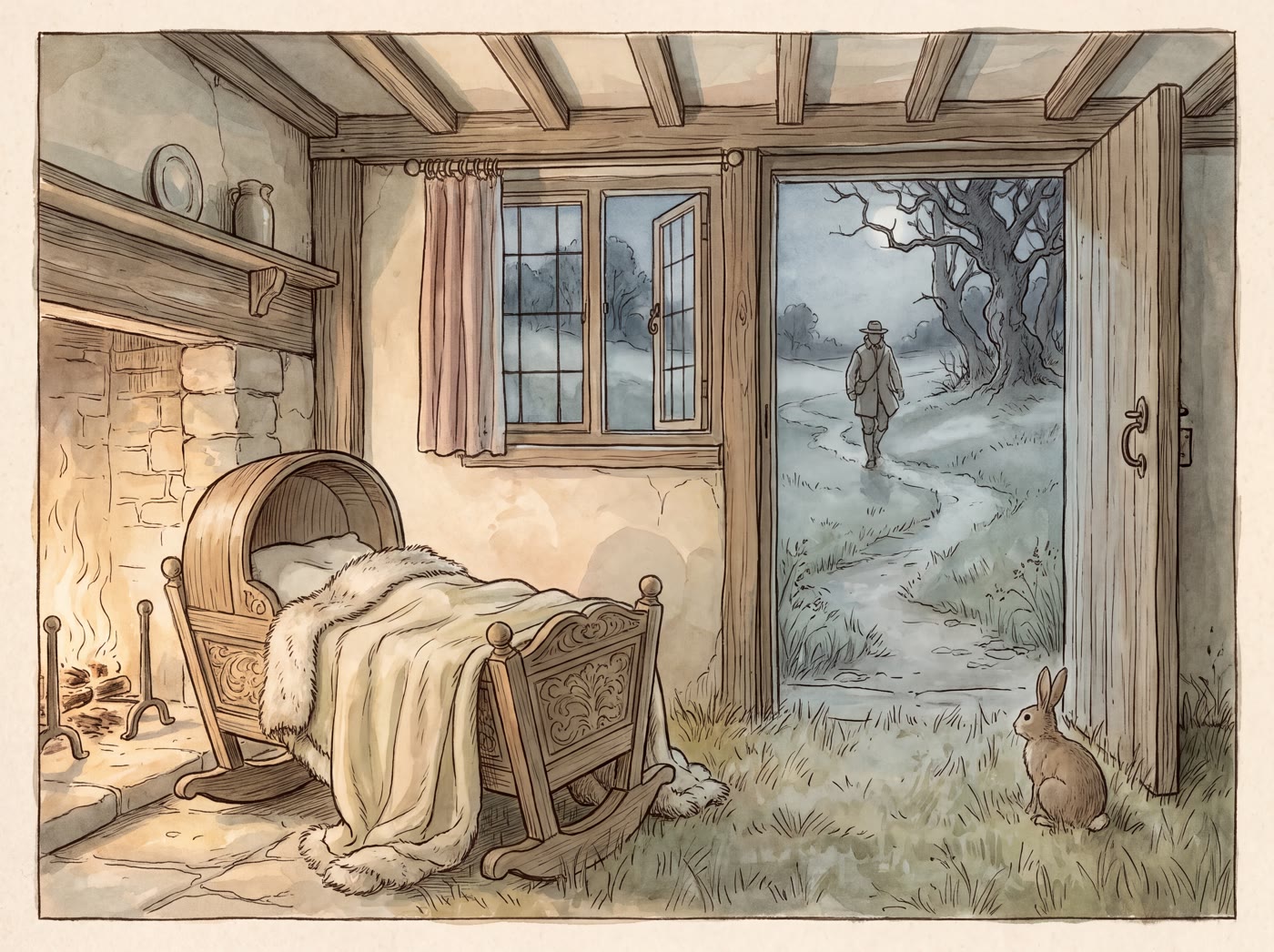
Bye, baby Bunting,
Daddy’s gone a-hunting,
Gone to get a rabbit skin
To wrap the baby Bunting in.
Where the rhyme comes from
Bye, Baby Bunting was first recorded in the eighteenth century, and it has never settled on one set of words. The earliest full text we can point to is in Gammer Gurton’s Garland, a small collection of rhymes put together by Joseph Ritson. It was first issued at Stockton, undated, and is usually placed in the early 1780s — Sir Harris Nicolas gave 1783, Joseph Haslewood thought about 1784. There the lullaby opens differently:
Bee baw bunting,
Daddy’s gone a hunting,
To get a little lamb’s skin,
To lap his little baby in.
So the father’s catch was a lamb’s skin before it was a rabbit’s. The rabbit arrives in print by 1815, when Tommy Thumb’s Song Book gives “Lullaby Baby Bunting, / Your father’s gone a hunting, / To catch a rabbit for a skin, / To wrap the Baby Bunting in”. A longer family version, in which mother, sister and brother each have somewhere to be, appears in Songs for the Nursery of about 1805:
Bye, baby Bunting,
Father’s gone a-hunting,
Mother’s gone a-milking,
Sister’s gone a-silking,
Brother’s gone to buy a skin
To wrap the baby Bunting in.
An even earlier snatch of the rhyme is reported in The Gentleman’s Magazine for April 1731, though that is a secondary report and we have not read the page ourselves. The version printed at the top of this page is the one now sung, and the Opies give it in The Oxford Dictionary of Nursery Rhymes. One small variant, “To get a little rabbit’s skin”, appears in Arthur Rackham’s illustrated Mother Goose of 1913.
What does it mean?
What is a bunting? In the rhyme it is a pet name for the baby. “Bunting” has been a term of endearment since at least the 1660s, and the origin of the word is not known. It has long been linked with plumpness: the Scots buntin means short and thick, and John Jamieson’s dictionary of Scots (1808–25) has “a buntin brat, a plump child”. The Oxford English Dictionary is cautious, suggesting only that this sense may possibly be what “baby bunting” means, “if there be any at all”. A plump, snug baby is a sensible guess, but it remains a guess.
The traffic ran the other way too. The hooded, sleeping-bag-like garment for babies, also called a bunting, is dated to 1922 in Merriam-Webster’s Collegiate Dictionary, and Webster’s Second says it is named after the baby bunting of the rhyme. The word was a nursery pet name long before it was clothing.
The rabbit skin. Parents sometimes pause at that third line. It is simpler than it sounds: the father has gone to fetch something warm to wrap the baby in, and the whole rhyme is a reassurance that someone is out working on the baby’s behalf and will be home. We know of no scholarly source that finds any hidden meaning in it, and we will not invent one.
Sharing it with children
This is a lullaby, so sing it slowly, in a low voice, with a gentle rocking beat — a swaying three-in-a-bar or a lilting six-in-a-bar both suit it. Rock the baby in your arms on each stressed word, and let the last line fade almost to a whisper.
For a toddler, make it a game with a soft toy or doll: on “to wrap the baby Bunting in”, tuck it up snugly in a blanket and give it a pat. Swap “Daddy” for Mummy, Grandad, Nanny or the name of a brother or sister, and let the child decide who has gone where. Older children can borrow the roles from the longer version — mother, sister, brother — and add the rest of the family, or the pets.
Extra verses to sing
These verses aren’t traditional — they’re ours. Sing them slowly, and put in whatever names suit your own household.
Bye, baby Bunting,
Grandad’s gone a-humming,
Gone to find a blanket warm
To keep the baby Bunting from harm.
Bye, baby Bunting,
The moon has gone a-hunting
For silver stars to light the floor
Till baby Bunting dreams once more.