Dame, Get Up and Bake Your Pies
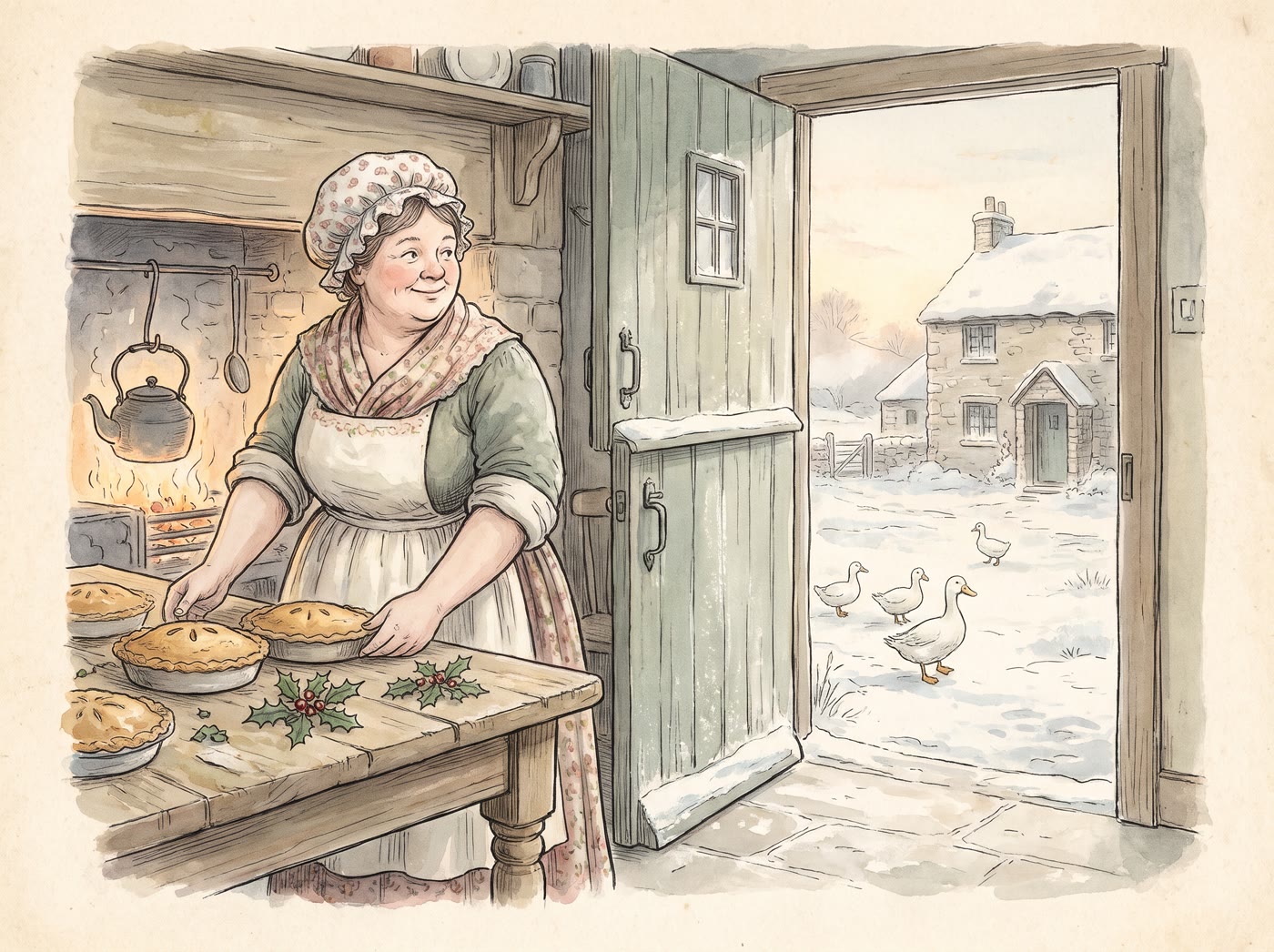
Dame, get up and bake your pies,
Bake your pies, bake your pies;
Dame, get up and bake your pies,
On Christmas day in the morning.
Dame, what makes your maidens lie,
Maidens lie, maidens lie;
Dame, what makes your maidens lie,
On Christmas day in the morning?
Dame, what makes your ducks to die,
Ducks to die, ducks to die;
Dame, what makes your ducks to die,
On Christmas day in the morning?
Their wings are cut and they cannot fly,
Cannot fly, cannot fly;
Their wings are cut and they cannot fly,
On Christmas day in the morning.
Where the rhyme comes from
The earliest printing we can trace is in Sir Cuthbert Sharp’s The Bishoprick Garland, a collection of Durham verse published in 1834. It is not quite the version above. Sharp’s text opens “Maids, get up and bake your pies”, follows with “See the ships all sailing by”, and answers the question about the ducks with a scolding: “You let your lazy maidens lie”. We have seen it only as reprinted in A. H. Bullen’s A Christmas Garland (1885), not in the 1834 book itself.
The familiar “Dame” wording, with the clipped wings, is the one James Orchard Halliwell printed in The Nursery Rhymes of England, where it stands as no. CLXXXII in the fifth edition of 1886. The same four verses, with a tune, appear in Northumbrian Minstrelsy (1882) by John Collingwood Bruce and John Stokoe. The rhyme is catalogued as number 497 in the Roud Folk Song Index. Beyond 1834 the trail goes cold: how long it was sung before anyone wrote it down is not known, and we have found nothing to support the dates sometimes given for it in the eighteenth century.
As for the tune, the singer Jean Ritchie, introducing her 1959 recording, called it the tune of Greensleeves sped up to dance tempo. Reg Hall, in a 1964 album note for the singer Isla Cameron, wrote that it “will be familiar as Greensleeves but is really a variant of Nuts in May”. Ritchie called the rhyme a children’s game-song; Hall counted it among the well-known Northumbrian children’s songs. Those are performers’ notes rather than scholarship, so take them as a good pointer rather than a ruling.
If the closing line sounds familiar, it should: I Saw Three Ships has the same “Christmas day in the morning” refrain, and the 1834 Durham text even has ships sailing by. The two share a shape and an image; we have found no source that says they share a tune, or which borrowed from the other.
What does it mean?
The meaning of these verses is not recorded. None of the collections we have consulted explains why the maidens lie abed, why the ducks are dying, or what clipped wings have to do with Christmas morning. The two printed versions even give different answers to the ducks’ question.
Our reading, and only ours. It reads to us like a household scene played for laughs: a mistress rousing a slumbering house before dawn on the busiest morning of the year, with the sleepy maids and the unlucky ducks as the cause of her troubles. Clipped wings are a practical way to keep farmyard birds from wandering, so the last verse may simply be a plain, slightly comic answer. We cannot show that anyone ever meant more than that, and you should be wary of any site that tells you flatly what the pies or the ducks stand for.
Sharing it with children
The repeated lines make this an easy call-and-response rhyme. Sing or say the first two lines of each verse and let the children come in on the refrain, “On Christmas day in the morning”. Give each verse a mime: a stretch and a yawn for getting up, hands kneading imaginary dough for the pies, a sleepy head on folded hands for the maidens, and flapping arms that suddenly freeze for the ducks’ clipped wings.
Because the rhyme is built from one repeating line, it is simple to swap in other names: “Daddy, get up and bake your pies” is a good way to start a Christmas-morning household. In a nursery or at the kitchen table, a lump of play dough and a few pie tins turn it into a bakery game, with a count of how many pies have been baked. If you know Greensleeves, try singing it to that tune; if you don’t, a steady clapped beat does very well.
Extra verses to sing
These verses aren’t traditional — they’re ours. They keep the shape of the original, so you can sing them straight after the fourth verse.
Dame, the pies are baked at last,
Baked at last, baked at last;
Dame, the pies are baked at last,
On Christmas day in the morning.
Dame, come sit and share your pies,
Share your pies, share your pies;
Dame, come sit and share your pies,
On Christmas day in the morning.