I Saw Three Ships
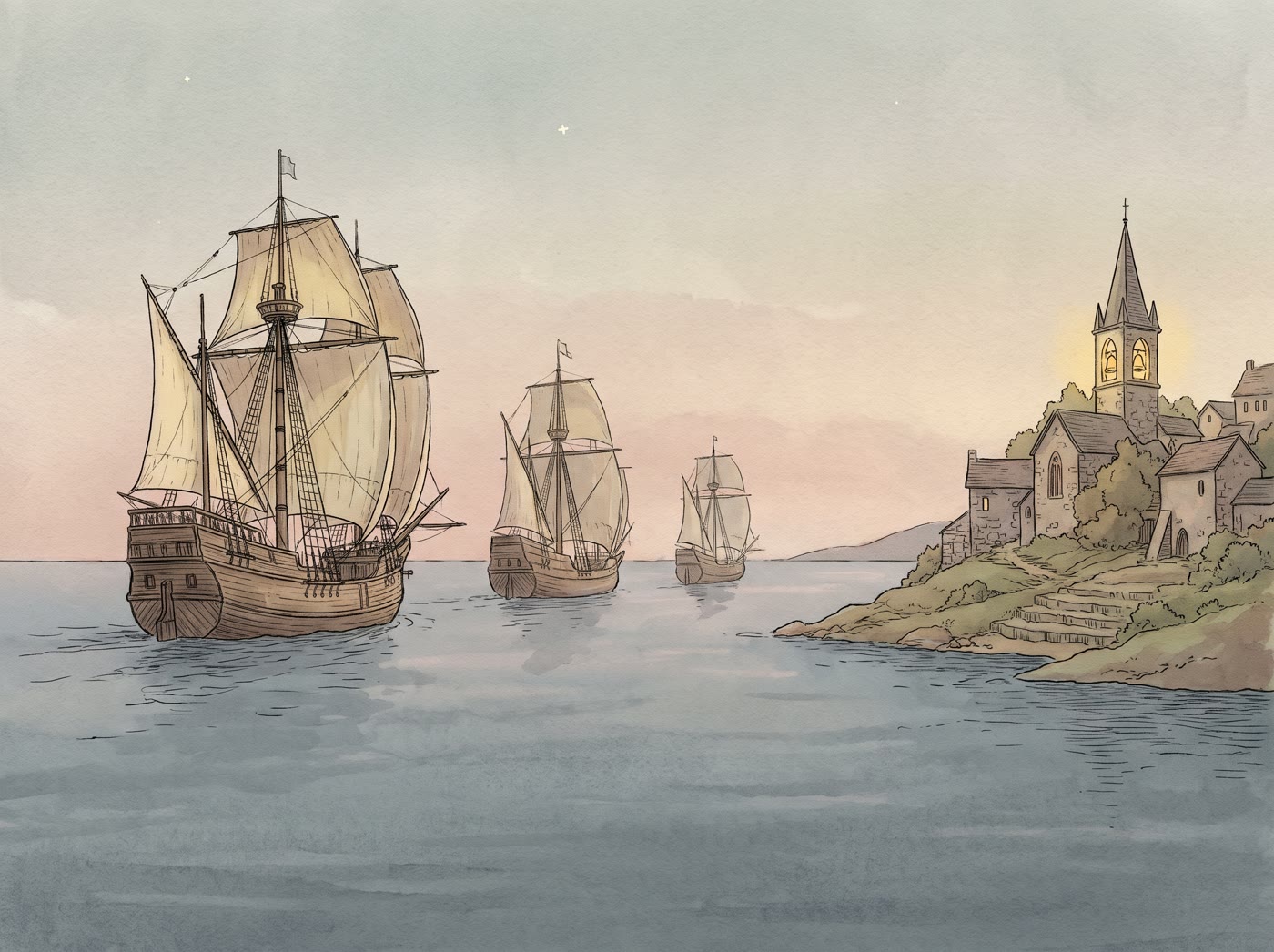
I saw three ships come sailing in
On Christmas day, on Christmas day;
I saw three ships come sailing in
On Christmas day in the morning.
And what was in those ships all three,
On Christmas day, on Christmas day?
And what was in those ships all three,
On Christmas day in the morning?
Our Saviour Christ and his lady,
On Christmas day, on Christmas day;
Our Saviour Christ and his lady,
On Christmas day in the morning.
Pray whither sailed those ships all three,
On Christmas day, on Christmas day?
Pray whither sailed those ships all three,
On Christmas day in the morning?
O they sailed into Bethlehem,
On Christmas day, on Christmas day;
O they sailed into Bethlehem,
On Christmas day in the morning.
And all the bells on earth shall ring,
On Christmas day, on Christmas day;
And all the bells on earth shall ring,
On Christmas day in the morning.
And all the Angels in Heaven shall sing,
On Christmas day, on Christmas day;
And all the Angels in Heaven shall sing,
On Christmas day in the morning.
And all the Souls on Earth shall sing,
On Christmas day, on Christmas day;
And all the Souls on Earth shall sing,
On Christmas day in the morning.
Then let us all rejoice amain,
On Christmas day, on Christmas day;
Then let us all rejoice amain,
On Christmas day in the morning.
Where the rhyme comes from
This is a carol first and a nursery rhyme second. The words above are those printed by William Sandys, an English lawyer and antiquarian, in Christmas Carols, Ancient and Modern (London, 1833). An earlier printing is known: the editors of the New Oxford Book of Carols give the earliest printed text as one in John Forbes’s Cantus, second edition, published at Aberdeen in 1666. The song is number 700 in the Roud Folk Song Index. After Sandys it was reprinted again and again — by Rimbault, and by Husk in Songs of the Nativity (1868), among others — and Cecil Sharp later noted versions in Gloucestershire and Worcestershire, the Gloucestershire one sung by village children.
Folk singers knew it in other dress. The commonest version opens “As I sat on a sunny bank” and has Joseph and his fair lady on the ships, one whistling and the other singing. A fragment quoted by Joseph Ritson, said to be sung at Christmas in the mid-sixteenth century, has a ship steered by Saint Michael while “all the bells of heaven they rang”. Husk wondered whether it was the original of our three ships — a suggestion, not a demonstrated descent.
The nursery form is a different festival altogether. Charles Welsh’s A Book of Nursery Rhymes prints a New Year’s Day rhyme that begins “I saw three ships come sailing by” and ends each stanza “New Year’s Day in the morning”. Three pretty girls are aboard: one could whistle, another could sing, and the other could play on the violin — “Such joy was there at my wedding”. Walter Crane’s The Baby’s Opera (1877) also gives a New Year’s Day version.
What does it mean?
The puzzle is plain enough: Bethlehem is inland, and the nearest large water, the Dead Sea, is some twenty miles away. Sailing into it is, to say the least, unlikely. Husk made a wry point of his own in 1868: the ships carry only two holy persons, yet there are three of them.
The relics of the Magi. The explanation most often repeated is that the ships recall three ships said to have carried the relics of the Three Wise Men to Cologne in the twelfth century. The evidence is thin. Its main support is one late version noted by Sabine Baring-Gould from a Humber boatman and published in 1895, in which the ships carry three “crawns” bound for “Coln upon Rhine”. No early text mentions Cologne, and whether that single version preserves an old meaning or reinterprets one is not known.
Ships of the desert. Another suggestion makes the ships the Magi’s camels. It is a pleasing idea, but we have found nothing to support it.
Nobody knows. The simplest reading is that the ships are a folk image of the Nativity arriving by sea, and ship images appear in older carol fragments than this one. As for “his lady”, it means Mary, as variant texts make clear. Beyond that, the meaning of the three ships is unknown.
Sharing it with children
These are our suggestions, not tradition. Because every stanza repeats its first line and ends on the same refrain, it is an easy call-and-response song: sing each line, and let the children answer with “On Christmas day in the morning”.
For a lap version, sit a child on your knees and rock slowly from side to side like a ship on a calm sea, rocking a little wider for each ship. Hold up one finger, then two, then three as the ships appear, and ask what might be inside them — the second stanza asks exactly that. In a group, children can sway in a line as the three ships and sound imaginary bells for “all the bells on earth shall ring”.
Extra verses to sing
These verses aren’t traditional — they’re ours. Sing them after the ninth stanza, with the same refrain.
And what could we put in the ships so small,
On Christmas day, on Christmas day;
Apples and nuts and a ribboned ball,
On Christmas day in the morning.
And who will wave from the harbour wall,
On Christmas day, on Christmas day;
The children, the lamplighter, one and all,
On Christmas day in the morning.