The Owl and the Pussycat
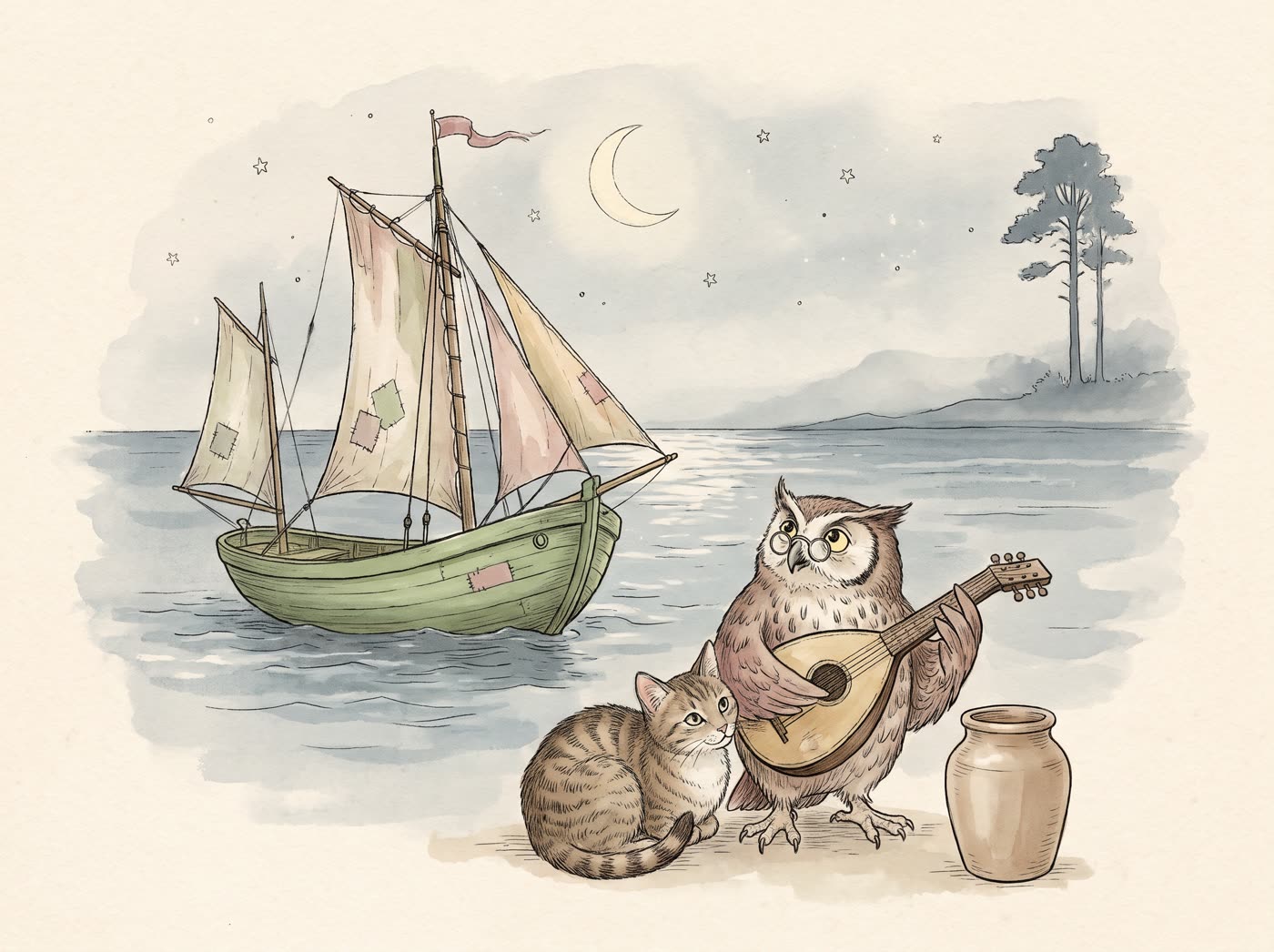
The Owl and the Pussy-Cat went to sea
In a beautiful pea-green boat,
They took some honey, and plenty of money
Wrapped up in a five-pound note.
The Owl looked up to the stars above,
And sang to a small guitar,
“O lovely Pussy! O Pussy, my love,
What a beautiful Pussy you are,
You are,
You are!
What a beautiful Pussy you are!”
Pussy said to the Owl, “You elegant fowl!
How charmingly sweet you sing!
O let us be married! too long we have tarried:
But what shall we do for a ring?”
They sailed away, for a year and a day,
To the land where the Bong-tree grows
And there in a wood a Piggy-wig stood
With a ring at the end of his nose,
His nose,
His nose,
With a ring at the end of his nose.
“Dear pig, are you willing to sell for one shilling
Your ring?” Said the Piggy, “I will.”
So they took it away, and were married next day
By the Turkey who lives on the hill.
They dinèd on mince, and slices of quince,
Which they ate with a runcible spoon;
And hand in hand, on the edge of the sand,
They danced by the light of the moon,
The moon,
The moon,
They danced by the light of the moon.
Where the rhyme comes from
Edward Lear wrote the poem for a child: Janet Symonds, the three-year-old daughter of his friend the poet John Addington Symonds. The exact date of writing is not established — the late 1860s is as close as we can safely say.
Its first appearance was in a magazine, not a book. The poem was printed in February 1870 in the American magazine Our Young Folks, published in Boston, and then collected the following year in Lear’s own book Nonsense Songs, Stories, Botany, and Alphabets (1871), which carried his own illustrations. The words above follow the book; the magazine text differs a little in its punctuation. The book spells it “Pussy-Cat”, where many modern printings have “Pussycat”.
Lear left an unfinished sequel about the couple’s children, which was not published until 1938. We have not reproduced it here.
What does it mean?
There is no hidden history to debunk here, and none of the sources we have read claims a secret meaning: it is nonsense verse, offered for the pleasure of the sound. The land where the Bong-tree grows is Lear’s own invention, and we have found no meaning given for it.
The runcible spoon. The question most readers ask is what a runcible spoon is. The honest answer is that Lear made the word up. He used “runcible” for other things too — a runcible hat, a runcible cat, a runcible goose — and he does not appear to have had any firm idea of what it meant. An editorial note in Our Young Folks in 1872 called it a nonsense word introduced for the comical effect of a well-sounding epithet, “without any shadow of a meaning”.
The three-pronged fork. Since the 1920s dictionaries have defined a runcible spoon as a sharp-edged fork with three broad curved prongs; Merriam-Webster dates that sense to 1926, decades after Lear’s death in 1888. It is a later definition, and it does not match Lear’s own drawing, in which a runcible spoon looks more like a ladle. It has been suggested that he shaped the word from “rouncival”, an old word for a large pea, but that is a suggestion, not a certainty.
Sharing it with children
The poem is a voyage, so let it rock. Sit a child on your lap, or on a cushion that will wobble, and sway slowly through the first stanza as the pea-green boat goes to sea. Keep the sway going for the rolling refrains and let the child join in with “You are, you are!” in echo, which is the part small children tend to catch first.
The poem acts itself out. Pick an owl and a cat, hum an imaginary guitar for the serenade, and make a ring from finger and thumb for the pig to wear on his nose. A real ring is not needed: a curled finger on the end of the nose makes the best Piggy-wig. For the last four lines, hold hands and dance in a slow circle, then stop on “the moon” and point upwards.
For an older child, try a spoon hunt: gather every spoon, ladle and fork in the kitchen and ask which one is the runcible spoon. Since Lear never said, every answer is allowed — and the child can draw their own.
If the owl is the favourite, another one turns up in the tongue twister Oliver Oglethorpe Ogled an Owl and Oyster, full of round O sounds. And for two children who like playing a pair, Tweedledum and Tweedledee is another two-hander, with a rattle in place of a ring.
Extra verses to sing
These verses aren’t traditional — they’re ours. They borrow Lear’s rhythm and refrain, nothing more.
The Owl and the Pussy-Cat sailed home again
Beneath a sleepy sky,
With a jar of jam, and a loaf and a ham,
And a lullaby to sing by.
And the Piggy-wig waved from the shore,
The shore,
The shore,
And the Piggy-wig waved from the shore.